
Ad hoc committee report finds against Mchunu, backs Ramaphosa decision to place him on leave
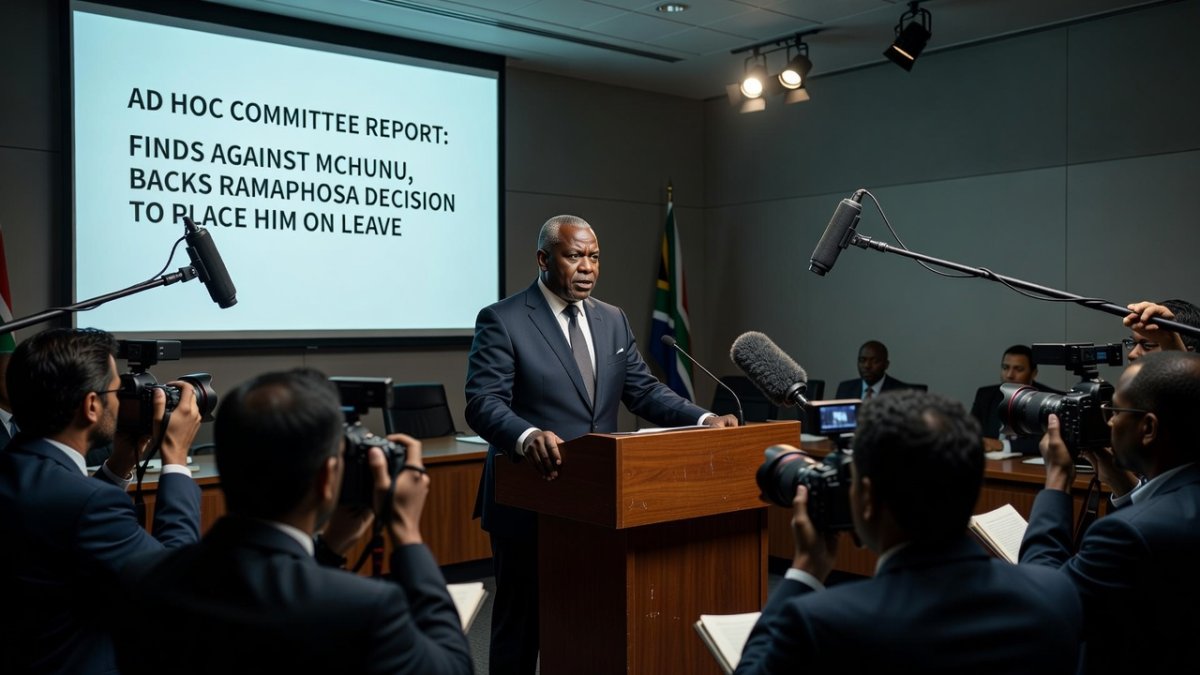
Ad hoc committee report finds against Mchunu, backs Ramaphosa decision to place him on leave
Explosive Findings Rock South African Policing Leadership
The evidence leaders of the ad hoc committee probing serious allegations levelled by KwaZulu-Natal SAPS commissioner Lieutenant-General Nhlanhla Mkhwanazi delivered a damning verdict this week. Their report slams suspended Police Minister Senzo Mchunu for conduct that undermined the integrity of the force and justifies President Cyril Ramaphosa’s swift decision to place him on special leave. As a sports journalist who has covered countless high-stakes athletic showdowns where one misstep can end careers, I recognise the same high-tension drama unfolding here in the corridors of power.
The committee, which convened its decisive session on Thursday, examined claims of political interference, questionable appointments, and breakdowns in command structures within the South African Police Service. Evidence leaders concluded that Mchunu’s actions created an environment where operational independence was compromised, echoing the kind of systemic failures that have derailed Olympic dreams when administrators meddle with selection panels.
Background: Mkhwanazi’s Bombshell Allegations
Lieutenant-General Mkhwanazi, a no-nonsense veteran with over 30 years in policing, went public with accusations that Mchunu bypassed established protocols when dealing with sensitive KZN operations. Among the claims were directives that allegedly favoured certain factions within the police and delayed critical resource allocations to high-crime areas. These revelations emerged amid a national crime wave that saw contact crimes rise 5.7% in the latest quarterly statistics released by Stats SA.
President Ramaphosa acted decisively on 13 October, suspending Mchunu pending the outcome of the inquiry. The ad hoc committee, comprising members from multiple parties, was tasked with establishing whether the minister’s conduct warranted further action. Thursday’s sitting marked the culmination of weeks of testimony, document reviews, and cross-examination.
Key Adverse Findings Against Mchunu
The evidence leaders’ report contains five primary adverse findings. First, Mchunu was found to have exercised undue influence over provincial appointments, including the controversial secondment of senior officers without proper consultation with the national commissioner. Second, communications between the minister’s office and KZN command were deemed irregular and lacking transparency. Third, delays in approving operational plans for gang-related violence in Durban were directly attributed to ministerial interference. Fourth, the committee noted a pattern of bypassing the Civilian Secretariat for Police Service, undermining civilian oversight. Fifth, Mchunu’s public statements were criticised for eroding morale within the ranks at a time when SAPS visibility on the streets remains critical.
“The evidence demonstrates a clear departure from the principles of cooperative governance enshrined in the Constitution,” the lead evidence presenter stated during Thursday’s proceedings. These conclusions directly support Ramaphosa’s suspension order, providing the legal and political cover needed for the presidency to maintain stability ahead of the 2026 local government elections.
Expert Perspectives and Political Context
Constitutional law expert Professor Pierre de Vos described the findings as “a significant precedent for ministerial accountability.” He noted that while police ministers have historically enjoyed wide latitude, recent court rulings on state capture have narrowed that discretion. “This case shows that even temporary political appointees must respect operational independence,” de Vos told Global1 News.
From an athletics standpoint, the situation mirrors the 2016 IAAF doping scandal where administrators were accused of shielding athletes. Just as clean competitors demanded structural reform then, ordinary South Africans now expect a police service free from political patronage. The energy on the streets of Johannesburg feels similar to the charged atmosphere before a Comrades Marathon start—anticipation mixed with anxiety about whether the system can deliver fair play.
Implications for SAPS and National Security
The report’s endorsement of Ramaphosa’s decision carries immediate operational consequences. Acting Police Minister Bheki Cele has already signalled a review of all provincial deployments. Crime statistics for the first half of the financial year show 27,000 murders, underscoring the urgency of restoring command cohesion. Analysts warn that prolonged uncertainty could embolden criminal networks in KZN, where taxi violence and extortion remain entrenched.
Internationally, the episode risks tarnishing South Africa’s reputation ahead of upcoming BRICS security dialogues. Neighbouring countries rely on SAPS intelligence sharing for cross-border operations. A weakened ministry could slow joint task teams targeting wildlife trafficking and drug routes that have already claimed too many young lives—much like how a single injury can derail an entire relay team.
Reactions from Key Stakeholders
Opposition parties welcomed the findings. DA spokesperson Dianne Kohler Barnard called the report “a vindication of parliamentary oversight.” The EFF, however, criticised the process as “too little, too late,” demanding Mchunu’s full resignation rather than suspension. Within the ANC, insiders describe quiet relief that the matter has been contained before the party’s December policy conference.
Mkhwanazi himself has remained measured. In a brief statement after Thursday’s session, he reiterated his commitment to professional policing: “My duty is to the people of KwaZulu-Natal. I will continue to serve with integrity.” Supporters within the province view him as a rare voice of independence in a politicised environment.
Looking Ahead: Reform or Recurrence?
The ad hoc committee is expected to table its full report in the National Assembly next week. Recommendations are likely to include legislative amendments strengthening the separation between political and operational roles. Civil society groups such as the Institute for Security Studies have already begun drafting proposals for an independent police inspectorate with subpoena powers.
For South Africans weary of crime, the episode serves as a reminder that leadership accountability matters as much on the beat as it does on the track. Just as athletes train under strict codes to ensure fair competition, our police leadership must operate under transparent rules that prioritise public safety over political expediency.
The Ramaphosa administration now faces the delicate task of appointing a permanent successor who can restore trust without triggering further factional battles. The stakes could not be higher: every day of instability translates into more families mourning loved ones lost to preventable violence.
This is Dante Williams for Global1 News, reporting from Johannesburg. 🇿🇦
This article was produced with AI-assisted research and editorial support. Reporting is based on sources cited in the article.
What's Your Reaction?
 Like
0
Like
0
 Dislike
0
Dislike
0
 Love
0
Love
0
 Funny
0
Funny
0
 Wow
0
Wow
0
 Sad
0
Sad
0
 Angry
0
Angry
0
Breaking News and Investigations Correspondent at Global1.News. Based in London, covering global breaking news, security, and investigative stories. Known for digging deeper and connecting the dots across continents.











Comments (0)