
2026 Ballon d’Or: Details of awards confirmed as Dembele, Harry Kane, Mbappe battle
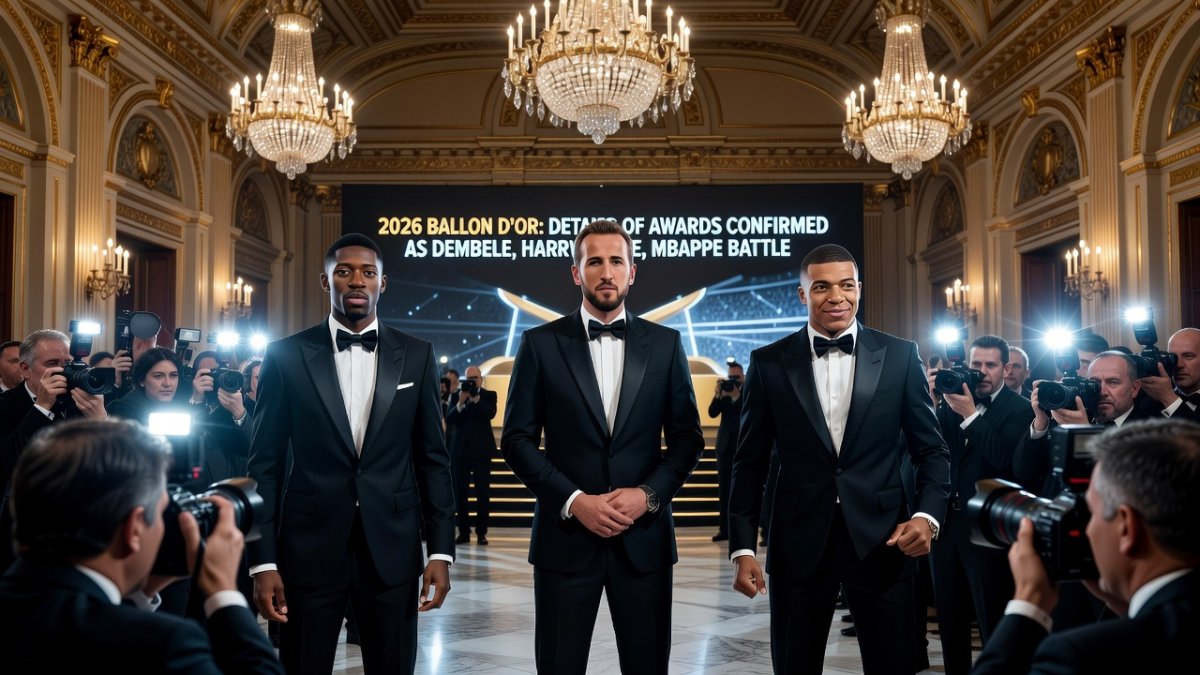
2026 Ballon d’Or: Details of awards confirmed as Dembele, Harry Kane, Mbappe battle
London to Host Landmark 70th Edition on October 26, 2026
The organisers of the Ballon d’Or have confirmed that the 2026 edition will be hosted in London, United Kingdom, marking a significant shift for the prestigious individual award in world football. The 70th edition of the ceremony has been fixed for October 26, 2026, at a yet-to-be-named central London venue with capacity for over 2,000 guests. This announcement comes as the European football season draws to a close and with the 2026 FIFA World Cup on the horizon in the United States, Canada and Mexico, setting the stage for an awards night that will blend club excellence with international anticipation.
As a journalist covering global economic trends from Lagos, I see this not merely as a sporting gala but as a calculated business move. Football’s commercial machinery continues to expand, and hosting the event in London signals organisers’ intent to tap into one of the world’s most lucrative media and sponsorship markets.
Confirmed Nominees and the Race for Glory
Leading candidates include Ousmane Dembele of Paris Saint-Germain, Harry Kane of Bayern Munich, and Kylian Mbappe, whose club future remains the subject of intense speculation. Dembele’s resurgence in the 2025-26 campaign, marked by 22 goals and 18 assists across all competitions, has positioned him as a genuine contender. Kane, with his consistent scoring record exceeding 30 goals for the third straight season, represents England’s strongest individual claim. Mbappe’s blend of speed and finishing continues to dominate metrics, though questions linger over his adaptation to any new tactical system post his high-profile transfer saga.
These three names dominate early betting markets, yet the expanded voting panel—now including 100 journalists from each of FIFA’s six confederations—could open doors for surprise contenders from South America and Africa. Nigerian fans will watch closely for any recognition of players like Victor Osimhen, whose Serie A and Champions League contributions have already influenced transfer valuations exceeding €90 million.
Economic Implications of a London Host City
London’s selection carries measurable economic weight. The UK events industry generates £42 billion annually, and major awards ceremonies typically inject between £15 million and £25 million into local hospitality, transport and media services. Organisers project that the 2026 Ballon d’Or will attract 1,200 accredited journalists and over 400 corporate sponsors, figures that rival the GDP contribution of mid-sized Nigerian states for a single week.
From a business perspective, the timing aligns perfectly with the conclusion of the 2025-26 domestic leagues and the eve of the World Cup. Broadcasters are expected to pay record fees for global rights, with preliminary estimates suggesting a 12 percent increase over the 2025 figures. This revenue stream directly funds grassroots programmes, illustrating how elite individual awards trickle down to emerging markets.
Historical Context and Evolving Format
The Ballon d’Or, first awarded in 1956, has undergone several transformations. The 2026 edition returns to a single annual ceremony after the brief experiment with separate men’s and women’s events in different cities. The decision to centralise in London also reflects France Football’s strategy to internationalise the brand beyond Paris.
Previous London-linked ceremonies, such as the 2010 FIFA Ballon d’Or hybrid, demonstrated the city’s logistical strengths. With Heathrow and the Elizabeth line offering seamless access, organisers have cited infrastructure reliability as a decisive factor over competing bids from Madrid and Doha.
African Perspectives and Market Opportunities
For African football stakeholders, the London location offers networking advantages. Nigerian football administrators and agents based in the UK diaspora will find easier access than they would in previous European host cities. The ceremony’s proximity to major investment banks and private equity firms active in sports could accelerate discussions around academy funding and broadcasting deals for the Nigeria Professional Football League.
Data from the 2022 World Cup showed that African players generated 18 percent of all social media engagement despite representing only 9 percent of squads. A similar pattern is expected in 2026, meaning visibility at the Ballon d’Or could translate into higher endorsement values for players from CAF nations.
Expert Voices on the 2026 Race
“The expanded voting base makes this the most democratic Ballon d’Or in decades,” said Dr. Amina Yusuf, sports economist at the University of Lagos. “We are likely to see at least one African player in the top ten for the first time since 2019.”
Meanwhile, former Arsenal midfielder and current pundit Martin Keown told Global1 News: “Kane’s consistency is unmatched. If England perform at the World Cup, he could become the first Englishman to win since Michael Owen in 2001.”
PSG sporting director Luis Campos emphasised Dembele’s tactical evolution: “His decision-making in the final third has matured. The numbers speak for themselves.”
Looking Ahead to the 2026 World Cup
The October timing positions the Ballon d’Or as a final checkpoint before the World Cup. Players will carry form from club into the international tournament, and any standout performer in the United States, Canada and Mexico could retroactively influence perceptions of the October winner. This overlap creates a narrative bridge that sponsors are eager to exploit through cross-platform campaigns.
Logistical coordination between the two events also raises questions about player welfare. With the Ballon d’Or falling just six weeks before the World Cup opener, medical and recovery protocols will come under scrutiny from FIFPro, the global players’ union.
In summary, the confirmation of London as host and the October 26 date crystallises a high-stakes intersection of sporting prestige and economic calculation. For Nigerian readers, the story extends beyond who lifts the trophy; it concerns how African football can leverage increased global visibility to secure sustainable investment. The race between Dembele, Kane and Mbappe will dominate headlines, yet the real winners may be the markets and communities that capitalise on football’s continued commercial expansion.
This is Sarah Okafor for Global1 News, reporting from Lagos. 🇳🇬
This article was produced with AI-assisted research and editorial support. Reporting is based on sources cited in the article.
What's Your Reaction?
 Like
0
Like
0
 Dislike
0
Dislike
0
 Love
0
Love
0
 Funny
0
Funny
0
 Wow
0
Wow
0
 Sad
0
Sad
0
 Angry
0
Angry
0

Africa Correspondent at Global1.News. Based in Lagos, covering politics, business, technology, and culture across the continent. Focused on telling African stories beyond the headlines — the innovation, entrepreneurs, and communities shaping the region's future.












Comments (0)