
WHO chief calls for DRC ceasefire to tackle Ebola outbreak
WHO Chief Calls for DRC Ceasefire to Tackle Ebola Outbreak By Jessica Ali | Global1 News Exclusive GENEVA — The head of the World Health Organization has demanded an immediate ceasefire in eastern Democratic Republic of the Congo, warning that the latest Ebola outbreak risks turning into a “catastrophic collision of disease and conflict.” Tedros Adhanom Ghebreyesus issued the c
WHO Chief Calls for DRC Ceasefire to Tackle Ebola Outbreak
By Jessica Ali | Global1 News Exclusive
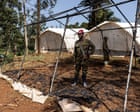
GENEVA — The head of the World Health Organization has demanded an immediate ceasefire in eastern Democratic Republic of the Congo, warning that the latest Ebola outbreak risks turning into a “catastrophic collision of disease and conflict.” Tedros Adhanom Ghebreyesus issued the call after new cases surged near Beni and Butembo, areas long plagued by armed militias and government offensives. Uganda has already sealed its border crossings, a move that signals how fast this crisis could spill across the region.
The Ceasefire Demand
Tedros did not mince words in his briefing to member states. He described active combat zones blocking vaccination teams and contact tracers from reaching villages where the virus has already claimed at least 38 lives since the outbreak was declared three weeks ago. “We cannot fight Ebola with bullets in the air,” he said. The WHO chief’s language is sharper than usual because the numbers are moving fast and the geography is impossible.
Health workers on the ground report that one confirmed case sits inside a displacement camp controlled by the M23 rebel group. Another cluster has appeared along a supply route used by the Congolese army. Both sides have ignored previous humanitarian pauses. Tedros is betting that naming the problem directly might shame someone into stopping the shooting, even briefly.
Uganda Closes the Border
Within hours of Tedros’s statement, Ugandan President Yoweri Museveni ordered the closure of all official crossings with the DRC, including the busy Mpondwe post in Kasese district. Thermal scanners and rapid testing units are now operating at unofficial footpaths as well. Uganda has lived through this before; the 2019 Ebola flare-up crossed from Congo and killed several people before being contained. Officials in Kampala are not taking chances with a second wave while their hospitals are still recovering from COVID backlogs.
The closure has stranded hundreds of traders and families. Cross-border markets that normally move cassava, charcoal, and gold have gone silent. Local leaders on the Ugandan side say the economic pain is real, but the alternative—uncontrolled spread—is worse. Museveni’s government is already coordinating with WHO and the African Union on mobile laboratories that can be deployed if cases jump the border anyway.
Why Conflict Makes Ebola Deadlier
Eastern Congo’s armed groups do not respect ring vaccination. They tax humanitarian convoys, kidnap nurses, and sometimes accuse health teams of spreading the disease themselves. In the last major Ebola epidemic that ran from 2018 to 2020, more than 300 attacks on health facilities were recorded. The current outbreak is smaller so far, but the same militias are still active and the same roads remain mined or contested.
Without a pause in fighting, contact tracing collapses. One missed chain of transmission in a crowded camp can seed dozens of new infections within days. The virus does not care which faction controls the village; it only needs one symptomatic patient moving through porous checkpoints. Tedros knows the math. He has watched similar dynamics in Yemen and Syria.
Regional and Global Stakes
Congo produces more than 70 percent of the world’s cobalt. Mining operations in North Kivu continue even as Ebola spreads, because the mineral prices are too high for companies to pause. Chinese and European firms with stakes in those mines are quietly pressing Kinshasa for security guarantees, not health guarantees. That tension between extraction and epidemic control is rarely discussed in official statements but shapes every decision on the ground.
Neighboring Rwanda has already increased surveillance at its own border posts, though it has not closed them. Burundi and Tanzania are watching closely. A regional spread would overwhelm health systems still short on PPE and intensive-care beds. The African CDC has activated its emergency operations center in Addis Ababa, but funding pledges from wealthy nations remain slow, as they always do until the first exported case appears on a European or American flight manifest.
What the Data Show
WHO situation reports list 112 suspected cases and 38 confirmed deaths as of the latest update. Genomic sequencing points to the same Zaire ebolavirus strain that caused the 2018–2020 epidemic, not a new spillover. That means existing vaccines and monoclonal antibody treatments should work, provided teams can actually reach patients. The limiting factor is not science; it is access.
Local health officials in Beni say they have doses of the Ervebo vaccine sitting in cold storage but cannot transport them safely beyond a 20-kilometer radius of the city. Fuel convoys are being diverted to military operations. Generators at field hospitals run out of diesel for hours at a time. These are not abstract logistics problems; they are the direct result of active conflict.
The Political Reality
Kinshasa has declared a state of emergency in the affected provinces, yet the same decree authorizes expanded military operations against the very groups controlling the villages where Ebola is spreading. The contradiction is obvious to everyone except the officials writing the orders. Tedros’s ceasefire request is therefore not neutral; it challenges the government’s core security strategy at the same time it asks armed groups to stand down.
Whether either side listens is an open question. Past humanitarian pauses in Congo have lasted days at most before collapsing. Still, the WHO chief’s public pressure creates a diplomatic record that donor countries can reference when they eventually decide whether to condition aid on access guarantees.
This outbreak is not an isolated health event. It is the predictable outcome of years of neglected governance, resource extraction, and low-intensity war. Tedros has named the collision. The question now is whether anyone with a gun is willing to pause long enough for the doctors to work.
This is Jessica Ali for Global1 News. 🔥
This article was produced with AI-assisted research and editorial support. Reporting is based on sources cited in the article.
What's Your Reaction?
 Like
0
Like
0
 Dislike
0
Dislike
0
 Love
0
Love
0
 Funny
0
Funny
0
 Wow
0
Wow
0
 Sad
0
Sad
0
 Angry
0
Angry
0

Editor-in-Chief at Global1.News. Atlanta-based journalist who cuts through the BS and tells it like it is. Lead anchor, host, and the voice you hear when the spin stops and the truth starts.










Comments (0)