
London, United Kingdom – June 24, 2026
Climate Irony in London: Extreme Heat Cancels Conference on Extreme Heat London, United Kingdom – June 24, 2026 — The Grantham Research Institute on Climate Change and the Environment at the London School of Economics cancelled its event titled 'Extreme Heat: Improving governance and strengthening action around the world' because its venue, the Shaw Library, had no cooling mech
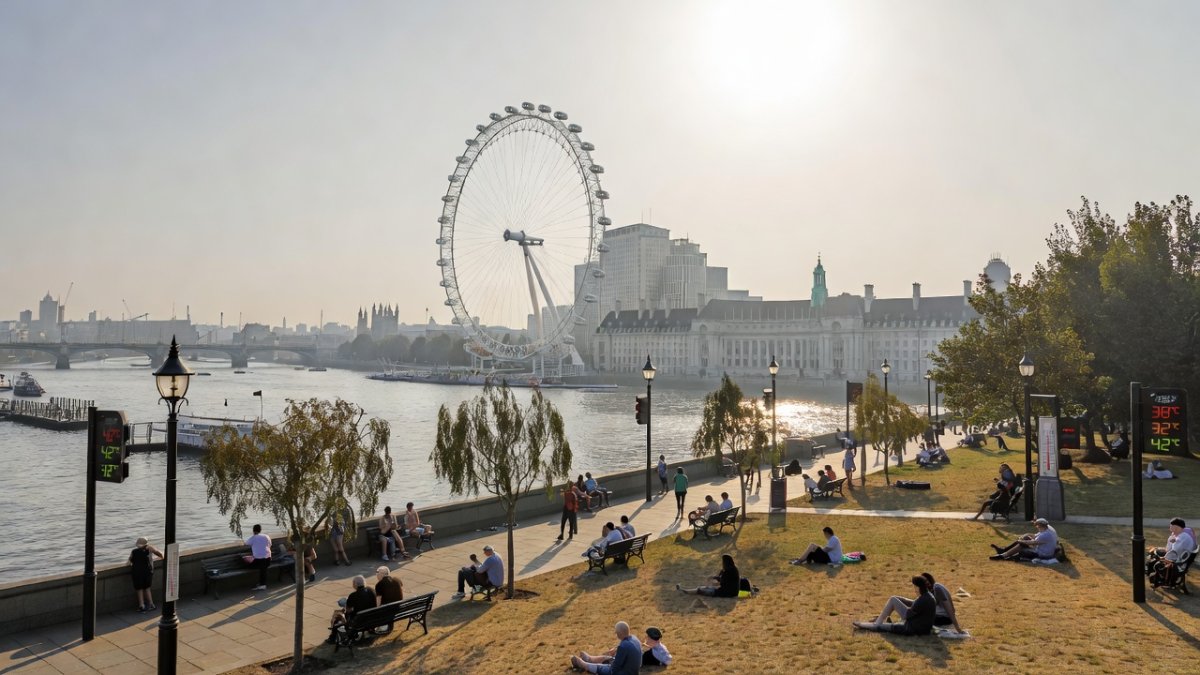
Climate Irony in London: Extreme Heat Cancels Conference on Extreme Heat
London, United Kingdom – June 24, 2026 — The Grantham Research Institute on Climate Change and the Environment at the London School of Economics cancelled its event titled 'Extreme Heat: Improving governance and strengthening action around the world' because its venue, the Shaw Library, had no cooling mechanisms. The event was part of London Climate Action Week. The organisers wrote: 'The event venue, like most buildings in London, does not have any cooling mechanisms in place, and we cannot risk the wellbeing of speakers or guests.' This is a direct illustration of how unprepared even wealthy nations are for the climate they now inhabit.
Record-Breaking Heat and the Red Warning
The UK Met Office issued its rare red extreme heat warning for Wednesday and Thursday in June 2026, covering large parts of England including London. Temperatures reached 34.6C in Surrey on Tuesday, with forecasts predicting 38C on Wednesday and 39C on Thursday, which would shatter the existing June record of 35.6C set in both 1957 and 1976. UN Secretary-General António Guterres described London as “cooking” during a related statement on global heat impacts. Attribution analysis by ClimaMeter confirmed that human-driven climate change added between 2C and 4C to the peak temperatures observed across southern England.
The UK Health Security Agency activated its highest-level red heat-health alert, stating there was a “risk to life for even the healthy population” and urging immediate behavioural changes. Hospitals reported surges in heat-related admissions, while transport operators warned of potential rail buckling. This event mirrors conditions already routine in parts of India. Delhi recorded 49.9C in May 2026, prompting the National Disaster Management Authority to activate continuous monitoring across 23 states. The Indian Institute of Technology’s temperature modelling teams in Delhi and Kanpur have produced downscaled projections showing that similar 2-4C amplification from climate change is already embedded in South Asian heatwaves, validating the UK experience as a preview of conditions long familiar to Indian cities.
Public health messaging in both countries converged on hydration, shaded rest periods and avoidance of outdoor exertion during peak hours. The UK red alert therefore served as a stark reminder that even nations with advanced early-warning systems face governance gaps when infrastructure lags behind rising baselines. India’s NDMA framework, refined through annual post-heatwave reviews, offers operational templates for rapid alert dissemination that the UK could adapt. The convergence of records on both continents underscores that extreme heat governance must now treat 35C-plus days as the new normal rather than anomalies.
Schools, Hospitals and Public Infrastructure Under Siege
Victorian-era school buildings across London and southeast England were labelled “greenhouses” by the National Education Union as indoor temperatures exceeded 32C, forcing dozens of closures. Hospitals cancelled non-urgent outpatient appointments to free capacity for heatstroke cases, while rail operators imposed speed restrictions to prevent track buckling on lines serving commuter routes. South East Water introduced an immediate hosepipe ban affecting 3.2 million households. Official estimates indicate UK heatwaves already kill between 20,000 and 30,000 elderly people annually when excess mortality is aggregated, a figure projected to rise sharply without adaptation.
India confronted identical pressures years earlier. Ahmedabad’s Heat Action Plan, launched in 2010 as South Asia’s first comprehensive municipal response, reduced all-cause mortality during heatwaves by approximately 30 percent through targeted interventions. The National Disaster Management Authority subsequently scaled similar plans to 23 states, incorporating school timing adjustments in Rajasthan and Bihar that shift classes to early morning or evening slots. Cool-roof programmes in Surat and Hyderabad have coated over 1.2 million square metres of low-income housing with reflective coatings, lowering indoor temperatures by 3-5C. Research from the Indian Institute of Technology Madras on passive cooling techniques, including ventilated facades and phase-change materials, directly parallels recommendations now emerging from the UK’s Climate Change Committee.
The London cancellations therefore highlight a shared infrastructure deficit. Victorian schools in Britain and pre-1980s concrete blocks in Indian cities both lack mechanical cooling, yet behavioural and low-cost retrofits have proven effective in India. Expanding cool-roof mandates and revising academic calendars represent immediately deployable measures that require no new technology, only political will. Cross-learning between UK local authorities and Indian municipal corporations could accelerate implementation on both sides.

Europe's Widening Heat Crisis
France recorded its hottest night and day on meteorological record, with 44.3C daytime peaks accompanied by roughly 40 drowning deaths as people sought relief in rivers and lakes. Spain saw one in eight weather stations exceed 40C, while the UK Climate Change Committee stated bluntly that national infrastructure was “built for a climate that no longer exists.” Greenpeace UK called for statutory maximum indoor temperature limits in rented housing and mandatory passive-cooling standards for new builds. These developments expose systemic vulnerabilities across the continent.
India’s experience supplies tested policy responses. NITI Aayog’s national adaptation targets for 2025-2030 explicitly prioritise urban heat-island mitigation. Mumbai’s urban heat island effect routinely adds 4-6C above suburban baselines, while Chennai experiences 3-5C differentials; both cities now deploy cool-roof and tree-planting programmes targeting construction workers, street vendors and gig-economy riders who face the highest exposure. The Ministry of Health has issued standardised heatstroke treatment protocols adopted in 18 states, including intravenous rehydration kits prepositioned at primary health centres. These measures align closely with the UK Climate Change Committee’s recent call for passive cooling retrofits and revised building codes.
The London conference cancellation therefore illustrates that governance frameworks in wealthy nations remain reactive rather than anticipatory. India’s decade-long refinement of Heat Action Plans demonstrates that low-cost, community-level interventions can reduce mortality even when mechanical air conditioning remains unaffordable for large populations. European capitals could accelerate their own adaptation timelines by studying implementation details from Ahmedabad and subsequent Indian city programmes rather than reinventing protocols from scratch.
What This Means for India’s Climate Adaptation Strategy
India pioneered systematic Heat Action Plans following the 2010 Ahmedabad model, which combined SMS alerts, revised labour timings, and public cooling shelters. Cool-roof initiatives, early-warning dissemination through ASHA workers, and restrictions on outdoor work between 11 a.m. and 4 p.m. have become standard across multiple states. The London event cancellation demonstrates that even advanced economies require the same proactive posture. Passive solar architecture, updated green building codes, and academic calendar reforms are now essential across Indian metros facing 45C-plus peaks with increasing frequency.
Bengaluru’s technology sector has already adjusted work hours for 120,000 employees during summer months, while Delhi Metro has installed platform cooling misting systems at 28 stations. These incremental adaptations reduce productivity losses estimated at 3-5 percent of urban GDP during severe heat episodes. The Indian Institute of Technology’s ongoing research into low-cost evaporative cooling panels offers scalable solutions for informal settlements. London’s experience confirms that reliance on mechanical air conditioning alone is neither financially nor environmentally sustainable at population scale.
India can assume a leadership role in global heat adaptation by accelerating and documenting these programmes. Sharing operational data from NDMA-coordinated state plans with international partners would position Indian cities as reference models. The UK’s emerging recognition that existing building stock must be retrofitted validates the strategic direction India adopted after 2010. Continued investment in passive measures, combined with updated labour regulations, will determine whether Indian urban economies remain resilient as global temperatures climb.
The 2050 Projection: When 45C Becomes Britain’s Reality
Met Office projections for 2050 indicate a plausible 14-day heatwave featuring nine consecutive days above 40C and a peak of 45C across parts of England. Such conditions would necessitate mandatory building codes requiring passive cooling elements, expanded healthcare surge capacity, and wholesale reform of school calendars. Both the UK and India face the same trajectory, making cross-national cooperation on adaptation standards increasingly urgent. The UK Climate Change Committee’s recommendations for prioritising passive cooling in new construction align directly with India’s cool-roof and ventilated-roof programmes already operating at scale.
India’s Heat Action Plans provide a tested governance template that the UK could localise. Pre-positioned medical supplies, community volunteers trained in heatstroke recognition, and dynamic labour regulations have demonstrably lowered mortality in South Asian cities. Conversely, UK research on high-resolution urban climate modelling can inform Indian municipal planning for megacities projected to house 600 million people by 2050. Joint research initiatives between the Indian Institute of Technology and UK universities could accelerate development of affordable cooling materials suitable for both temperate and tropical climates.
The 2050 scenario therefore functions as a planning horizon rather than a distant abstraction. Infrastructure decisions taken in the next five years will determine whether societies experience manageable heatwaves or repeated systemic disruptions. India’s early adoption of Heat Action Plans positions it to export practical knowledge, while the UK’s engineering expertise can support next-generation passive technologies. Coordinated action offers the only viable path to protect populations on both continents.
Heat governance failures now transcend geography, as the cancelled London conference vividly demonstrated. Indian cities operating established Heat Action Plans hold immediately applicable models for early warning, infrastructure retrofits and community protection. Adaptation measures must scale at the same pace as rising temperatures if societies are to avoid repeated crises that undermine both public health and economic stability.
— By Dr. Raj Patel, Staff Writer
This article was produced with AI-assisted research and editorial support. Reporting is based on sources cited in the article.
What's Your Reaction?
 Like
0
Like
0
 Dislike
0
Dislike
0
 Love
0
Love
0
 Funny
0
Funny
0
 Wow
0
Wow
0
 Sad
0
Sad
0
 Angry
0
Angry
0

India/South Asia Correspondent at Global1.News. Analytical voice with a background in science and health journalism. Based in New Delhi, covering Indian politics, education, healthcare, technology, and policy. Breaks down complex data into clear, actionable reporting.















Comments (0)