
US Strikes on Southern Iran Escalate as Tehran Retaliates Across the Gulf
US strikes on southern Iran entered a sixth night, hitting bridges, railways and power infrastructure while Iran retaliated across the Gulf — striking US assets in Bahrain, Qatar, Oman, Kuwait, Jordan and Syria as the Strait of Hormuz standoff intensifies.
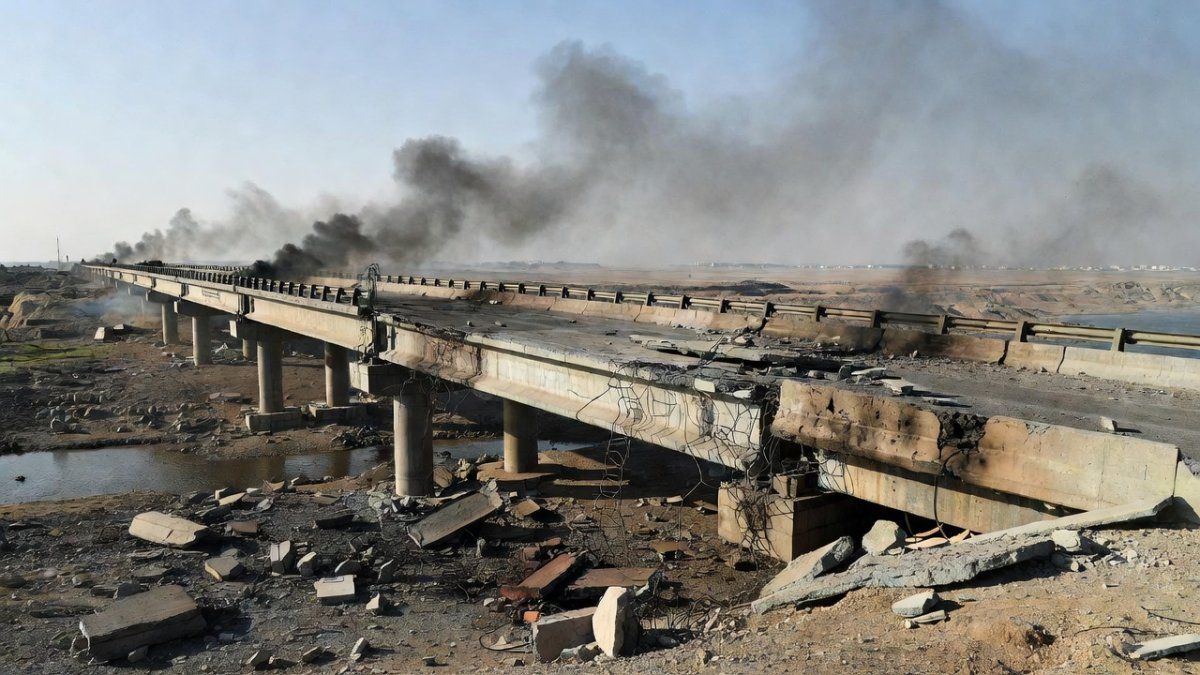
The United States has carried out a sixth consecutive night of major attacks on Iran, striking bridges, railway infrastructure, communications towers, and power facilities across the country's southern provinces — while Iran retaliated with a coordinated wave of missile and drone strikes targeting US assets in Bahrain, Qatar, Oman, Kuwait, Jordan, and Syria. The escalation marks the most intense phase of the conflict since it erupted on February 28, raising fears of a broader regional war that could disrupt global energy markets and draw Gulf states deeper into the confrontation.
Iranian authorities report at least 38 civilians have been killed and more than 400 injured since the two sides met in Switzerland on June 22 for talks aimed at ending the war through a 60-day negotiation period, according to AFP. That agreement reached between Washington and Tehran — a memorandum of understanding extending an April ceasefire and setting out a framework for negotiations — has effectively collapsed as both sides accuse the other of violations.
The Sixth Night of US Strikes on Iran
US Central Command confirmed that at 01:40 GMT on Friday, it completed its latest major wave of attacks against Iran, though the military provided few details about the specific sites targeted. Iranian media reports paint a more complete picture: US forces struck at least six bridges in the southern Hormozgan province, a railway station, a communications tower overlooking Bandar Abbas, and other infrastructure across multiple provinces.
The targeted bridges include the Gariyeh Bridge on the Bandar Abbas-Khamir-Lar route, a bridge near Latidan village, two bridges on the Kahurestan-Lar road, a partially constructed bridge on the Bandar Khamir-Keshar-Bandar Abbas axis, and a bridge in Maroo village. The Kahurestan Bridge strike also hit a nearby residential area, killing two people and wounding eight, according to Iranian officials.
Iran's Ministry of Energy reported that the attacks caused damage to power lines in Bandar Abbas and surrounding villages, triggering power outages that are only gradually being restored. In Semnan province, officials said the main building of a civilian airport sustained what they described as "minor damage." A bottled water facility in Dehloran in western Ilam province was also reportedly hit.
Iran's Multi-Front Retaliation
The Islamic Revolutionary Guard Corps (IRGC) claimed a 13th wave of retaliatory strikes on Friday, targeting US military assets across the region. In Bahrain, the IRGC said it struck US helicopters and reconnaissance aircraft at the Sakhir airbase. Qatar activated its air defence systems after Iranian projectiles entered its airspace, with the Ministry of Defence confirming all projectiles were intercepted — though a child was injured by falling shrapnel over Doha and is receiving medical treatment.
In Oman, the IRGC claimed to have destroyed a US air control radar in the northern Ghanim region and a maritime surveillance radar positioned on rocks in the Strait of Hormuz. A tanker was hit by an unknown projectile on Thursday while sailing approximately 19 nautical miles east of Khasab, according to the United Kingdom Maritime Trade Operations agency. The IRGC also reported hitting a US military base in Kuwait, targeting a missile defence radar, weapons depots, and two HIMARS surface-to-surface missile launchers.
Jordan's army confirmed its air defence systems shot down three Iranian missiles transiting its airspace on Friday morning, with no casualties reported as Royal Engineering Corps teams dealt with falling debris. In Syria, the IRGC said it attacked a US special operations command centre at the al-Tanf military base, according to the Tasnim news agency, describing the strike as retaliation for the killing of Iranian soldiers in Iranshahr.
The Strategic Prize: Bandar Abbas and the Strait of Hormuz
The intensity of the US campaign has centred on Bandar Abbas, Iran's primary naval hub overlooking the Strait of Hormuz — the narrow waterway through which more than 90 percent of Iran's crude oil exports once passed. The city hosts both Iran's conventional navy and the naval arm of the IRGC, making it one of the most strategically important positions in the Gulf region. Mark Hilborne, a senior lecturer at King's College London's School of Security Studies, told Al Jazeera that the focus on bridges is deliberate, as they "are important for military logistics and operations, and enable Iran to move equipment to the south." He added that attacking bridges would undermine Iran's ability to interfere with shipping in the strait and sustain operations there.
Iranian military spokesperson Ebrahim Zolfaghari declared that the Strait of Hormuz "will never return to what it was before the 40-day war," accusing the United States of destabilising the waterway. The strategic standoff over the strait has intensified after Oman announced a new shipping transit corridor, prompting Iran to threaten blocking marine traffic entering the waterway, while the US has resumed a naval blockade of vessels travelling to and from Iranian ports.
Civilian Infrastructure and the Question of War Crimes
The expanding scope of US strikes has increasingly drawn scrutiny over whether they comply with international law. Under the Geneva Conventions, civilian objects are protected from attack unless they contribute to military action — a legal grey zone that militaries often exploit to justify attacks in real time. Joel Rayburn, a retired US Army colonel and senior fellow at the Hudson Institute, told Al Jazeera that military lawyers at CENTCOM may have cleared these targets as "dual-use" — civilian infrastructure potentially used for military purposes.
Iranian Foreign Minister Abbas Araghchi has condemned the strikes on what he described as the country's "vital infrastructure," saying the attacks constitute "a flagrant violation of the United Nations Charter and the fundamental principles of international law." He described the strikes as "serious international crimes" under international humanitarian law, including the four Geneva Conventions of 1949, and stated that "all governments are obligated to prosecute and punish those who commit such crimes."
Health facilities have also been affected. More than 200 patients were evacuated from Baghaei Specialised Hospital in Ahvaz after strikes rendered the hospital inoperable, according to hospital director Reza Bazar. Iranian authorities report that 3,468 people were killed between February 28 and June 7 during the first phase of the war, with 38 additional civilians killed since the June 22 talks.
What This Means: Is a Ground Invasion Being Prepared?
The pattern of strikes extending well beyond conventional military targets into bridges, water facilities, food storage sites, and power infrastructure has led analysts to question whether Washington is preparing for something more significant than an aerial campaign. Alex Alfirraz Scheers, a London-based military analyst, told Al Jazeera that "because the United States is growing increasingly frustrated, particularly President Trump, and therefore becoming more desperate, we could see the early stages of a preparation for something like a limited ground invasion on those strategic outposts, but also into territorial Iran proper."
Simon Mabon, a professor of international relations at Lancaster University, described the pattern of strikes as "perhaps a precursor to a ground invasion," pointing to growing rhetoric in the US suggesting that securing the Strait of Hormuz and Iran's southern coastline may require forces on the ground. President Trump had earlier told Fox News that Washington would "save the energy targets for last" — suggesting a phased escalation strategy that could culminate in strikes on Iran's energy sector.
The implications for Gulf states are profound. Iran has justified its strikes against neighbours by insisting Washington has used bases in these countries as launchpads to strike Iran — a position that places Qatar, Bahrain, Kuwait, and the UAE in an increasingly precarious position as hosts of major US military facilities. Iran's military has said it will continue to target any country that allows its territory to be used for operations against Iran.
Diplomatic Efforts Falter as Fighting Intensifies
Efforts to de-escalate the crisis are accelerating even as the fighting intensifies. China's Foreign Minister Wang Yi and his Pakistani counterpart Ishaq Dar called on Friday for an immediate ceasefire and the resumption of dialogue, with Wang describing the April ceasefire agreement as "hard-won" and warning: "Peace is before our eyes — we cannot fall at the last hurdle and even more so cannot lose what we have gained." Both China and Pakistan have sought to mediate in the months-long conflict.
In a development that has added further complexity to the situation, US Vice President JD Vance stated during an appearance on Joe Rogan's podcast on Wednesday that several Israeli government members had tried to influence US public opinion to oppose a diplomatic deal. "I know beyond a shadow of a doubt that there have been people within the Israeli government who are trying to, like, actually shift us away from that policy because they want to continue the military campaign," Vance said.
The war, which began on February 28 with coordinated Israeli and US strikes on Iran, has already exacted a devastating human toll. The deadliest single incident came on that first day, when a double-tap missile strike destroyed the Shajareh Tayyebeh girls' elementary school in Minab, killing at least 150 people — most of them children and school staff — an attack that a subsequent investigation by The New York Times attributed to the United States.
Regional Implications
The widening confrontation between the US and Iran represents the most serious threat to Gulf stability since the 2019 attacks on Saudi Aramco facilities. Gulf states are now caught directly in the crossfire — hosting US military installations that make them legitimate targets in Iran's calculus, while having limited ability to influence Washington's military decisions. The strategic dilemma for Doha, Manama, Kuwait City, and Abu Dhabi is acute: they cannot afford to sever security arrangements with Washington, but their populations and infrastructure are increasingly vulnerable to Iranian retaliation.
For global energy markets, the stakes could not be higher. With Iran threatening to block the Strait of Hormuz — through which approximately 20 percent of the world's oil passes — and the US enforcing a naval blockade, the disruption of this critical chokepoint would send oil prices soaring and trigger economic consequences far beyond the Middle East. The Strait of Hormuz has become both the primary battleground and the central bargaining chip in the conflict, with neither side showing willingness to back down.
The coming days will be critical. Whether the US military campaign succeeds in forcing Iran back to negotiations, or instead provokes a wider regional war that draws in Gulf states, Israel, and potentially other actors, will define the Middle East's security landscape for a generation. What is clear is that the April ceasefire, once hailed as a diplomatic breakthrough, has unravelled completely — and the region is now paying the price.
By Malik Hassan, Staff Writer
This article was produced with AI-assisted research and editorial support. Reporting is based on sources cited in the article.
What's Your Reaction?
 Like
0
Like
0
 Dislike
0
Dislike
0
 Love
0
Love
0
 Funny
0
Funny
0
 Wow
0
Wow
0
 Sad
0
Sad
0
 Angry
0
Angry
0

Middle East Correspondent at Global1.News. Based in Beirut, covering politics, conflict, energy, and society across the Middle East. Brings context and depth to a region often reduced to headlines.













Comments (0)