
Venezuela Government and Opposition to Hold Formal Talks Starting August
Venezuela's interim government and opposition factions will begin formal talks August 1, six months after Maduro's capture. Triggered by devastating twin earthquakes that killed over 4,700, negotiations will focus on electoral reform, democratic institutions, and political reconciliation.
Venezuela Government and Opposition to Hold Formal Talks Starting August
In a development that could reshape Venezuela's political landscape, the interim government of President Delcy Rodríguez has announced it will begin formal negotiations with a faction of the opposition starting August 1. The breakthrough comes more than six months after the dramatic capture of former president Nicolás Maduro by US special forces in Caracas, and in the shadow of devastating twin earthquakes that have killed thousands and brought the country to its knees.
The announcement, made almost simultaneously by government officials and opposition leaders on Tuesday, marks the first structured dialogue between the two sides since Delcy Rodríguez — a longtime Maduro loyalist — assumed power with the backing of the Trump administration. For millions of Venezuelans who have endured years of political crisis, economic collapse, and now natural disaster, the question is whether this is a genuine step toward democracy or another chapter in a long-running political drama.
Tags: Venezuela, Delcy Rodríguez, opposition talks, Dinorah Figuera, Jorge Rodríguez, María Corina Machado, political prisoners, Foro Penal, democratic transition, Venezuela earthquakes
From Dawn Raid to Dialogue: A Nation Transformed
It was January of this year when US troops stormed Caracas in a daring operation that ended with Nicolás Maduro in handcuffs, bound for New York to face drug-trafficking charges. The raid sent shockwaves across Latin America and was hailed by the opposition as the beginning of the end for the authoritarian chavista era that had dominated Venezuela for more than two decades.
But the transition did not go as many had hoped. Instead of handing power to the democratically elected opposition, the Trump administration threw its support behind former Vice-President Delcy Rodríguez, a Maduro loyalist who had been sanctioned by the US just months earlier. The move left Venezuela in a political gray zone — Maduro was gone, but the chavista machinery remained firmly in control, much to the frustration of opposition leaders who had spent years fighting for change.
Now, with the announcement of formal talks, there is renewed cautious optimism. "Only through unity can we move forward with reconstruction and maintain peace," said Jorge Rodríguez, head of the government-controlled National Assembly and brother of the interim president, citing the devastation of the June 24 earthquakes as the catalyst for dialogue.
The Earthquake That Changed Everything
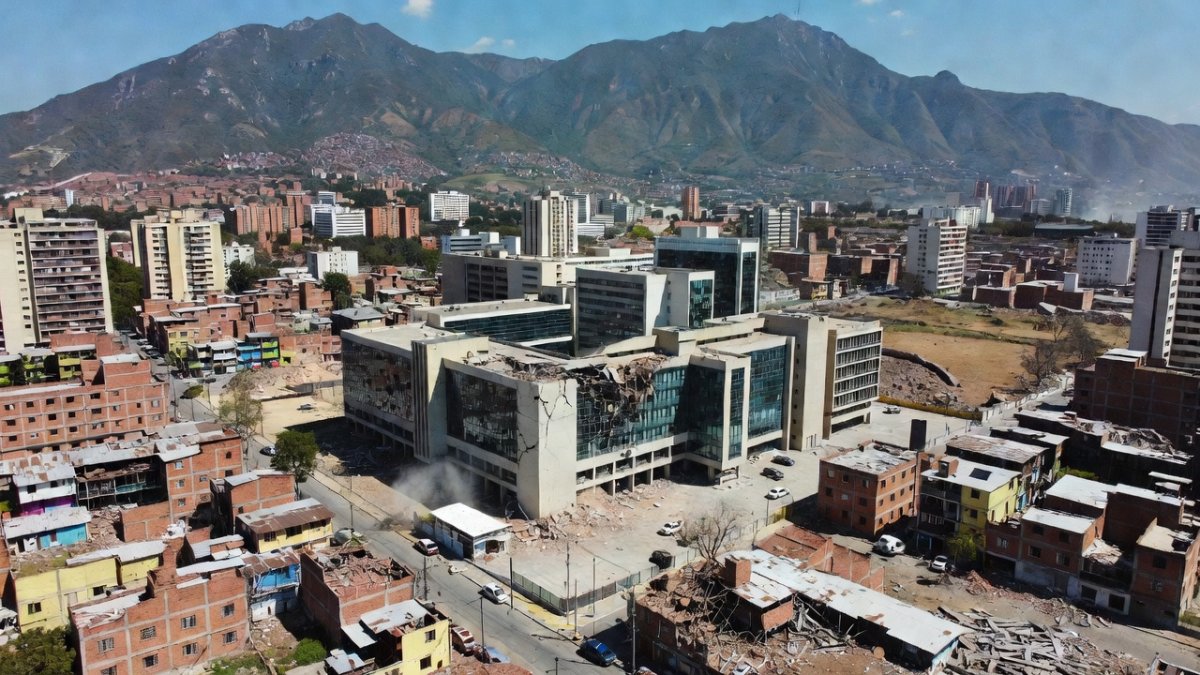
It is impossible to overstate the impact of the twin earthquakes that struck northern Venezuela on June 24. With a confirmed death toll of at least 4,734 — and rising as more bodies are pulled from the rubble — the disaster has overwhelmed hospitals, collapsed thousands of buildings, and displaced entire communities across the states of La Guaira, Miranda, and Caracas.
In the coastal town of Caraballeda, entire residential blocks lie in ruins. A country club has been converted into a makeshift hospital. Rescue workers continue to dig through debris more than three weeks after the quakes, occasionally pulling out survivors — like 12-year-old Fabiana, who survived 32 hours trapped beneath rubble by eating ketchup and cheese she found in the wreckage of her kitchen.
It is this catastrophe that Jorge Rodríguez cited as the urgent reason for the talks. The government says reconstruction will require national unity. The opposition, meanwhile, points to the international relief effort — led by the United States — as proof that "Venezuela is not alone" and that engagement with the international community must go hand in hand with democratic reform.
The Opposition's Path to the Table
The opposition team heading into negotiations will be led by Dinorah Figuera, a former lawmaker who returned to Venezuela in June after nearly eight years in exile. Her arrival in Caracas was itself a diplomatic story — she told reporters she had come home "on invitation from the US State Department" with a specific mission: pushing for the renewal of the National Electoral Council (CNE).
The CNE has been the subject of intense controversy for years. Controlled by staunch Maduro loyalists, it was the body that declared Maduro the winner of the 2024 presidential election, even though independently verified voting tallies showed an overwhelming victory for opposition candidate Edmundo González. For the opposition, reforming the CNE is not just a procedural issue — it is the foundation of any credible democratic transition.
The opposition group consists of former lawmakers elected in 2015, the last time opposition parties won a majority in the National Assembly. Elections held since then have either been boycotted by the opposition or widely dismissed as neither free nor fair, as Maduro and his Socialist Party (PSUV) systematically consolidated control over all branches of government.
The Elephant in the Room: María Corina Machado
One name conspicuously absent from the negotiations is María Corina Machado, the opposition leader who captured global attention when she was awarded the Nobel Peace Prize in November 2025 for her work promoting democracy in Venezuela. Machado, who had to slip out of the country secretly to receive the prize in Oslo, has not been able to return despite her Nobel platform.
In a twist that highlights the complex geopolitics at play, Machado publicly dedicated her Nobel Prize to President Donald Trump — yet the Trump administration now appears to have sidelined her in favor of Dinorah Figuera as the preferred interlocutor for Venezuela's democratic transition. Machado attempted to return to Venezuela shortly after the earthquakes but was unable to make it into the country.
Her absence from the negotiating table raises uncomfortable questions. Is the US deliberately choosing a more moderate opposition figure over Machado, who represents a more radical break with chavismo? And what message does that send to the Venezuelan people, who voted overwhelmingly for change in 2024 but have yet to see it materialize?
What This Means: Political Prisoners and Human Rights
For all the talk of dialogue and reconstruction, the human cost of Venezuela's authoritarian years remains staggering. According to Foro Penal, the prisoners' rights organization, 372 political prisoners remain behind bars — this despite the release of scores of detainees following Maduro's ouster. Opposition politicians, journalists, and human rights activists who dared to criticize the government have for years faced persecution, imprisonment, and forced exile.
The opposition's stated priorities for the talks include strengthening democratic institutions, reforming the electoral system, and providing guarantees for political participation. At the heart of these demands is a simple question: can Venezuelans participate in their own governance without fear of reprisal? For the families of those 372 prisoners, and for the thousands who have fled into exile, the talks are not an abstract political exercise — they are about whether it will ever be safe to come home.
For Mexico and the broader Latin American community, Venezuela's trajectory carries profound implications. The region has watched with a mixture of hope and wariness as the post-Maduro transition has unfolded. A genuine democratic opening in Caracas would strengthen democratic movements across the hemisphere; a continuation of authoritarian control dressed in new clothes would be a devastating signal to pro-democracy forces everywhere.
What to Watch For
The formal talks are scheduled to begin August 1, and the early agenda will be critical. Watch for the pace of electoral reform — whether the government shows willingness to genuinely restructure the CNE or seeks to merely rebrand it. Also monitor the political prisoner situation: the release of more detainees would be the clearest signal of good faith.
Equally important is the role of external actors. The United States has been the dominant force in shaping Venezuela's post-Maduro landscape, but how the European Union, Mexico (under President Claudia Sheinbaum), Colombia, and Brazil engage with this process will determine whether the transition has genuine regional legitimacy or remains a US-driven project.
For the millions of Venezuelans who have lost homes, loved ones, and livelihoods in the earthquakes — and the millions more who lost years of their lives to political repression and economic collapse — the talks represent a fragile hope. Whether that hope turns into real change depends on what happens when the talking stops and the hard work of rebuilding begins.
By Rosa Martinez, Staff Writer
This article was produced with AI-assisted research and editorial support. Reporting is based on sources cited in the article.
What's Your Reaction?
 Like
0
Like
0
 Dislike
0
Dislike
0
 Love
0
Love
0
 Funny
0
Funny
0
 Wow
0
Wow
0
 Sad
0
Sad
0
 Angry
0
Angry
0
Latin America/Andes Correspondent at Global1.News. Based in Bogota, covering politics, environment, energy, and social movements across the Andean region. Passionate about environmental journalism and communities protecting their land.










Comments (0)