
Typhoon Maysak Exposes China's Climate Pressures and Disaster Response Imperatives
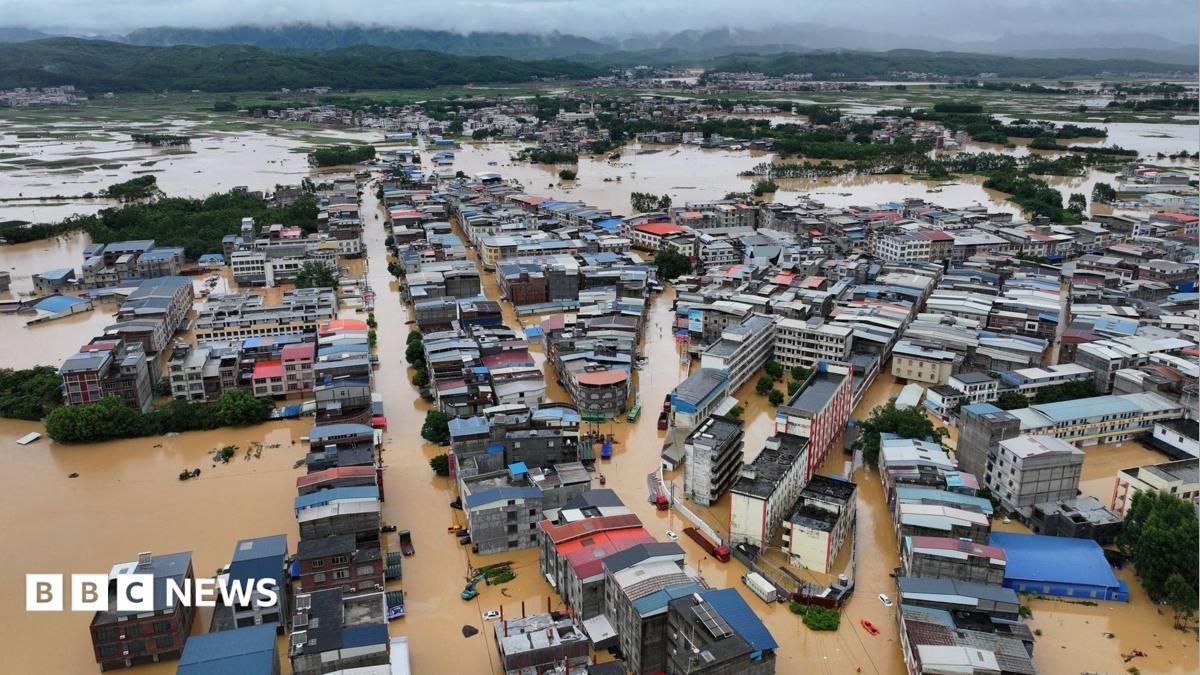
Swift Onset of Flooding in Guangxi Province The rapid progression of flooding triggered by Typhoon Maysak caught residents of Renhe village in Guangxi off guard on the night of July 7, 2026. Heavy rainfall that began on Sunday escalated by Monday morning, with water levels rising from knee height to full submersion of ground floors within hours. Local accounts describe families
Swift Onset of Flooding in Guangxi Province
The rapid progression of flooding triggered by Typhoon Maysak caught residents of Renhe village in Guangxi off guard on the night of July 7, 2026. Heavy rainfall that began on Sunday escalated by Monday morning, with water levels rising from knee height to full submersion of ground floors within hours. Local accounts describe families fleeing without provisions, highlighting the compressed timeline of the event. This pattern aligns with the typhoon's documented characteristics of sudden onset and intense, short-duration winds, as reported through state media channels.
Human Costs and Evacuation Challenges Across Affected Areas
At least four deaths have been recorded in Guangxi, where the typhoon inundated Nanning and surrounding villages after rivers swelled and dam walls failed. Official estimates place the number of evacuated individuals at 60,000, with a total of 90,000 affected by the deluge. Residents in mountain villages remain stranded on rooftops, and supplies including infant formula have run critically low in isolated pockets. In the town of Yunbiao, floodwaters submerged areas in as little as ten minutes, outpacing the capacity of available lifeboats and rescue personnel. These constraints underscore the logistical strains when multiple villages require simultaneous intervention.
Tornado Formation and Secondary Impacts in Hubei
Hundreds of kilometres away in central Hubei province, the typhoon's remnants spawned thunderstorms and at least two tornadoes, resulting in 17 deaths and hundreds of injuries. The last such tornado in the region occurred in 2021, making these events notable for their rarity. Footage from Huanggang captured outdoor furniture airborne and a reported incident of an individual drawn from a high-rise apartment. Escaped farmed snakes in floodwaters added further hazards in Guangxi, complicating rescue operations already hampered by forecasts of continued heavy rain.
Leadership Directives and Operational Priorities
President Xi Jinping directed comprehensive rescue and relief measures, emphasizing treatment of the injured, resettlement of displaced residents, and effective disaster prevention. State media coverage has focused on rescue footage, reflecting the standard emphasis on coordinated response during seasonal typhoon activity. Maysak marks the first landfall of the 2026 season, occurring amid typical summer patterns where such storms frequently produce widespread flooding. Authorities in Nanning have flagged risks that additional precipitation could impede ongoing efforts.
Climate Vulnerability Within Broader National Planning
China's exposure to intensifying weather events intersects with long-term objectives outlined in the 14th Five-Year Plan, which prioritizes adaptation infrastructure alongside technological self-sufficiency. Typhoon Maysak illustrates how short-duration extremes can disrupt agricultural zones in southern provinces, where rice and aquaculture operations face direct inundation risks. Historical patterns show that Guangxi and Hubei contribute substantially to national food output, and repeated disruptions carry cumulative effects on supply chains. The Dual Circulation strategy, aimed at balancing domestic resilience with external engagement, gains relevance here as internal disaster management becomes a test of economic stability.
Economic Ramifications for Agriculture and Regional Development
Flood damage to farmland and transport links in Guangxi carries immediate costs for local producers, with potential ripple effects on downstream markets. Evacuations of 60,000 people interrupt labor availability during critical growing periods, while infrastructure repairs in Nanning will require reallocations from provincial budgets. In Hubei, tornado-related property losses compound these pressures. Such events test the fiscal margins available for both recovery and forward investments in flood defenses, particularly as another system, Super Typhoon Bavi, approaches the eastern seaboard later in the week.
Strategic Calculus and Regional Influence Considerations
Beijing's handling of Maysak reflects the political necessity of demonstrating effective governance during visible crises, which in turn supports domestic cohesion and international perceptions of capability. ASEAN neighbors share similar typhoon exposure, creating openings for technical exchanges on early-warning systems and joint relief protocols. For the Global South, China's experience offers comparative lessons on scaling evacuation logistics under compressed timelines. The EU, meanwhile, monitors these developments for insights into supply-chain vulnerabilities affecting trade in agricultural commodities. Second-order effects may include accelerated domestic focus on meteorological forecasting upgrades, reinforcing multilateral institution-building efforts through forums that address shared climate risks.
Forward Outlook Amid Successive Storm Systems
With Super Typhoon Bavi projected to reach China's eastern coast, authorities face sequential demands on resources already mobilized for Maysak recovery. This sequence highlights the value of sustained investment in resilient infrastructure, consistent with national priorities for technological advancement in disaster monitoring. Residents' reports of limited rescue reach in remote villages point to ongoing gaps that future planning must address without overstating immediate resolution timelines. The episode reinforces the interplay between natural hazard patterns and strategic imperatives for self-reliant adaptation measures.
By Prof. Marcus Chen, Staff WriterThis article was produced with AI-assisted research and editorial support. Reporting is based on sources cited in the article.
What's Your Reaction?
 Like
0
Like
0
 Dislike
0
Dislike
0
 Love
0
Love
0
 Funny
0
Funny
0
 Wow
0
Wow
0
 Sad
0
Sad
0
 Angry
0
Angry
0

World Politics Analyst at Global1.News. Based in Beijing, covering US-China relations, global trade, and geopolitical strategy. Brings deep analytical perspective to the power dynamics shaping international affairs.













Comments (0)