
The most spectacular rocket explosion since N1 just happened in Florida
The most spectacular rocket explosion since N1 just happened in Florida
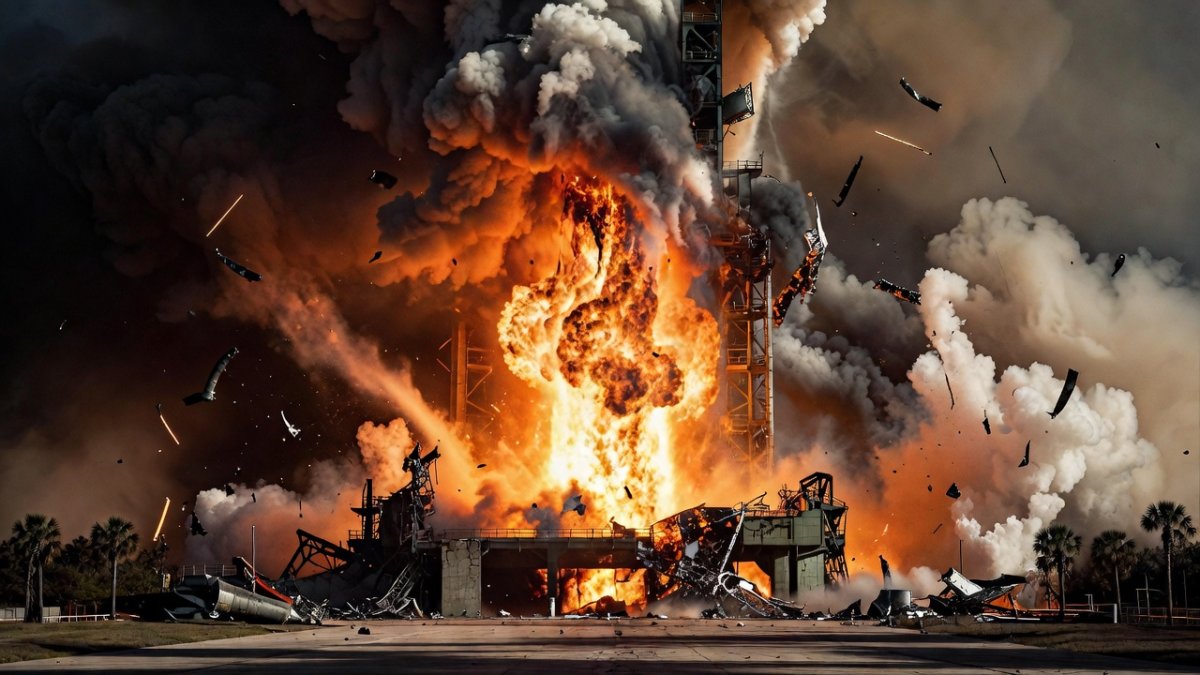
Thursday evening in Cape Canaveral delivered a fireball that lit up the sky like a second sunset. Blue Origin’s New Glenn rocket, meant to prove its heavy-lift credentials with a static-fire test, instead became an uncontrolled inferno seconds after its seven BE-4 engines roared to life. The vehicle, secured to the pad at Launch Complex 36, tore itself apart in a blast that scattered debris across the Florida scrub and left a blackened crater where the test stand once stood. NASASpaceflight.com’s live feed captured every frame, and the footage is already looping across every space channel and social feed. This wasn’t a minor anomaly. This was a total loss.
What the Cameras Actually Showed
The test began normally enough. Ignition at 6:47 p.m. local time produced the expected blue-white plumes from the methane-fueled engines. Within four seconds the plume color shifted to an angry orange. Telemetry dropped. At seven seconds the vehicle’s base structure visibly buckled. By nine seconds the entire stack was engulfed. The explosion registered on seismic sensors 12 miles away. No one was injured because the test was conducted remotely, but the hardware is gone. Blue Origin has not yet released an official statement beyond confirming the test occurred and that an investigation is underway. That silence speaks louder than any press release.
New Glenn Was Never Just Another Rocket
Blue Origin spent more than a decade and an estimated $2.5 billion developing New Glenn. The first stage stands 57 meters tall, uses seven BE-4 engines producing roughly 3.9 million pounds of thrust, and was designed to lift 45 metric tons to low Earth orbit while landing on a drone ship for reuse. NASA awarded the company a $2.9 billion contract in 2020 to fly the rocket on the Artemis V mission. That contract now sits in limbo. Every BE-4 engine that flew Thursday was one of only a handful that had ever reached full-duration testing. The company’s entire cadence hinged on proving those engines could handle a full stack without failure.
Jeff Bezos founded Blue Origin in 2000 with the stated goal of making spaceflight routine. Yet the company’s orbital ambitions have repeatedly slipped. The original New Glenn debut target was 2020. The current internal schedule before this test pointed to a first flight no earlier than late 2025. Thursday’s failure pushes that date further right and raises fresh questions about whether Blue Origin can ever close the gap with faster-moving competitors.
Why This Failure Echoes the Soviet N1
The N1 rocket’s four launch attempts between 1969 and 1972 each ended in spectacular pad or low-altitude explosions. The most famous, the second flight, destroyed the launch tower and left a crater visible from orbit. New Glenn’s test failure shares the same dramatic signature: an engine anomaly that cascaded into total structural breakup before the vehicle could even clear the pad. The difference is that N1 was pushing the absolute limits of 1960s Soviet engineering. New Glenn was built with modern materials, modern sensors, and modern simulation tools. The fact that a static-fire test still produced this level of destruction suggests fundamental issues in engine integration or propellant management that computer models failed to catch.
Technical Clues Pointing to BE-4 Problems
Industry sources familiar with the BE-4 program describe persistent challenges with turbopump cavitation and injector face heating at full throttle. Thursday’s test ran the engines at 100 percent power for the first time on a flight-like vehicle. The rapid color change in the plume is consistent with a fuel-rich mixture shift, possibly from a turbopump failure dumping extra methane into the chamber. Once one engine departs its operating envelope, the thrust imbalance on a seven-engine cluster can rip the thrust structure apart in seconds. Blue Origin has previously stated that each BE-4 undergoes 20 hot-fire tests before integration. That protocol clearly did not prevent the failure mode observed Thursday.
SpaceX’s Raptor engines have suffered their own explosions during early Starship tests, but those occurred on vehicles already flying or during controlled destruction sequences. New Glenn was supposed to be the safer, more conservative design. The gap between that promise and Thursday’s result is now measured in charred wreckage.
Contract and Schedule Fallout
NASA’s Human Exploration and Operations Mission Directorate must now decide whether to keep New Glenn on the Artemis manifest. The agency has already shifted several payloads to SpaceX’s Falcon Heavy and Starship vehicles while waiting for New Glenn. A second supplier for heavy lift remains desirable on paper, but not if the supplier cannot deliver. United Launch Alliance, which also relies on BE-4 for the Vulcan Centaur, watched the same test. Vulcan’s first flight is currently scheduled for late 2024. Any shared-engine issues could ripple across both programs.
Insurance markets will also react. A total loss on a static-fire test is rare in the current commercial era. Premiums for future Blue Origin missions will climb, further squeezing already thin margins on a vehicle that has yet to reach orbit.
The Broader Competitive Picture
SpaceX now launches more than 100 times per year and recovers first stages on a weekly cadence. Blue Origin’s suborbital New Shepard vehicle has flown successfully more than twenty times, yet the company’s orbital aspirations remain aspirational. Thursday’s explosion underscores a persistent organizational problem: Blue Origin moves deliberately, sometimes to the point of paralysis, while the market rewards speed and iteration. The result is a growing capability gap that no amount of billionaire backing has closed.
National security launch customers watching the test footage will draw their own conclusions. The U.S. Space Force has expressed interest in New Glenn for future missions, but only after demonstrated reliability. That bar just got higher.
What Comes Next
Blue Origin will spend weeks sifting through debris and telemetry. Expect the usual statements about lessons learned and a commitment to safety. Those statements will not change the fact that the company now faces its most public setback since the company’s founding. The next static-fire attempt, whenever it occurs, will be scrutinized by every camera in the space industry. Investors, partners, and NASA program managers will all be watching the same feed that captured Thursday’s fireball.
The space race does not reward spectacle for its own sake. It rewards the teams that can absorb failures and still deliver flight hardware on schedule. Blue Origin has absorbed another spectacular failure. Delivery remains the open question.
By Jessica, Staff Writer
This article was produced with AI-assisted research and editorial support. Reporting is based on sources cited in the article.
What's Your Reaction?
 Like
0
Like
0
 Dislike
0
Dislike
0
 Love
0
Love
0
 Funny
0
Funny
0
 Wow
0
Wow
0
 Sad
0
Sad
0
 Angry
0
Angry
0

Editor-in-Chief at Global1.News. Atlanta-based journalist who cuts through the BS and tells it like it is. Lead anchor, host, and the voice you hear when the spin stops and the truth starts.















Comments (0)