
Xi Jinping Demands Global AI Symphony as China Challenges US Tech Dominance in Shanghai
Xi Jinping at Shanghai's World AI Conference July 17, 2026, urged global AI cooperation as a "symphony," not solo act, stressing people-centred control. China pledges 5,000 training spots for developing nations amid US chip curbs and energy edge powering its AI rise.
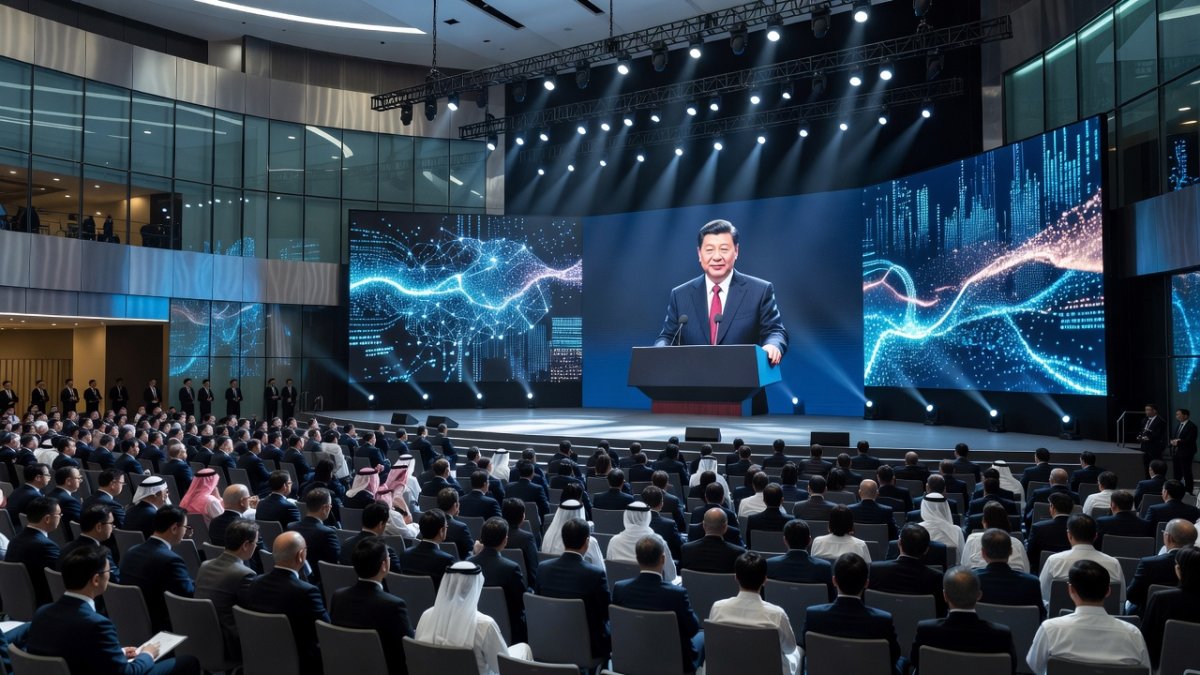
Shanghai Summit Opens with Bold Call for Multilateral AI Future
Chinese President Xi Jinping delivered a keynote address Friday at the opening ceremony of the World AI Conference and High-Level Meeting on Global AI Governance in Shanghai, framing artificial intelligence as a shared global endeavor rather than a zero-sum race. Speaking on July 17, 2026, Xi declared that "AI development should not be a solo performance by a single country, but a symphony of international cooperation." The remarks came as China positions itself as a counterweight to American and European restrictions on Chinese technology, underscoring Beijing's ambition to rival US dominance in the field. The conference itself serves as a high-profile showcase of that ambition, drawing attention to Chinese advances even as Washington tightens export controls.
Xi's speech mixed lofty rhetoric with concrete policy signals. He stressed a "people-centred" approach that keeps "humans at the wheel," rejecting any vision of AI that sidelines human oversight. At the same time, he took direct aim at what he described as the misuse of security arguments to fragment the global tech landscape. The timing is deliberate: just weeks after fresh US measures, China is using the Shanghai stage to court partners across the Global South and BRICS nations while highlighting its own industrial strengths.
People-Centred Doctrine Puts Humans Firmly in Control
Central to Xi's message was the insistence that artificial intelligence must remain subordinate to human decision-making. He called for robust laws and regulations, technological monitoring systems, and early warning mechanisms "to ensure AI is always under human control." This people-centred framing is not new in Chinese official discourse, but the Shanghai speech elevated it to a global governance principle. Xi argued that only by keeping humans at the wheel can the world avoid the risks of unchecked algorithmic power.
The emphasis lands against a backdrop of rapid domestic adoption. Daily consumption of AI tokens in China has increased a thousandfold over the past two years, a surge that reflects both exploding demand for generative tools and the scaling of Chinese large language models. Officials present this growth as evidence that Beijing's approach—pairing aggressive industrial policy with calls for ethical guardrails—can deliver both speed and safety. Critics outside China will note the tension between such rhetoric and the Communist Party's tight control over information flows, yet the speech carefully avoided domestic political flashpoints and focused instead on international norms.
Rejection of Security-Driven Tech Fragmentation
Xi explicitly opposed "overstretching the national security concept in the field of AI or placing one country's security over that of others." The line was widely interpreted as a rebuke of US and European export controls that have targeted Chinese firms. In May 2026, the US Commerce Department reaffirmed restrictions on semiconductor shipments to Chinese subsidiaries operating abroad. American licensing requirements for advanced AI chip exports now apply to all businesses with headquarters or a parent company in China, measures Washington justifies on national security grounds.
Beijing has long argued that such controls amount to technological containment rather than genuine security policy. By framing the issue as one of fairness and shared prosperity, Xi sought to rally developing nations that fear being locked out of the AI revolution. The speech did not name the United States or the European Union, but the context was unmistakable: China is offering an alternative vision in which AI infrastructure and talent flow more freely across borders, particularly to partners in Africa, Latin America, Asia, and the BRICS grouping.
Outreach to Global South and BRICS Partners
China announced concrete plans to deepen AI cooperation with international bodies and countries across Africa, Latin America, Asia, and the BRICS nations. The centerpiece is a pledge to provide 5,000 AI training opportunities for developing countries over the next five years. The program is designed to build local capacity in model development, data governance, and application deployment, positioning Chinese platforms and expertise as the default choice for many emerging economies.
This outreach serves dual purposes. First, it expands markets for Chinese AI companies that have already begun undercutting Western rivals on price. Second, it builds political capital for Beijing's preferred governance model—one that prioritizes development and sovereignty over the more restrictive frameworks favored in Washington and Brussels. Conference organizers highlighted bilateral and multilateral side events aimed at locking in these partnerships before the next round of Western export rules takes effect.
Energy Edge Powers China's Data Center Ambitions
Underlying China's AI push is a structural advantage few competitors can match: electricity. China generates more than twice as much electricity as the United States, and much of it is available at lower cost. That abundance is critical because AI training and inference are extraordinarily power-hungry. A typical data center consumes as much electricity as 100,000 households; hyperscale facilities can draw as much power as 2 million homes. Cheap, reliable power therefore translates directly into lower operating costs and faster scaling of compute clusters.
Chinese planners have spent years building out renewable and coal capacity specifically to support digital infrastructure. The result is an energy surplus that allows Chinese cloud providers and AI labs to expand without the same price spikes or grid constraints facing operators in parts of the United States and Europe. Xi did not dwell on the numbers in his speech, but the infrastructure reality looms large over every discussion of who will lead the next phase of AI development.
Chinese Models Gain Global Traction on Cost
While American companies still dominate the highest-performance frontier models, Chinese offerings such as DeepSeek and others are rapidly closing the gap and winning users with dramatically lower costs. Developers and enterprises in price-sensitive markets are increasingly turning to these alternatives, attracted by competitive performance at a fraction of the expense of leading US systems. The Shanghai conference featured live demonstrations and partnership announcements designed to accelerate that shift.
The thousandfold jump in domestic AI token consumption over two years has given Chinese labs vast amounts of real-world usage data, accelerating iteration cycles. Combined with the energy cost advantage, this creates a feedback loop: more users generate more data, which improves models, which attract still more users. Western restrictions on advanced chips have forced Chinese firms to innovate around hardware constraints, producing software optimizations that further reduce the cost of inference. The net effect is a growing global user base that no longer defaults to Silicon Valley platforms.
Regulatory Frameworks and Early Warning Systems
Beyond the diplomatic messaging, Xi outlined a practical agenda for keeping AI under human control. He called for comprehensive laws and regulations, continuous technological monitoring, and early warning systems capable of detecting and mitigating risks before they cascade. Chinese regulators have already rolled out domestic rules on generative AI content, algorithm registration, and data security; the Shanghai speech suggested Beijing wants similar principles embedded in any future international instruments.
Whether other major powers will accept Chinese-led standards remains an open question. The United States and European Union continue to treat advanced AI capabilities as strategic assets subject to export licensing and investment screening. Yet the sheer scale of China's domestic market and its outreach to the Global South mean that de facto standards may emerge from usage patterns rather than formal treaties. The 5,000 training slots and the emphasis on BRICS cooperation are early moves in that longer game.
Strategic Stakes for the Global Tech Order
The World AI Conference in Shanghai is more than a trade show; it is a declaration of intent. By hosting the event and delivering a keynote that blends cooperation rhetoric with pointed criticism of security-driven barriers, Xi Jinping has placed China at the center of the global AI governance debate. The combination of energy abundance, rapid domestic adoption, cost-competitive models, and targeted outreach to developing nations gives Beijing tangible leverage.
US and EU restrictions—reaffirmed as recently as May 2026 by the Commerce Department—have slowed Chinese access to the most advanced semiconductors, yet they have not halted progress. Instead, they have accelerated efforts to build indigenous supply chains and to court partners who feel excluded by Western controls. Whether the "symphony of international cooperation" Xi envisions materializes will depend on how many countries choose to play along. For now, the score is being written in Shanghai, and China is conducting.
By Jessica Ali, Staff WriterThis article was produced with AI-assisted research and editorial support. Reporting is based on sources cited in the article.
What's Your Reaction?
 Like
0
Like
0
 Dislike
0
Dislike
0
 Love
0
Love
0
 Funny
0
Funny
0
 Wow
0
Wow
0
 Sad
0
Sad
0
 Angry
0
Angry
0

Gulf/MENA Correspondent at Global1.News. Based in Doha, covering Gulf politics, energy markets, diplomacy, and development across the Middle East and North Africa. Tracks the economic transformation of the Gulf states.















Comments (0)