
South Korea Drone Swarm Drill Signals ROK Counter-UAS Shift
The South Korean military’s first dedicated live-fire drill against drone swarms marks a deliberate pivot in Republic of Korea defense planning. Conducted on June 23 2026 by the Air Force Missile Defense Command, the exercise demonstrated how existing platforms can be repurposed to meet emerging aerial threats. The event occurred at a west-coast training range and involved simu
The South Korean military’s first dedicated live-fire drill against drone swarms marks a deliberate pivot in Republic of Korea defense planning. Conducted on June 23 2026 by the Air Force Missile Defense Command, the exercise demonstrated how existing platforms can be repurposed to meet emerging aerial threats. The event occurred at a west-coast training range and involved simultaneous engagement of fifty target drones. This measured demonstration reflects years of incremental adaptation rather than sudden innovation.
Execution of the June 2026 Live-Fire Exercise
The drill featured eight Vulcan 20mm anti-aircraft cannons firing in coordinated salvos from a distance of one kilometer. Forty-four of the fifty drones were neutralized through the concentrated defensive barrier created by these legacy systems. The remaining six targets were engaged by a portable laser system and five shotguns, illustrating a layered approach that combines kinetic and directed-energy effects. Colonel Nam Hyung-joo, chief of intelligence and operations at the Air Force Missile Defense Command, stated that the exercise represented the first attempt to defend against drone swarms using existing assets and that future development would incorporate lessons learned.
Reporters Kim Hee-su of AJP/Aju Press and Aditya Kumar of thedefensenews.com documented the sequence of engagements and the resulting destruction rates. Their accounts confirm that the Vulcan cannons operated as the primary barrier while supplementary systems addressed residual threats. The exercise therefore provided empirical data on saturation thresholds and response times under controlled conditions. Such data will inform subsequent adjustments to firing doctrine and sensor integration.
Placing the event within the broader trajectory of ROK force modernization reveals a pragmatic emphasis on rapid fielding over bespoke procurement. By adapting the Vulcan M167/M61 platform, commanders avoided lengthy acquisition cycles while still generating measurable defensive capability. The inclusion of a portable laser component further signals that directed-energy solutions are moving from experimental to operational testing phases. This combination of old and new assets underscores the fiscal and temporal constraints that shape South Korean defense choices.
Legacy of the December 2022 North Korean Drone Intrusion
The December 2022 North Korean drone incursion, during which five unmanned aerial vehicles penetrated ROK airspace and one approached the presidential no-fly zone in Seoul, catalyzed institutional change. That episode exposed gaps in detection, identification, and engagement protocols against small, low-altitude platforms. In direct response, the Republic of Korea established the Drone Operations Command in September 2023, headquartered in Pocheon near the Demilitarized Zone. The new command centralized planning for both offensive drone employment and defensive countermeasures.
North Korea’s subsequent acceleration of reconnaissance and suicide-drone programs has sustained pressure on ROK planners. Pyongyang’s emphasis on low-cost, attritable systems mirrors tactics observed in Ukraine and the Middle East, where swarms have targeted air bases, ammunition depots, and critical infrastructure. South Korean analysts therefore treat the 2022 incident not as an isolated event but as a harbinger of future saturation attacks. The June 2026 drill directly addressed this scenario by stressing simultaneous engagement of multiple targets.
Inter-Korean dynamics add political weight to these technical developments. Any visible improvement in ROK counter-drone posture influences deterrence calculations in Pyongyang and reassurance calculations in Washington. The placement of the Drone Operations Command near the DMZ also carries symbolic significance, signaling that drone defense is now treated as a frontline mission rather than a rear-area concern. Historical precedent from earlier artillery and missile standoffs suggests that incremental capability gains can shift the threshold for provocation.
Technological Adaptation of Legacy Platforms
The Vulcan 20mm cannon, originally designed for aircraft and helicopter defense, has been recalibrated for slower, smaller drone targets through software and fire-control modifications. Its high rate of fire and proven reliability make it a cost-effective interim solution while dedicated counter-UAS systems mature. The June 2026 exercise validated this adaptation under realistic swarm conditions, yielding quantitative measures of coverage and ammunition expenditure.
Parallel development of the “Block-I” laser weapon system provides a complementary non-kinetic option. Although still in earlier stages of deployment, the portable laser component used in the drill demonstrated the ability to neutralize residual threats after kinetic saturation. Integration challenges remain, particularly regarding power supply, beam stability, and target acquisition in cluttered electromagnetic environments. Continued testing will determine whether lasers can assume a larger share of engagements.
The Korea Defense Blog’s May 2026 reporting on ROK Army K-6 machine-gun anti-aircraft training further illustrates the breadth of adaptation efforts across services. These parallel initiatives suggest a deliberate strategy of distributing counter-drone responsibilities rather than concentrating them in a single platform. Such distribution reduces single-point vulnerabilities and allows commanders to tailor responses to threat profiles.
Regional Security Implications in Northeast Asia
The exercise occurs against a backdrop of heightened tension on the Korean Peninsula and shifting alignments among major powers. China’s own drone programs and Russia’s battlefield experience with Ukrainian unmanned systems create a regional environment in which counter-UAS proficiency becomes a marker of military relevance. South Korea’s demonstrated progress therefore carries diplomatic weight beyond immediate peninsular defense.
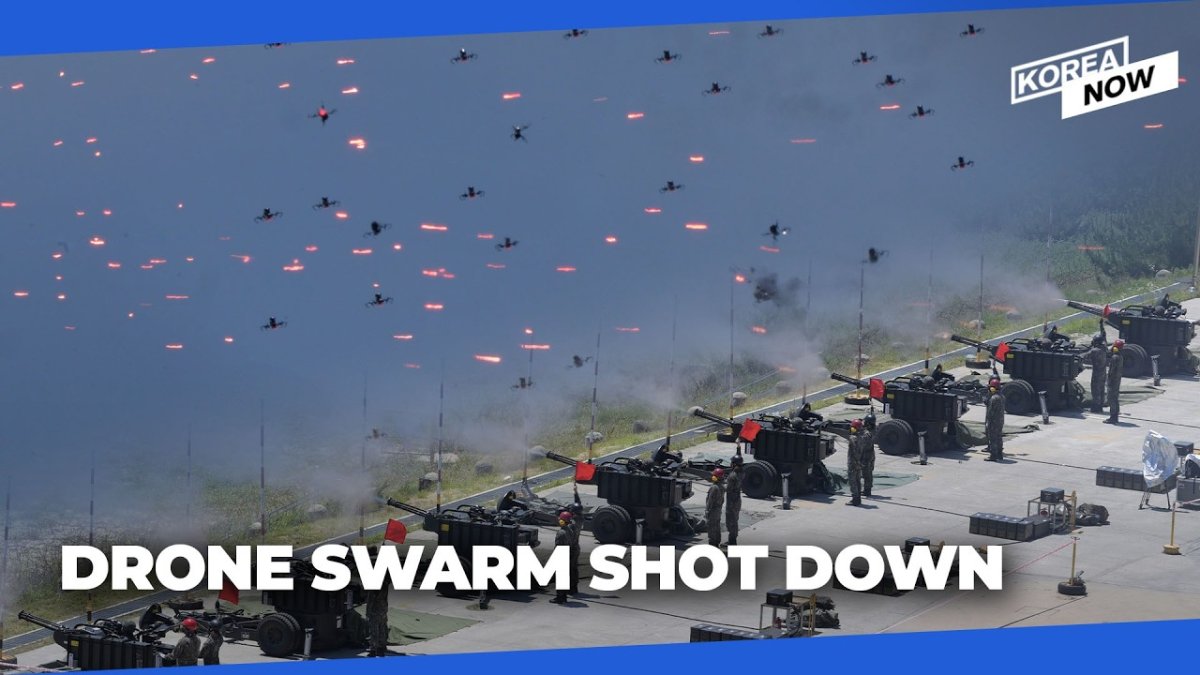
US-ROK joint live-fire drone exercises conducted earlier in 2026 already established patterns of interoperability. The June 2026 national drill builds on that foundation by refining indigenous procedures that can later be synchronized with American forces. This sequencing reflects Seoul’s preference for demonstrating autonomous capability before deepening alliance integration, a pattern visible in other modernization programs.
Domestic political considerations also shape the trajectory. Public awareness of North Korean drone overflights has increased pressure on successive administrations to show tangible progress. The transparent release of exercise footage through the Korea Now video series serves both informational and reassurance functions. It signals to domestic audiences that the military is actively addressing an acknowledged vulnerability.
Outlook for Sustained Counter-UAS Development
Future ROK efforts will likely emphasize sensor fusion, automated threat prioritization, and expanded directed-energy capacity. The lessons extracted from the June 2026 drill will feed into procurement decisions for both ground-based and vehicle-mounted systems. Defense-industry participation in these programs aligns with broader governmental objectives of fostering indigenous technological autonomy.
Regional proliferation of drone technology ensures that counter-UAS requirements will remain dynamic. North Korea’s continued investment in low-observable and swarm-capable platforms will compel iterative ROK responses. The establishment of the Drone Operations Command provides an institutional home for such iteration, reducing the risk of fragmented service-level initiatives.
Ultimately, the June 2026 exercise represents an early waypoint rather than a culminating achievement. Its measured results and explicit commitment to ongoing refinement, as articulated by Colonel Nam, indicate that South Korea views drone defense as a long-term operational domain. How quickly additional capabilities are fielded will depend on budgetary allocations, technological maturation, and the evolving threat environment across Northeast Asia.
By Prof. David Park, Staff Writer
This article was produced with AI-assisted research and editorial support. Reporting is based on sources cited in the article.
What's Your Reaction?
 Like
0
Like
0
 Dislike
0
Dislike
0
 Love
0
Love
0
 Funny
0
Funny
0
 Wow
0
Wow
0
 Sad
0
Sad
0
 Angry
0
Angry
0

East Asia/Technology Correspondent at Global1.News. Seoul-based voice covering Korean politics, technology, business, and culture. Analyzes how technology and geopolitics intersect across East Asia.















Comments (0)