
China Surpasses US in Global Favorability for First Time, Pew Survey Reveals
Pew Research Center survey of 36 countries finds China now viewed more favorably than the US in 25 nations — a historic first. Japan ranks among just six countries still favoring Washington, with only 11% viewing China favorably. Xi Jinping outpolls Donald Trump globally in confidence ratings.
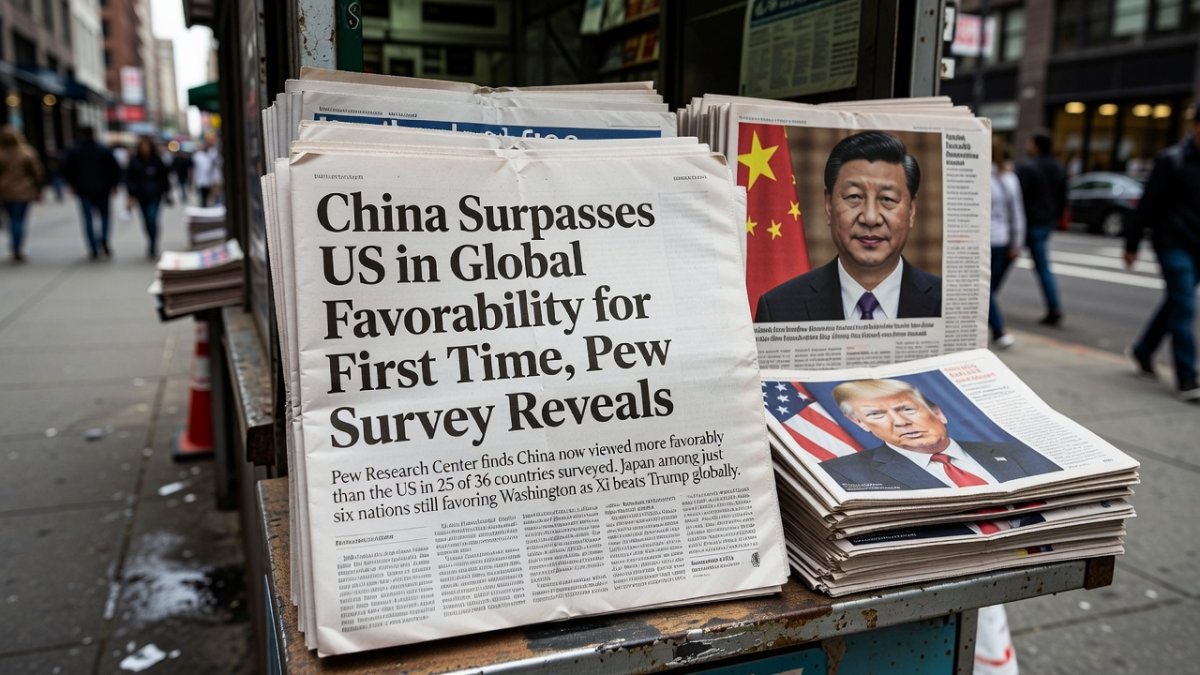
China Surpasses US in Global Favorability, Pew Survey Reveals
Tokyo — For the first time since Pew Research Center began tracking global attitudes toward the United States and China more than two decades ago, Beijing has overtaken Washington in worldwide public opinion. The Spring 2026 Global Attitudes Survey, released Wednesday, shows that China is now viewed more favorably than the United States in 25 of the 36 countries polled — a seismic shift in international perceptions with profound implications for Japan and the broader Asia-Pacific region.
The findings, based on interviews with more than 42,000 respondents conducted between February and May 2026, mark a dramatic reversal from as recently as 2023, when the US held a commanding lead. Across a core group of 20 countries surveyed consistently since 2023, the median favorable rating of China has risen from 32% to 46%, while the US has fallen from 58% to 36% over the same period.
Tags: Pew Research Center, China favorability, US global image, Xi Jinping, Donald Trump, Japan-China relations, US-Japan alliance, global attitudes survey, soft power, Asia-Pacific geopolitics
The Data: A Historic Reversal in Global Opinion
The scale of the shift is unprecedented in Pew's tracking history. In 25 of 36 countries surveyed, a greater share of respondents expressed favorable views of China than of the United States. This includes several longstanding US allies: Canada, Australia, France, Germany, and the United Kingdom all now view China more positively than America.
Countries that recorded the largest swings toward China include Spain, Indonesia, Italy, Greece, and Canada. China also reached record-high favorability ratings in Italy, Spain, Colombia, Mexico, Indonesia, Malaysia, Nigeria, and Turkey. Researchers found that middle-income countries generally held more positive views of China, while wealthier nations tended to be more negative — though Singapore stood as a notable exception, combining high GDP per capita with strong pro-China sentiment.
Jonathan Schulman, one of the study's researchers, noted that Pew has seen previous dips in US favorability — in 2008 at the end of George W. Bush's administration, and in 2017 at the start of Trump's first term. "Even then, however, favorable views of China tended to be on par or slightly lower," Schulman told the BBC.
The Six Holdouts: Japan Among a Handful Still Favoring the US
Only six countries in the survey still view the United States more favorably than China. They are, in order: Poland, the Philippines, South Korea, India, Japan, and Israel. Notably, five of these six are among America's closest security partners — a fact that underscores how vital alliance relationships have become to sustaining US global influence.
Japan's position is particularly complex. While Japanese respondents view the US more favorably overall, the data reveals deep ambivalence. Only 11% of Japanese expressed a favorable view of China — the lowest figure in the entire survey, tied with some of the most geopolitically contested regions. Israeli respondents also gave China a low 27% favorability rating, while Poland, the Philippines, India, and South Korea showed relatively more balanced views.
The sharp divide within the Asia-Pacific region is striking. Pakistan recorded the highest favorability toward China at approximately 90%, while Japan's 11% sits at the polar opposite. "The most positive — and the most negative — views of China in the survey came from the Asia-Pacific," the Pew report notes.
Xi Outpaces Trump in Global Confidence
The survey also asked respondents whether they had confidence in Chinese President Xi Jinping and US President Donald Trump "to do the right thing in world affairs." Overall, confidence levels in both leaders were low, with most scores falling below 50%. However, Xi consistently outperformed Trump across the surveyed nations.
Xi's highest confidence rating came from Pakistan at 83%, while his lowest was Japan at just 7% — underscoring the deep mistrust of Chinese leadership among the Japanese public. For Trump, the highest rating was 68% in the Philippines and the lowest was 4% in the West Bank and East Jerusalem.
Schulman noted a significant methodological observation: "People don't have that strong an opinion on Xi as they do for other leaders." By contrast, respondents were "more likely to give an answer, and give an answer on the extremes" when it came to Trump. This suggests that while Xi may benefit from relative global obscurity, Trump's polarizing international image is a concrete drag on US soft power.
Perceptions of Power: US Interference vs. Chinese Predictability
The Pew survey offers revealing insights into how the two superpowers are perceived on the world stage. While the United States is still seen as more respectful of personal freedoms than China, that gap is narrowing. More strikingly, on foreign policy behavior, China holds a clear advantage.
In a set of additional questions posed in 17 middle-income nations, a median of 75% of respondents said the US interferes in the affairs of other countries "a great deal" or "a fair amount." Only 45% said the same of China. This perception gap aligns with findings on foreign policy preferences: respondents in these countries expressed more concern about US behavior than Chinese behavior.
Chong Ja Ian, a non-resident scholar with Carnegie China, offered a sharp analysis of the dynamic. "The volatility of US policy, including the use of force and the resulting economic harm, has put many on edge," he told the BBC. He noted that the survey period — February to May 2026 — coincided with Trump intensifying rhetoric about annexing Greenland, the US capture of Venezuelan leader Nicolas Maduro, and the launch of the US-Iran war.
"Whether China is absolutely popular is an open question," Chong said, "but it seems like a more predictable entity at present. Beijing has also been working hard to burnish its image," particularly in developing countries. He cautioned, however, that "people attribute the more coercive and economically less helpful policies to Xi personally but associate more positive elements, such as technological advances, to China more broadly."
What This Means: Strategic Implications for Japan
For Japan, the Pew survey presents a sobering strategic picture. While Japan remains among the handful of nations still favoring the United States — and Japanese public skepticism toward China remains the most pronounced in any surveyed country — the global trend lines are unmistakable and carry direct consequences for Tokyo.
First, the erosion of US soft power complicates Japan's security strategy. Tokyo has increasingly positioned itself as a linchpin of US-led alliances in the Indo-Pacific, from trilateral cooperation with the US and South Korea to expanded defense ties with Australia, the Philippines, and partners in Southeast Asia. A world in which Washington's global standing is in steady decline makes it harder to sustain the coalition-building that underpins Japan's security architecture.
Second, China's rising favorability — particularly in Southeast Asia — directly affects the regional environment in which Japan operates. Countries like Indonesia, Malaysia, and the Philippines have all shown growing warmth toward Beijing. While the Philippines remains one of the six nations favoring the US, the margin is narrow, and China's infrastructure and economic diplomacy continue to deepen ties across the Association of Southeast Asian Nations.
Third, the survey data underscores a challenge for Japan's own public diplomacy. With only 11% of Japanese viewing China favorably and 7% expressing confidence in Xi, the domestic political space for rapprochement with Beijing remains extremely limited. Yet Japan's economic interdependence with China — as a trade partner, supply chain node, and technology competitor — demands a more nuanced approach than public opinion alone would permit.
What to Watch For
The Pew survey captures a snapshot of global opinion during a period of extraordinary international turbulence. The US war with Iran, escalating trade tensions, and Trump's unilateralist foreign policy all unfolded during the polling window. Whether these trends continue depends heavily on how the broader geopolitical environment evolves.
For Japan's policymakers, several factors bear watching. The trajectory of US favorability in allied nations — particularly South Korea, which is among the six holdouts but by a slim margin — will signal whether the alliance architecture can withstand the broader decline. China's ongoing efforts to expand its influence through Belt and Road infrastructure, technology exports, and diplomatic outreach in the Global South suggest the current trend has structural momentum.
And for the Japanese public, the survey offers a reminder that while Japan stands apart in its sharp skepticism of China and Xi Jinping, that position becomes increasingly distinctive as global opinion shifts. Navigating between alliance solidarity, regional economic integration, and public sentiment will remain one of the defining challenges of Japanese foreign policy in the years ahead.
By Kenji Tanaka, Staff Writer
---**Internal Linking Opportunities:**- "Japan's defense buildup and the evolving US alliance" — anchor text for a related Global1.news article on Japan's security policy- "China's Belt and Road influence in Southeast Asia" — anchor text for analysis of Chinese economic diplomacy- "US foreign policy under Trump and implications for Asia" — anchor text for broader geopolitical analysis**Social Media Teaser (for X / Postiz):**For the first time ever, China is now viewed more favorably than the US in 25 of 36 countries surveyed by Pew. Japan is among just six nations still favoring Washington. Xi beats Trump globally — but only 7% of Japanese trust him. Full analysis. #PewSurvey #Japan #China #US #GlobalOpinionThis article was produced with AI-assisted research and editorial support. Reporting is based on sources cited in the article.
What's Your Reaction?
 Like
0
Like
0
 Dislike
0
Dislike
0
 Love
0
Love
0
 Funny
0
Funny
0
 Wow
0
Wow
0
 Sad
0
Sad
0
 Angry
0
Angry
0

Japan Correspondent at Global1.News. Tokyo-based voice covering Japanese politics, technology, economy, and culture. Tracks the intersection of tradition and innovation in one of the world's most dynamic societies.














Comments (0)