
Israel kills 11 Palestinians, including police chief, in Gaza
The Targeting of Civilian Police Infrastructure Israeli strikes on Tuesday, July 14, 2026, claimed the lives of 11 Palestinians across the Gaza Strip, among them Colonel Mohammed Marwan Salem, director of the Jabalia police station. The attack hit a police post near Shadia School in the Al-Falouja area west of Jabalia refugee camp, according to...
The Targeting of Civilian Police Infrastructure
Israeli strikes on Tuesday, July 14, 2026, claimed the lives of 11 Palestinians across the Gaza Strip, among them Colonel Mohammed Marwan Salem, director of the Jabalia police station. The attack hit a police post near Shadia School in the Al-Falouja area west of Jabalia refugee camp, according to reports from Anadolu Agency cited by Middle East Monitor. This incident raises serious questions about the systematic erosion of civilian institutions that, even in wartime, have maintained basic order in one of the most densely populated areas on earth. Palestinian police in Gaza have historically managed traffic, investigated ordinary crimes, and coordinated emergency responses, roles that become even more critical when hospitals and rescue services are overwhelmed.
The Gaza police force has historically operated primarily as civil servants responsible for traffic regulation, criminal investigations, crowd control, and maintaining basic public order rather than functioning as a militant organization. Established under the Palestinian Authority after the Oslo Accords, the police were deliberately separated from Hamas’s military wing, the Izz ad-Din al-Qassam Brigades. Officers often received training from international donors focused on rule-of-law programs. Israeli strikes on police headquarters, training academies, and personnel have therefore raised questions about the blurring of lines between civilian governance structures and legitimate military targets. Critics argue that such attacks effectively dismantle the administrative backbone necessary for any functioning society, especially in a territory lacking independent courts or a robust judicial system.
This pattern echoes controversies in other modern conflicts where civil defense and civilian infrastructure have come under fire. During the 1999 NATO bombing of Yugoslavia, strikes on Serbian interior ministry buildings and police stations were criticized for undermining post-conflict stabilization. Similarly, coalition targeting of Iraqi police facilities in 2003-2004 complicated efforts to restore order after Saddam Hussein’s fall. In Gaza, the repeated destruction of police infrastructure exacerbates an already fragile security vacuum. Without functioning courts or detention facilities, even routine criminal matters go unaddressed, leading to increased vigilantism, clan-based justice, and opportunities for armed groups to fill the governance gap. The death of a senior police chief in such strikes removes experienced administrators at a time when basic law and order is most needed to prevent total societal collapse.
The long-term impact on Palestinian society is profound. With no functioning legislature or independent judiciary under current conditions, police represent one of the few remaining symbols of civilian authority. Their systematic targeting risks accelerating the militarization of daily life and further entrenches the perception that no civilian institution is safe. Human rights organizations have documented how the absence of police services has led to rising incidents of theft, gender-based violence, and black-market activity, all of which compound the humanitarian emergency created by prolonged conflict and blockade.
Humanitarian Toll on an Already Fractured Society
The deaths come as the Gaza Health Ministry reports 1,108 Palestinians killed since the fragile ceasefire took effect on October 10, 2025. Since October 2023, the cumulative death toll has surpassed 73,000. These figures reflect not only direct casualties but the slow-motion collapse of a society struggling to survive under repeated military pressure. Bodies from Tuesday’s strikes were transferred to Al-Shifa Medical Complex and the American field hospital, both of which continue to operate with severely limited resources. Two additional Palestinians were killed in shelling that struck a tent southwest of Gaza City, while a drone strike on a tent near Tayba Towers west of Khan Younis left one dead and three wounded. In Rafah’s Al-Mawasi area, a child identified as Moataz Abu Shaar was killed by gunfire. Each incident compounds the daily misery of families living in makeshift shelters, without reliable electricity, clean water, or safe passage for medical evacuations.
Named Victims and the Human Face of Loss
Colonel Mohammed Marwan Salem was not a combatant in any armed faction but a career police officer responsible for the northern district’s law enforcement. His killing, alongside ten other civilians, strips away another layer of administrative capacity in northern Gaza. Moataz Abu Shaar, whose exact age has not been released but who is described simply as a child, represents the persistent vulnerability of minors in so-called “safe zones” like Al-Mawasi. These names, recorded by local health officials and shared through Palestinian media, remind readers that behind every statistic are families who must now navigate mourning without adequate support systems. The transfer of bodies to overburdened medical facilities in Gaza City and Khan Younis further illustrates how even the rituals of death have become logistically nightmarish.
Pattern of Ceasefire Violations Since October 2025
The October 10, 2025 ceasefire was intended to halt the intense fighting that had devastated Gaza for nearly two years. Yet the Gaza Health Ministry’s documentation of 1,108 deaths in the subsequent nine months reveals a pattern of incremental violations. Israeli strikes on civilian infrastructure, including police posts, schools, and displacement tents, have continued with varying intensity. Tuesday’s attacks fit into a broader sequence that includes previous incidents targeting humanitarian zones and essential service providers. Palestinian officials argue that such actions deliberately undermine the fragile stability required for reconstruction, while Israeli statements have often framed these operations as necessary to prevent militant activity, though evidence linking the named victims to armed groups has not been publicly presented in most cases.
Since the fragile ceasefire agreement collapsed in October 2025, Palestinian health authorities report at least 1,108 deaths in Gaza, with the highest monthly tolls recorded in November (312 deaths) and January (287 deaths), concentrated primarily in northern Gaza districts and along the eastern border areas. These figures include both airstrikes and ground operations. The nature of violations has been consistent: frequent Israeli drone strikes on civilian neighborhoods, artillery shelling targeting areas near the perimeter fence, and live gunfire directed at farmers and demonstrators approaching the buffer zone. Many incidents occurred outside declared “buffer zones,” raising questions about adherence to international humanitarian law standards of distinction and proportionality.
The original ceasefire terms, brokered with Egyptian and Qatari mediation, explicitly prohibited targeted killings, required phased Israeli withdrawals from populated areas, and mandated humanitarian corridors. However, Israeli officials have cited continued rocket fire and militant activity as justification for “defensive” operations, while Palestinian factions accuse Israel of using technical violations to justify broader military campaigns. Independent monitors have documented over 180 separate incidents involving Israeli forces firing on civilians since the breakdown, many involving unarmed individuals. The absence of robust UN monitoring mechanisms has been glaring; unlike previous ceasefires that included UNTSO observers or temporary international verification teams, the 2025 agreement relied primarily on indirect guarantees from mediators without on-ground enforcement capabilities.
This pattern of incremental violations has created a dangerous new normal where low-level violence is tolerated until it escalates into full-scale operations. Data compiled by local NGOs shows that roughly 68% of post-ceasefire fatalities were civilians, including women and children, according to hospital records. The repeated cycle of limited strikes followed by larger retaliatory actions has eroded trust in diplomatic processes and strengthened hardliners on both sides. Without credible third-party verification or consequences for breaches, the ceasefire framework appears increasingly hollow, setting the stage for prolonged low-intensity conflict that continues to extract a heavy civilian toll.
International Response and Diplomatic Inaction
Reactions from world capitals have been muted. The United Nations has called for investigations into civilian deaths but stopped short of demanding accountability mechanisms with enforcement power. European Union member states issued statements expressing concern over the latest casualties while continuing security cooperation with Israel. The United States, a key mediator in the 2025 ceasefire talks, has urged restraint on all sides but has not tied continued military aid to compliance with humanitarian obligations. Human rights organizations, including Amnesty International and Human Rights Watch, have documented what they describe as disproportionate force against civilian targets, yet these reports have produced little tangible policy shift. For ordinary Palestinians, the gap between diplomatic rhetoric and lived reality grows wider with each new incident.
The international community’s response has been characterized by strong rhetorical condemnation coupled with limited concrete action. The UN Security Council has passed three resolutions since October 2025 calling for immediate cessation of hostilities and protection of civilians, yet all have been weakened by veto threats or abstentions, particularly from the United States. European Union statements have grown increasingly critical, with the EU foreign affairs chief describing the strikes as “disproportionate” and urging compliance with international law. However, these statements have not translated into meaningful policy shifts such as arms embargoes or sanctions. Meanwhile, the United States continues to provide Israel with approximately $3.8 billion in annual military aid, including precision-guided munitions that have been used in recent Gaza operations.
The International Criminal Court has expanded its ongoing investigation into the situation in Palestine, with prosecutors requesting additional evidence regarding targeting decisions and potential war crimes by all parties. Progress remains slow due to limited cooperation from both Israeli and Palestinian authorities. Regional mediators have shown varying degrees of engagement: Egypt continues to manage the Rafah crossing and hostage negotiations, Qatar hosts political discussions and provides financial support to Gaza, while Turkey has adopted a more vocal pro-Palestinian stance, including calls for accountability at the UN General Assembly. Despite these efforts, coordination between mediators has been inconsistent, limiting their collective leverage.
There remains a stark contrast between diplomatic language emphasizing “restraint,” “de-escalation,” and “protection of civilians” and the on-ground reality of continued strikes, displacement, and infrastructure destruction. This gap between rhetoric and action has fueled accusations of double standards, particularly in the Global South, where critics point to swift international responses in other conflicts compared to the relative impunity surrounding Gaza. The result is a growing sense of diplomatic fatigue that further diminishes prospects for meaningful intervention or accountability.
The Scale of Destruction and Infrastructure Collapse
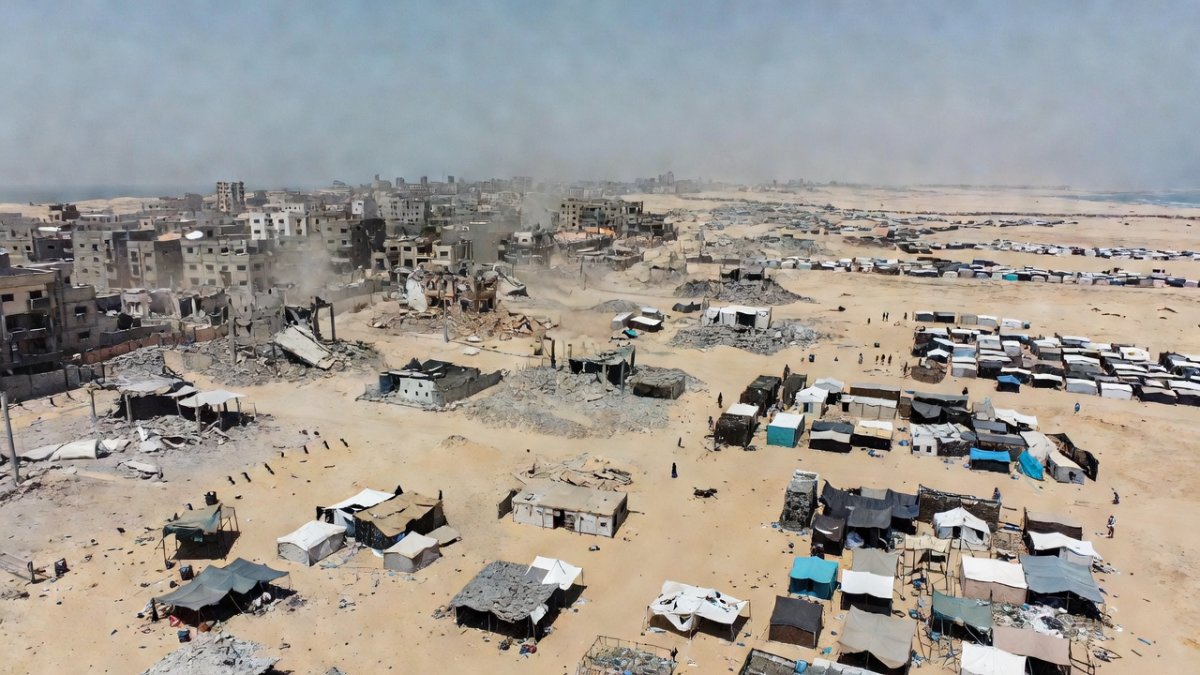
According to Gaza Health Ministry data, approximately 90 percent of the territory’s infrastructure has been damaged or destroyed since October 2023. This includes roads, water treatment plants, electrical grids, schools, and medical facilities. The repeated targeting of police stations, even those operating under ceasefire conditions, accelerates the breakdown of civil governance. In Jabalia, one of the oldest and largest refugee camps, the loss of local policing capacity leaves residents more vulnerable to both chaos and further military incursions. Families in Khan Younis and Rafah, already displaced multiple times, face the additional burden of caring for the wounded without functioning ambulances or secure routes to hospitals. The cumulative effect is a society pushed to the edge of functional collapse, where even basic services become privileges rather than rights.
Forward-Looking Analysis: Prospects for Stability
The latest killings underscore the precariousness of any political horizon in Gaza. Without genuine enforcement of ceasefire terms, including protection of civilian institutions and guarantees against arbitrary strikes, the cycle of violence appears destined to continue. Palestinian analysts in Gaza City speak of a generation growing up without consistent access to education, healthcare, or safe public spaces. International mediators face the challenge of rebuilding trust when daily casualties erode confidence in negotiated agreements. For the people of Jabalia, Khan Younis, and Rafah, the immediate priority remains survival: securing food, shelter, and medical care amid ongoing uncertainty. Any meaningful path forward must address not only the cessation of hostilities but the restoration of the civilian infrastructure necessary for dignified life. Until then, each new name added to the casualty lists deepens the collective trauma and postpones the possibility of genuine recovery.
Reconstruction of Gaza would require an estimated $45-60 billion over a 10-15 year period according to World Bank assessments, covering housing, hospitals, schools, water treatment facilities, and power infrastructure. Such an effort would necessitate lifting the longstanding blockade, establishing clear governance arrangements, and securing long-term funding commitments from international donors. The UN Relief and Works Agency (UNRWA) remains the primary provider of education, healthcare, and social services for the majority of Gaza’s population, yet faces chronic funding shortages and political pressure. Other agencies including the International Committee of the Red Cross and various NGOs would need guarantees of safe access and operational independence to participate effectively in recovery efforts.
Internal Palestinian political dynamics continue to complicate prospects for stability. The longstanding rift between the Fatah-led Palestinian Authority in the West Bank and Hamas governance in Gaza has prevented unified leadership necessary for large-scale reconstruction. Recent attempts at reconciliation have repeatedly faltered over security control, electoral timelines, and ideological differences. Without a legitimate, unified Palestinian governing body capable of making binding decisions, international donors remain reluctant to commit major funds that risk being diverted or destroyed in future fighting. Long-term humanitarian projections are grim: without significant policy changes, Gaza faces continued de-development, with rising poverty rates, deteriorating public health indicators, and a generation of children experiencing repeated trauma and interrupted education.
Breaking the cycle would require several simultaneous steps: a sustainable ceasefire backed by credible international monitoring, a clear political horizon addressing core final-status issues, phased security arrangements that address Israeli concerns while restoring Palestinian sovereignty, and a comprehensive reconstruction plan linked to governance reform. Regional actors including Saudi Arabia and the UAE could play important roles in economic development if normalized relations with Israel are paired with tangible progress on Palestinian statehood. Absent these elements, the pattern of periodic devastating conflicts followed by inadequate recovery appears likely to continue, perpetuating one of the most intractable humanitarian and political crises of the 21st century.
Daily Realities Under Continued Pressure
In the streets of Gaza, the impact of Tuesday’s attacks is felt in small, painful ways. Neighbors gather to offer condolences to the families of the fallen police officers and the child lost in Rafah. Health workers at Al-Shifa describe scenes of exhaustion as they receive new patients while still treating victims from previous strikes. Parents in displacement tents weigh the risks of allowing children outside against the psychological harm of prolonged confinement. These intimate struggles rarely make international headlines yet constitute the true texture of life under repeated military pressure. The killing of a local police chief, far from being an isolated security incident, reverberates through communities already stripped of so many sources of stability and hope.
By Fatima Al-Rashid, Staff Writer
This article was produced with AI-assisted research and editorial support. Reporting is based on sources cited in the article.
What's Your Reaction?
 Like
0
Like
0
 Dislike
0
Dislike
0
 Love
0
Love
0
 Funny
0
Funny
0
 Wow
0
Wow
0
 Sad
0
Sad
0
 Angry
0
Angry
0
Gulf/MENA Correspondent at Global1.News. Based in Doha, covering Gulf politics, energy markets, diplomacy, and development across the Middle East and North Africa. Tracks the economic transformation of the Gulf states.









Comments (0)