
The Three-Second Theft: How AI Voice Fraud Became The Fastest-Growing Threat To Your Wallet
AI voice cloning now needs just three seconds of audio to create convincing deepfakes. FBI reports 893 million dollars lost to AI-powered scams in 2025, a 1,200 percent surge. The Four-Stage scam model trending on HN reveals what actually protects you: a family code word.
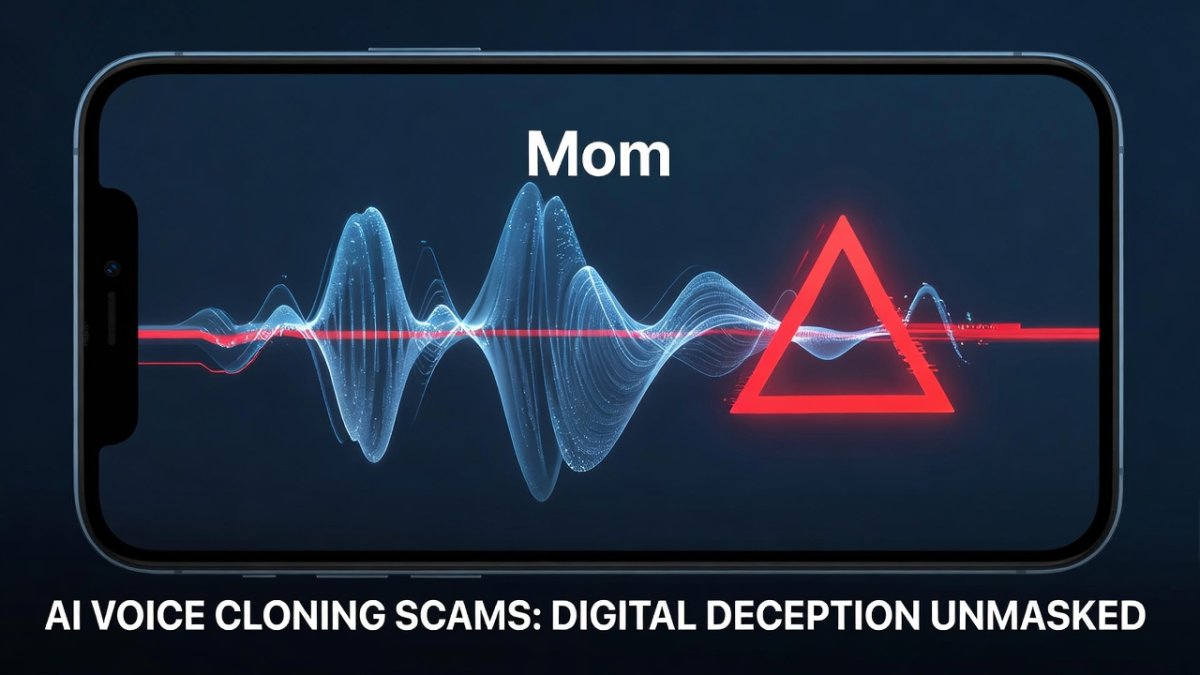
You know that sinking feeling when your phone rings and it's your kid — except it's not? That's not a hypothetical anymore. In 2026, AI voice cloning has gone from "scary future thing" to "this is happening to real families right now," and the numbers are staggering.
The FBI's Internet Crime Complaint Center (IC3) just dropped its first-ever standalone AI fraud tally: Americans lost $893 million to AI-powered scams in 2025 alone. And the weapon of choice? Three seconds of your voice pulled from a TikTok or a voicemail greeting. That's all it takes.
The Three-Second Theft: How AI Voice Fraud Became The Fastest-Growing Threat To Your Wallet
New York, NY – July 15, 2026 — A story currently sitting at #4 on Hacker News has been circulating across X, Reddit, and mainstream press: AI voice cloning now requires just three seconds of audio to produce a clone convincing enough to fool family members. The piece, titled "The Three-Second Theft: Why AI Voice Fraud Outruns Every Defence," captures the growing alarm as what was once a theoretical threat becomes an everyday reality.
The $893 Million Wake-Up Call
For the first time in its 25-year history, the FBI's annual Internet Crime Report broke out AI-facilitated fraud as its own category. The 2025 tally: 22,364 complaints tied directly to AI, totaling $893 million in losses. And researchers say fewer than 5% of victims ever report, meaning the real number is almost certainly in the billions.
The Federal Trade Commission (FTC) logged a 1,200% increase in deepfake-related complaints between 2023 and 2025. The trajectory is hockey-stick shaped. What started as a niche cybercrime vector has become the fastest-growing fraud category in the United States, and law enforcement is scrambling to catch up.
How Three Seconds of Audio Becomes a Weapon
The technical barrier has collapsed. In 2020, voice cloning required minutes of clean studio-quality audio and specialized machine learning expertise. By 2026, consumer-grade tools from ElevenLabs, Play.ht, and open-source models can clone any voice with up to 85% accuracy from a three-second sample — a TikTok clip, a voicemail greeting, a LinkedIn intro video, or even a "wrong number" call designed to capture your voice.
Once the clone is generated, the attacker has a voice profile that can read any script in real time, complete with emotional inflection, breathing patterns, and pitch variation. The result? A phone call from "your daughter" begging for help that sounds indistinguishable from the real thing.
Dr. Emily Carranza, a voice forensics researcher at MIT's Media Lab, told the press: "The human ear evolved to recognize emotional distress, not synthetic audio artifacts. When a parent hears their child crying for help, their brain doesn't run a spectral analysis. It acts. That's exactly what the scammers are counting on."
The Anatomy of an AI Voice Scam
Every AI voice scam follows the same four-stage model, cybersecurity researchers have documented:
Stage 1 — Audio Harvesting. Attackers scrape public sources for voice samples. Social media platforms like TikTok, Instagram, and YouTube are the biggest targets. A single 15-second story post is enough for a perfect clone.
Stage 2 — Clone Generation. The samples feed a voice-cloning model. Within minutes, the attacker has a voice profile that can produce any text, with realistic emotional range. The cost? As low as $5 per clone on dark-web marketplaces.
Stage 3 — Pretext Design. Scammers research their targets using public records, breached databases, and social media profiles. They pick high-pressure scenarios designed to bypass rational thought: emergency arrest, car accident, hospital admission, or fake kidnapping.
Stage 4 — Execution. The call comes, often with caller-ID spoofing to display the impersonated person's real number. The cloned voice begs for help, demands secrecy, and requests an irreversible payment method — gift cards, wire transfer, or cryptocurrency. The entire call lasts under three minutes. By design.
Real Victims, Real Stories
The real-world toll reads like a nightmare script. In one widely-reported case from early 2026, a mother in Arizona received a call from what sounded exactly like her 19-year-old daughter, sobbing and saying she'd been kidnapped by a drug cartel. "Mom, these bad men have me," the voice said. The scammer demanded $50,000 in ransom. The family nearly paid before a second call to the daughter's actual phone confirmed she was safe at college.
In another case documented by the FBI, a California couple lost their entire retirement savings — $178,000 — after receiving a call from an AI clone of their son's voice, claiming he'd been arrested in Mexico and needed bail money wired immediately. By the time they confirmed their son was in his Los Angeles apartment, the money was gone.
These aren't isolated incidents. According to AARP's fraud monitoring network, seniors aged 60 and over accounted for $3.4 billion in phone-based fraud losses in 2023, with AI voice cloning serving as the primary accelerant. The median loss per incident: $9,000.
The Underground Economy of Cloned Voices
The FBI's 2024 takedown of "VocalCopy," a Romania-based fraud ring, offers a rare glimpse at the scale of the operation. Agents recovered $48 million in laundered proceeds from a network that operated call centers, sold cloned voice profiles, and maintained target dossiers on thousands of American families.
On dark-web marketplaces, a "ready-to-call" voice profile package — containing a cloned voice, target research, and a script template — sells for as little as $15. According to Mandiant's 2024 Threat Intelligence Report, the average price is $45 per package. At that price point, voice cloning fraud is accessible to virtually anyone with an internet connection and a willingness to break the law.
The ecosystem has three tiers: organized fraud rings operating at industrial scale, lone-wolf operators using off-the-shelf SaaS tools for high-value individual targets, and initial access brokers who sell cloned voice profiles and dossiers to other criminals. All three tiers are growing.
What's Being Done — Legislation and Tech Defenses
The legal response has been fragmented. Tennessee's ELVIS Act (Ensuring Likeness, Voice, and Image Security), effective July 2024, was the first state law to explicitly add voice to protected personal attributes. Several other states followed, and the EU's AI Act includes provisions requiring disclosure of AI-generated content. But enforcement remains difficult — most scam operations are based outside U.S. jurisdiction.
On the tech side, companies are racing to build defenses. Voice authentication systems are being deployed by major banks, using liveness detection and behavioral voiceprint analysis. The FTC has proposed rules requiring AI-generated voices in commercial calls to be disclosed. And startups are building real-time deepfake detection tools that analyze call audio for synthetic artifacts.
But there's a cat-and-mouse dynamic at play. As detection tools improve, so do the cloning models. The Three-Second Theft piece on Hacker News this week sparked intense debate about whether technical solutions alone can ever outpace the speed of improvement in generative voice AI.
The One Defense That Actually Works
Security researchers agree on one thing: the most effective defense isn't a piece of software. It's a family code word. A simple, secret word or phrase that family members agree on in advance — one that never appears in texts, emails, or social media. If someone calls claiming to be a family member in distress and can't produce the code word, hang up and verify through a separate channel.
The FBI, AARP, and FTC all recommend this as the single most effective countermeasure. The logic is simple: AI can clone voice, but it cannot read minds. A code word that's never been spoken aloud is a test the scammer cannot pass.
Other practical defenses: avoid posting voice content publicly (or limit it to close friends), set voicemail greetings to a neutral recorded message rather than your natural voice, and establish a family verification protocol — always call back on a known number before sending money.
What This Means — Why It Matters To You
Voice cloning technology has followed the same curve as every other AI capability: exponential improvement, collapsing costs, and widespread accessibility. The three-second threshold isn't a static number — it's trending toward real-time. Researchers at McAfee Labs demonstrated in 2023 that 3-second clones achieved 85% accuracy. By 2026, that number has climbed higher, and the required sample size has shrunk further.
What makes this threat different from other online scams is its emotional precision. It bypasses every rational defense by weaponizing the one thing you trust most: the voice of someone you love. When your brain hears a family member in distress, it doesn't question authenticity — it acts. That's million-year-old evolutionary wiring being exploited by code written last month.
The $893 million FBI figure represents what's been reported. The true cost includes not just stolen money but the psychological trauma of believing you heard your child in danger. As voice cloning continues to improve and become cheaper, the problem will get worse before regulation or technology catches up.
The best advice, for now: pick a code word. Talk to your family about it tonight. Because the call might come tomorrow.
— Nova Chen, Global 1 News
This article was produced with AI-assisted research and editorial support. Reporting is based on sources cited in the article.
What's Your Reaction?
 Like
0
Like
0
 Dislike
0
Dislike
0
 Love
0
Love
0
 Funny
0
Funny
0
 Wow
0
Wow
0
 Sad
0
Sad
0
 Angry
0
Angry
0

Trend Reporter at Global1.News. Based in San Francisco, tracking the stories crossing from social platforms, forums, and community discussions into mainstream news — tech breakthroughs, cultural shifts, and world events that real people are engaging with right now.















Comments (0)