
ASEAN's Delicate Dance — Hedging Between Superpowers in a Divided Indo-Pacific
ASEAN continues its decades-long strategy of hedging between US security initiatives and Chinese economic integration through defense pacts like the 2023 EDCA expansion and the RCEP trade framework. Marcus Chen analyzes whether ASEAN centrality can survive intensifying great-power competition in the Indo-Pacific.
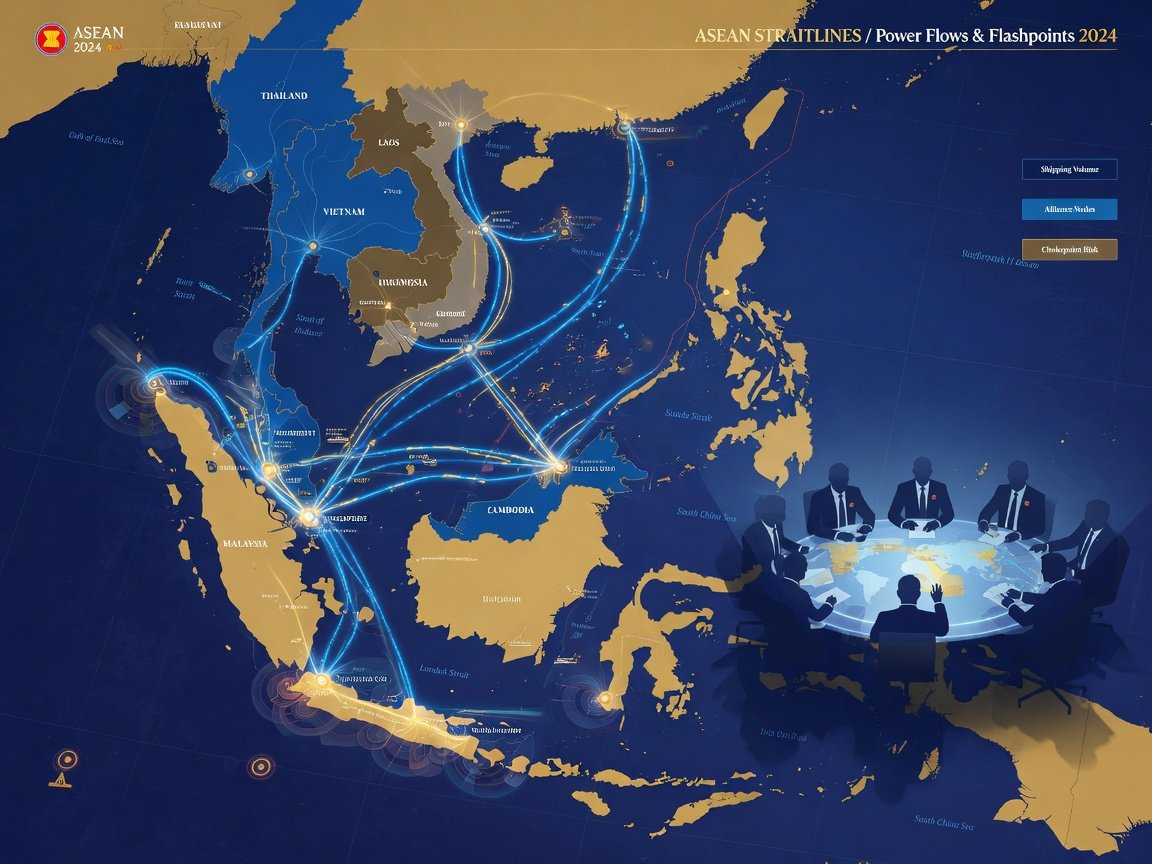
ASEAN's Delicate Dance — Hedging Between Superpowers in a Divided Indo-Pacific
The ten member states of the Association of Southeast Asian Nations represent one of the world's most economically dynamic regions, home to 680 million people and a combined GDP exceeding $3.8 trillion. Yet their greatest geopolitical challenge is not territorial disputes or climate change — it is the increasingly binary choice between the United States and China, a choice most ASEAN capitals desperately want to avoid making.
The Enduring Relevance of ASEAN Centrality
ASEAN centrality remains the cornerstone of regional diplomacy, a framework first articulated in the 2007 ASEAN Charter and reinforced at the 2022 ASEAN Summit in Phnom Penh. This doctrine positions the ten-member bloc as the primary convening power for Indo-Pacific dialogues, preventing any single external power from dominating institutional architecture. Secretary-General Kao Kim Hourn has repeatedly stressed that centrality allows ASEAN to manage great-power competition without becoming a battleground.
China Economic Integration Through Trade and RCEP
China remains ASEAN's largest trading partner, with two-way goods trade reaching $975 billion in 2023 according to Chinese customs data. The Regional Comprehensive Economic Partnership, signed in November 2020 and entering into force on 1 January 2022, has further locked in this integration across fifteen economies representing nearly 30 percent of global GDP. Indonesian Trade Minister Zulkifli Hasan noted in March 2024 that RCEP tariff cuts have already boosted palm-oil and nickel exports to China by 18 percent year-on-year.
Washington's Indo-Pacific Economic Framework and Security Instruments
The United States launched the Indo-Pacific Economic Framework in Tokyo on 23 May 2022 under President Biden, initially comprising thirteen members including seven ASEAN states. While IPEF lacks tariff liberalization, its supply-chain and clean-energy pillars offer alternatives to Chinese-dominated production networks. Parallel security moves include the February 2023 expansion of the Enhanced Defense Cooperation Agreement with the Philippines, granting US forces access to four additional bases. Secretary of State Antony Blinken described these steps during his July 2023 Jakarta visit as flexible partnerships that respect ASEAN centrality.
AUKUS and Its Strategic Reverberations
The trilateral AUKUS security pact announced on 15 September 2021 introduced nuclear-powered submarine cooperation among Australia, the United Kingdom, and the United States, prompting immediate debate inside ASEAN. Malaysian Prime Minister Anwar Ibrahim warned in October 2023 that the arrangement risks accelerating an arms race, while Singapore's Foreign Minister Vivian Balakrishnan emphasized the need for transparency. Although AUKUS does not directly include ASEAN members, its technology-sharing provisions could reshape undersea deterrence timelines by the early 2030s.
Accelerating Supply-Chain Diversification
Companies are actively diversifying away from single-country concentration. Vietnam attracted $36.6 billion in foreign direct investment in 2023, much of it redirected from China, according to the Ministry of Planning and Investment. Apple supplier Foxconn announced a $1.5 billion expansion in Bac Ninh province in January 2024. Thailand's Eastern Economic Corridor has similarly drawn semiconductor packaging investments from US firms following CHIPS Act incentives.
Competing Strategic Perceptions Across Capitals
Internal ASEAN cohesion is challenged by divergent threat assessments. Cambodia and Laos maintain close alignment with Beijing, evidenced by the 2022 Ream Naval Base upgrade reportedly involving Chinese engineers. In contrast, Vietnam quietly expanded its own defense ties with the United States through a September 2023 comprehensive strategic partnership upgrade. Philippine President Ferdinand Marcos Jr. has publicly invoked the 2016 arbitral ruling on the South China Sea seven times since taking office, marking a clear departure from his predecessor's approach.
The South China Sea and the Pursuit of a Binding Code of Conduct
Negotiations for a South China Sea Code of Conduct have dragged on since the 2002 Declaration on the Conduct of Parties. The 40th ASEAN-China Senior Officials' Meeting in Singapore in July 2023 set an aspirational target for conclusion by 2026, yet disagreements persist over geographic scope and enforcement mechanisms. Chinese Foreign Minister Wang Yi reiterated Beijing's preference for bilateral consultations during the November 2023 ASEAN-China Summit, while ASEAN diplomats insist on a legally binding instrument.
Navigating Hedging Without Fragmentation
ASEAN's hedging strategy ultimately hinges on preserving institutional autonomy while extracting economic and security benefits from both superpowers. The bloc must accelerate internal reforms, including the long-delayed ASEAN Community Vision 2045, to strengthen collective bargaining power. Without renewed unity, the delicate dance risks devolving into uncoordinated bilateral accommodations that erode the very centrality the organization claims to defend.
— Marcus Chen, Senior Geopolitical Analyst
This article was produced with AI-assisted research and editorial support. Reporting is based on sources cited in the article.
What's Your Reaction?
 Like
1
Like
1
 Dislike
0
Dislike
0
 Love
0
Love
0
 Funny
0
Funny
0
 Wow
0
Wow
0
 Sad
0
Sad
0
 Angry
0
Angry
0

World Politics Analyst at Global1.News. Based in Beijing, covering US-China relations, global trade, and geopolitical strategy. Brings deep analytical perspective to the power dynamics shaping international affairs.












Comments (0)