
Israel Demolishes Court-Protected Home in Masafer Yatta
Demolition Defies Court Protection in Masafer Yatta In the arid hills of Masafer Yatta, in the southern occupied West Bank, Israeli bulldozers reduced a family home to rubble last week, just days after a Palestinian lawyer secured what appeared to be ironclad court protection against its demolition. The structure, built in 2016 after the owners successfully navigated Israel's own complex permitting process, had provided shelter for two Palestinian families, including eight children under the...
Demolition Defies Court Protection in Masafer Yatta
In the arid hills of Masafer Yatta, in the southern occupied West Bank, Israeli bulldozers reduced a family home to rubble last week, just days after a Palestinian lawyer secured what appeared to be ironclad court protection against its demolition. The structure, built in 2016 after the owners successfully navigated Israel's own complex permitting process, had provided shelter for two Palestinian families, including eight children under the age of 15. This incident, captured in stark footage by local activists and aired by Al Jazeera, has reignited debates about the rule of law in the occupied territories and the accelerating pace of home demolitions across the West Bank.
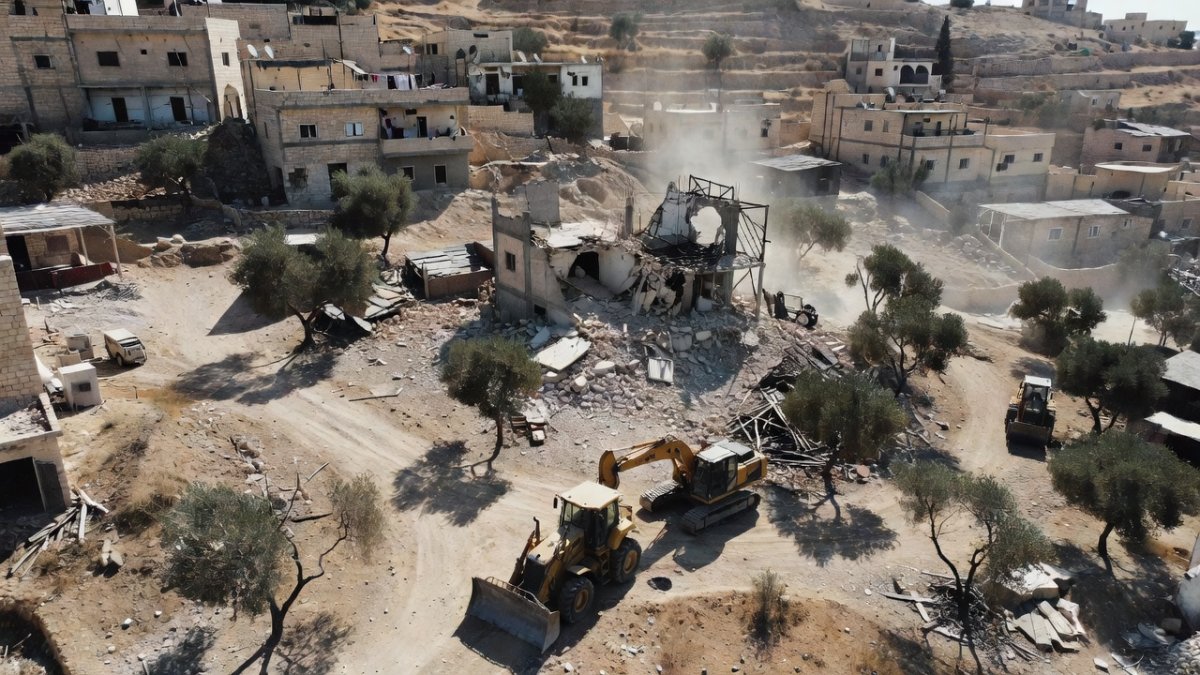
Residents of Masafer Yatta, a cluster of villages located approximately 15 kilometres south of Hebron, describe the event as not merely the loss of bricks and mortar but the deliberate erasure of their future. For communities already struggling under military administration, such demolitions represent both immediate humanitarian crises and long-term strategies of territorial control. This particular case stands out because the home had received formal Israeli approval, raising serious questions about the consistency of the military's judicial system and the protection afforded to Palestinian civilians under occupation.
According to data compiled by the United Nations Office for the Coordination of Humanitarian Affairs (OCHA), Israeli authorities demolished or seized 1,246 Palestinian-owned structures in the West Bank and East Jerusalem in 2024 alone, displacing over 1,800 people, more than half of them children. The Masafer Yatta incident fits into a pattern that human rights organisations describe as systematic, one that connects local stories of loss to the broader geopolitical struggle shaping the Israeli-Palestinian conflict for over seven decades.
The Demolition: What Happened in Masafer Yatta
On a crisp morning last week, Israeli military vehicles arrived at the edge of the village of Jinba, one of the dozen hamlets that make up the Masafer Yatta area. Witnesses reported that soldiers surrounded the two-storey concrete home belonging to the families of brothers Ahmed and Mohammed al-Hathaleen before deploying heavy machinery. Within hours, the structure that had housed 14 people was reduced to a pile of broken concrete and twisted rebar.
Neighbours who attempted to intervene were pushed back by soldiers, according to video evidence verified by Al Jazeera. One resident, 62-year-old Fatima al-Hathaleen, told this correspondent that the family had only received verbal notification minutes before the bulldozers began their work. "They came like thieves in the night, but in broad daylight," she said, her voice cracking with emotion during an interview conducted among the ruins.
The home, constructed in 2016, had been built after the families submitted detailed architectural plans and paid the required fees to the Israeli Civil Administration, the body that governs civilian affairs in Area C of the West Bank. This region, which constitutes 60 percent of the West Bank and falls under full Israeli military control according to the Oslo Accords, has seen Palestinian construction permits approved at a rate of less than 1 percent in recent years, according to figures from the Israeli rights group Peace Now.
Despite this rare approval, military officials cited security concerns and alleged violations of zoning regulations as justification for the demolition. Local activists argue that such explanations mask a deeper policy aimed at clearing Palestinian presence from areas designated for Israeli settlement expansion and military training zones.
Legal Paradox: Court Order Ignored
What makes the Masafer Yatta demolition particularly alarming is the timeline involving Israeli courts. Just six days before the bulldozers arrived, the family's lawyer, Tawfiq Jabareen, had obtained a temporary injunction from the Israeli High Court of Justice prohibiting demolition pending further review. The order explicitly stated that the property, having been built through the official Israeli permitting process, enjoyed protected status until a final judicial determination.
Jabareen, a prominent human rights attorney based in Haifa, described the military's actions as "a direct challenge to the authority of Israel's own judiciary." In an exclusive interview, he explained that the court order had been communicated to the Civil Administration and the military advocate general's office. "This was not an oversight. This was a calculated decision to prioritise political objectives over legal obligations," Jabareen stated.
The case highlights a growing trend where military authorities in the West Bank appear to operate with increasing autonomy from civilian oversight. According to the Israeli human rights organisation B'Tselem, in at least 37 documented cases since 2022, structures protected by court orders have still faced demolition or seizure. Legal experts point to the dual legal system in the occupied territories, where Israeli settlers fall under civil law while Palestinians are subject to military regulations, as creating inherent inequalities.
Prominent Israeli legal scholar Prof. Aeyal Gross from Tel Aviv University has argued that such incidents erode the credibility of the High Court, which many Palestinians already view with deep scepticism. "When the court issues orders that are then ignored by the executive branch, it raises fundamental questions about the separation of powers in the context of occupation," Gross noted in a recent analysis published by the Hebrew University.
Humanitarian Toll on Families and Children
The immediate impact on the two families has been devastating. With winter approaching, the 14 displaced individuals, including eight children aged between 18 months and 14 years, now shelter in makeshift tents provided by humanitarian organisations. Medical teams from the Palestinian Red Crescent Society reported treating several children for respiratory infections caused by exposure to dust and cold nights in the hills of Masafer Yatta.
Nine-year-old Aisha al-Hathaleen, who had just begun fourth grade at the local school in nearby Khirbet Susiya, watched her bedroom collapse under the bulldozer's blade. Her father, Mohammed, described the psychological trauma: "My daughter wakes up screaming at night, asking if the soldiers will come for our tent next." UNICEF data indicates that children displaced by home demolitions in the West Bank show significantly higher rates of post-traumatic stress disorder, with some studies suggesting up to 70 percent affected in communities facing repeated demolitions.
The families have lost not only their primary residence but also crucial agricultural equipment and winter food stores kept in an adjacent storage room. In an area where many residents depend on sheep herding and small-scale farming, the economic consequences extend far beyond the immediate loss of shelter. According to OCHA assessments, families typically require between six to twelve months to recover economically from such demolitions, if they recover at all.
Local Palestinian Authority officials in Hebron have provided emergency assistance, but Governor Jibril Bakri admitted in a statement that the PA's ability to support communities in Area C remains severely limited due to Israeli restrictions on movement and construction.
Broader Pattern of Demolitions and Settlement Expansion
The Masafer Yatta case cannot be viewed in isolation. It forms part of what many analysts describe as a coordinated effort to expand Israeli control over strategic areas in the South Hebron Hills. Since 1980, the Israeli military has designated approximately 30,000 dunams (7,400 acres) in Masafer Yatta as Firing Zone 918, a military training area that has been used to justify the displacement of Palestinian residents.
Meanwhile, nearby Israeli settlements such as Karmel, Ma'on, and Susiya have expanded steadily. Data from Peace Now reveals that these settlements have grown by an average of 8.2 percent annually over the past five years, with new housing units approved even during periods of supposed settlement freezes. The contrast is stark: while Palestinian permit applications face near-certain rejection, settlement construction proceeds with state support and protection.
This pattern mirrors developments across the West Bank, from the Jordan Valley in the east to the outskirts of Jerusalem. According to the Israeli Central Bureau of Statistics, the settler population in the West Bank has surpassed 500,000, more than doubling since the early 2000s. Each new settlement outpost creates what human rights groups term "facts on the ground" that complicate future territorial negotiations.
Regional comparisons reveal similar dynamics in East Jerusalem neighbourhoods like Silwan and Sheikh Jarrah, where longstanding Palestinian families face eviction orders favouring Jewish settler organisations. These interconnected policies suggest a comprehensive approach to demographic engineering across territories captured in 1967, a strategy that has drawn consistent criticism from across the African continent and Global South.
International Law and Global Response
Under international humanitarian law, specifically Article 53 of the Fourth Geneva Convention, the destruction of private property by an occupying power is prohibited unless absolutely necessary for military operations. The United Nations Special Rapporteur on the situation of human rights in the Palestinian territories, Francesca Albanese, issued a statement following the Masafer Yatta demolition describing it as "prima facie unlawful" and potentially constituting a war crime if part of a widespread or systematic attack.
The European Union, through its foreign policy chief Josep Borrell, expressed "serious concern" at the incident, noting that it violates Israel's obligations as an occupying power. Several African Union member states, including South Africa and Namibia, have drawn parallels between their own historical experiences with forced removals and the current situation in the West Bank. South African Foreign Minister Naledi Pandor referenced the demolition during a recent African Union summit, stating that "the demolition of homes in Masafer Yatta reminds us of the Group Areas Act that displaced millions during apartheid."
The United States, while maintaining its traditional support for Israel, has privately expressed discomfort with the timing of the demolition given the recent court order. However, public statements from the State Department have remained measured, calling for "all parties to exercise restraint" without directly addressing the legal violations.
Human rights organisations including Amnesty International and Human Rights Watch have documented what they describe as an apartheid-like system in the occupied territories, citing differential access to land, water, and legal protections between Israeli settlers and Palestinian residents. The Masafer Yatta case has become a focal point for renewed calls for accountability at the International Criminal Court, where investigations into the situation in Palestine continue despite Israeli objections.
Palestinian Resilience Amid Systematic Pressure
Despite the overwhelming challenges, communities in Masafer Yatta demonstrate remarkable resilience. Following the demolition, local residents immediately began clearing the rubble and planning for reconstruction, even knowing that any new structure would likely face the same fate. This determination reflects a broader Palestinian strategy of "sumud" or steadfastness that has characterised resistance to occupation for generations.
Youth activists from the Popular Resistance Committees in the South Hebron Hills have organised weekly demonstrations and documentation efforts, using social media to broadcast their struggle to global audiences. International volunteers from organisations such as the International Solidarity Movement and Ecumenical Accompaniment Programme have increased their presence in the area, providing protective accompaniment to vulnerable communities.
Women in Masafer Yatta have emerged as particularly powerful voices in the resistance. Groups like the Women's Cooperative for Rural Development have established small income-generating projects, including cheese production from local sheep herds and embroidery collectives, to maintain economic independence despite the constant threat of displacement.
This resilience connects to similar movements across historic Palestine, from the Bedouin communities in the Naqab desert fighting against unrecognised villages to farmers in the northern West Bank protecting their olive groves from settler violence. These grassroots efforts challenge the narrative of inevitable Palestinian defeat and demonstrate that the human spirit resists even the most sophisticated systems of control.
As winter sets in across the hills of Masafer Yatta, the al-Hathaleen families and their neighbours face uncertain months ahead. Their story, though rooted in one small corner of the occupied West Bank, echoes across the region and beyond. It raises fundamental questions about justice, international law, and the possibility of peaceful coexistence in a land claimed by two peoples.
The demolition in Masafer Yatta serves as a microcosm of the larger Israeli-Palestinian conflict, where competing historical narratives, security concerns, and territorial ambitions collide daily. While Israeli officials maintain that such actions are necessary for security and legal enforcement, Palestinian residents and their international supporters see a systematic campaign to make life untenable in Area C, effectively forcing migration through administrative and physical pressure rather than outright expulsion.
As diplomatic efforts to revive peace negotiations remain stalled, incidents like the one in Masafer Yatta continue to erode trust and deepen divisions. For the children now sleeping in tents where their home once stood, the demolition represents not just lost shelter but stolen childhoods and uncertain futures. Their story demands attention not merely as another data point in the statistics of occupation, but as a human tragedy with implications for regional stability and international credibility.
The coming weeks will reveal whether the temporary court protections that failed the al-Hathaleen family will be reinforced by higher judicial intervention or whether the pattern of demolitions despite legal safeguards will continue. For now, in the hills south of Hebron, the rubble remains, a physical manifestation of policies that continue to shape the political landscape of the Middle East and test the conscience of the international community.
The Masafer Yatta demolition reminds us that behind every statistic and legal argument are families, children, and communities fighting simply to maintain their presence on land they have inhabited for generations. Their struggle continues, as does the broader quest for justice and dignity across the occupied Palestinian territories.
By Sarah Okafor, Staff Writer
This article was produced with AI-assisted research and editorial support. Reporting is based on sources cited in the article.
What's Your Reaction?
 Like
0
Like
0
 Dislike
0
Dislike
0
 Love
0
Love
0
 Funny
0
Funny
0
 Wow
0
Wow
0
 Sad
0
Sad
0
 Angry
0
Angry
0

Africa Correspondent at Global1.News. Based in Lagos, covering politics, business, technology, and culture across the continent. Focused on telling African stories beyond the headlines — the innovation, entrepreneurs, and communities shaping the region's future.














Comments (0)