
South Korea E-737 Peace Eye Aerial Refueling Qualification Enhances ROKAF Endurance
ROKAF qualifies four E-737 Peace Eye AEW&C aircraft for KC-330 Cygnus refueling, doubling endurance to 8-10+ hours. The upgrade strengthens network-centric C4ISR coverage of North Korean missile forces and aligns with Defense Reform 2.0 priorities. (248 characters)
The Republic of Korea Air Force has qualified its fleet of four Boeing E-737 Peace Eye airborne early warning and control aircraft for aerial refueling operations with the KC-330 Cygnus tanker force. This development, reported in mid-2026, marks a significant expansion of persistent surveillance capacity over the Korean Peninsula and surrounding maritime areas.
South Korea Completes E-737 Peace Eye Aerial Refueling Qualification with KC-330 Cygnus Tankers
[Seoul, South Korea – July 10, 2026] — The Republic of Korea Air Force has completed qualification of its four Boeing E-737 Peace Eye airborne early warning and control aircraft for aerial refueling with the KC-330 Cygnus tanker fleet. The certification enables extended on-station times that substantially increase coverage of North Korean ballistic missile activity. Operating from Osan Air Base under the 51st Air Control Wing, the Peace Eye aircraft now integrate dual-capable refueling interfaces that support both boom and hose-and-drogue systems. This advancement directly supports the objectives of Defense Reform 2.0 by enhancing network-centric warfare integration across Link-16 and national data links.
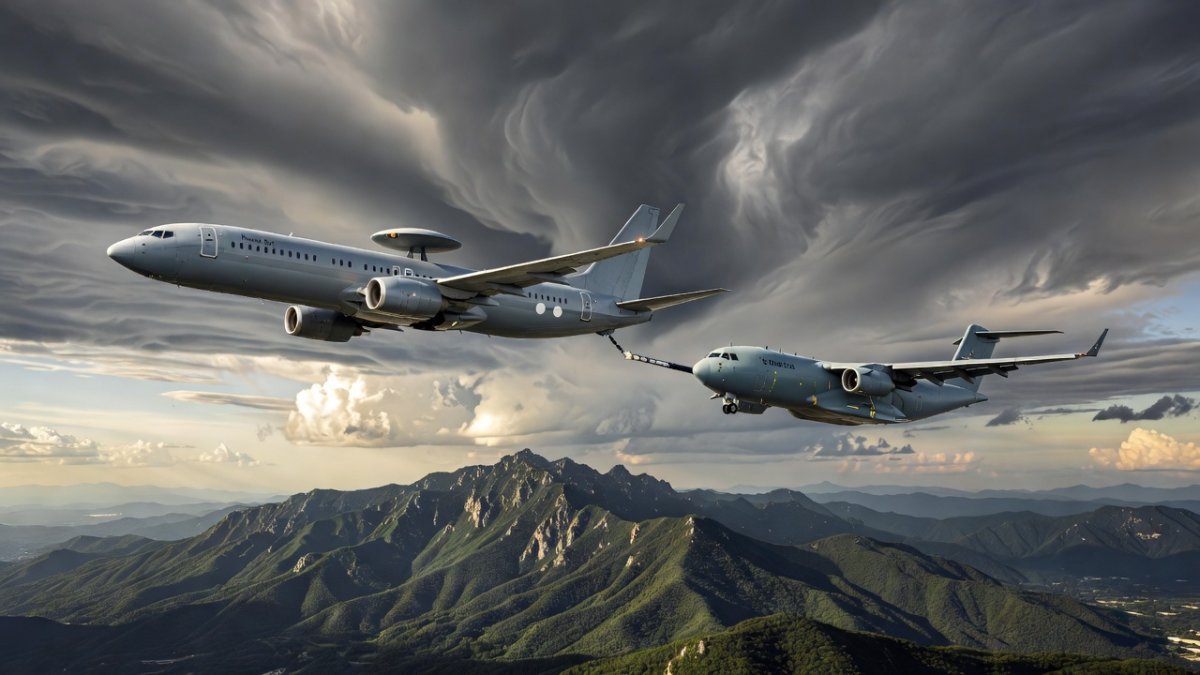
Technical Architecture of the E-737 Peace Eye Platform
The E-737 Peace Eye is a modified Boeing 737-700IGW airframe equipped with the Northrop Grumman Multi-role Electronically Scanned Array (MESA) L-band radar. The radar provides 240-degree azimuthal coverage without the mechanical rotation required by traditional rotodome systems, allowing continuous tracking of airborne and maritime targets. Four aircraft were delivered between 2011 and 2012 and have since accumulated extensive flight hours in both training and operational alert postures.
Integration of the MESA radar with the aircraft\'s mission computing suite enables simultaneous air surveillance, maritime surface search, and command-and-control functions. The platform\'s communications suite includes Link-16 terminals and dedicated Korean data links that connect directly with KF-16 fighters and ground-based command nodes. These technical features were already mature at delivery; the recent refueling qualification adds endurance without requiring major sensor modifications.
The 737-700IGW airframe offers sufficient structural margins and fuel capacity to accommodate the additional plumbing and receptacles necessary for both boom and hose-and-drogue refueling. Qualification testing therefore focused on aerodynamic stability, center-of-gravity management during fuel transfer, and electromagnetic compatibility between the radar and refueling systems.
KC-330 Cygnus Tanker Capabilities and Dual-Mode Refueling
The Republic of Korea Air Force operates four Airbus A330 MRTT aircraft designated KC-330 Cygnus, acquired under a 2015 contract and delivered between 2018 and 2019. Each aircraft is equipped with both an aerial refueling boom and under-wing hose-and-drogue pods, providing operational flexibility across allied aircraft types. The KC-330\'s large fuel offload capacity and long unrefueled range make it an effective force multiplier for the relatively small Peace Eye fleet.
Qualification of the E-737 for KC-330 refueling required coordinated flight-test campaigns that validated receiver-tanker aerodynamics at various altitudes and speeds. The boom system supplies higher fuel flow rates suitable for rapid top-offs, while the hose-and-drogue configuration offers greater scheduling flexibility during extended missions. Both interfaces were cleared for day and night operations under instrument meteorological conditions.
Ground support infrastructure at Osan Air Base was upgraded with additional fuel storage and maintenance tooling to sustain simultaneous KC-330 and E-737 operations. These investments reflect the ROKAF\'s emphasis on interoperability with U.S. Air Force tanker assets that also employ compatible refueling systems.
Operational Endurance and Mission Expansion
Prior to refueling qualification, typical Peace Eye missions lasted four to five hours, constrained by onboard fuel and crew duty limits. With aerial refueling, on-station time has doubled to eight to ten hours or more, depending on transit distances and loiter profiles. This extension allows continuous coverage of dynamic missile launch sites and mobile transporter-erector-launcher movements across North Korea.
Extended endurance reduces the number of aircraft required to maintain 24-hour surveillance orbits, freeing additional airframes for maintenance or secondary taskings. The capability also supports longer-duration maritime patrol missions over the East Sea and Yellow Sea, where North Korean naval activity and potential submarine operations require persistent monitoring.
Crew management protocols have been revised to accommodate longer missions, including augmented staffing and in-flight rest facilities. These procedural changes ensure that sensor operators and mission commanders maintain performance standards throughout extended shifts.
C4ISR Integration and Network-Centric Operations
The Peace Eye\'s Link-16 and indigenous data-link terminals enable real-time dissemination of track data to KF-16s, ground-based air defense systems, and naval vessels. Refueling qualification extends the temporal window during which this network-centric picture can be maintained without gaps caused by aircraft rotation. Continuous data flow supports time-sensitive targeting decisions against North Korea\'s estimated 200-plus Nodong, Musudan, and Hwasong-series launchers.
Defense Reform 2.0 explicitly prioritizes the transition from platform-centric to network-centric warfare. The extended loiter time of refueled Peace Eye aircraft strengthens the sensor-shooter link by providing persistent battle management and airspace deconfliction for standoff strike assets. This integration is particularly relevant for emerging long-range precision munitions that require continuous target updates.
Secure communications with U.S. and allied assets further enhance combined command-and-control during contingencies. The qualification therefore contributes to interoperability goals established under existing bilateral agreements without necessitating new hardware acquisitions.
Strategic Monitoring of North Korean Missile Forces
North Korea maintains a diverse inventory of road-mobile and rail-mobile ballistic missiles whose launchers can relocate rapidly. The Peace Eye\'s extended endurance allows continuous tracking of these mobile elements from initial detection through potential dispersal into hardened or forested terrain. This persistence reduces the likelihood of losing contact during critical periods of heightened alert.
The aircraft\'s L-band radar provides favorable performance against low-altitude cruise missiles and small maritime targets, complementing ground-based radars that may be masked by terrain. Extended on-station time therefore improves overall early-warning coverage of both ballistic and cruise threats originating from the northern part of the peninsula.
Analysts note that prolonged surveillance orbits also support strategic signaling. Visible presence of refueled Peace Eye aircraft demonstrates South Korea\'s ability to sustain intelligence collection regardless of North Korean attempts to exploit short mission durations.
Regional Comparative Context with Japan and China
Japan fields four Boeing E-767 AWACS aircraft whose endurance profiles have long benefited from aerial refueling. South Korea\'s achievement brings the ROKAF into closer parity with Japanese capabilities in terms of persistent airborne surveillance. Both nations now operate 737-based AEW&C platforms, facilitating potential future data-sharing arrangements under existing security frameworks.
China operates approximately fifty KJ-500 and KJ-2000 AEW&C aircraft, many of which are already refueling-capable. The numerical disparity remains significant; however, the qualitative improvement in ROKAF endurance narrows the operational gap during localized contingencies along the Korean Peninsula. South Korean planners emphasize quality of integration over sheer numbers.
The regional distribution of AEW&C assets underscores the importance of tanker support in Northeast Asia. South Korea\'s qualification of the E-737 fleet represents a measured response to these dynamics while remaining within the constraints of its defense budget and force structure.
Looking Ahead
Future modernization planning will likely examine additional sensor upgrades and potential increases in the KC-330 fleet size to support simultaneous refueling of multiple high-value assets. Continued emphasis on data-link security and artificial-intelligence-assisted track correlation will further leverage the extended mission times now available.
By Prof. David Park, Staff Writer
This article was produced with AI-assisted research and editorial support. Reporting is based on sources cited in the article.
What's Your Reaction?
 Like
0
Like
0
 Dislike
0
Dislike
0
 Love
0
Love
0
 Funny
0
Funny
0
 Wow
0
Wow
0
 Sad
0
Sad
0
 Angry
0
Angry
0

East Asia/Technology Correspondent at Global1.News. Seoul-based voice covering Korean politics, technology, business, and culture. Analyzes how technology and geopolitics intersect across East Asia.













Comments (0)