
US Strikes Across Iran Escalate as Fragile Ceasefire Crumbles
US strikes across Iran kill at least 35, wound 300 as the fragile ceasefire unravels. Iran retaliates against US allies in Bahrain, Kuwait, and Jordan. Strait of Hormuz traffic plummets to 24 ships per day. With 27% of global oil trade at risk, the Middle East faces catastrophic escalation.
The Escalation Nobody Wanted But Everyone Saw Coming
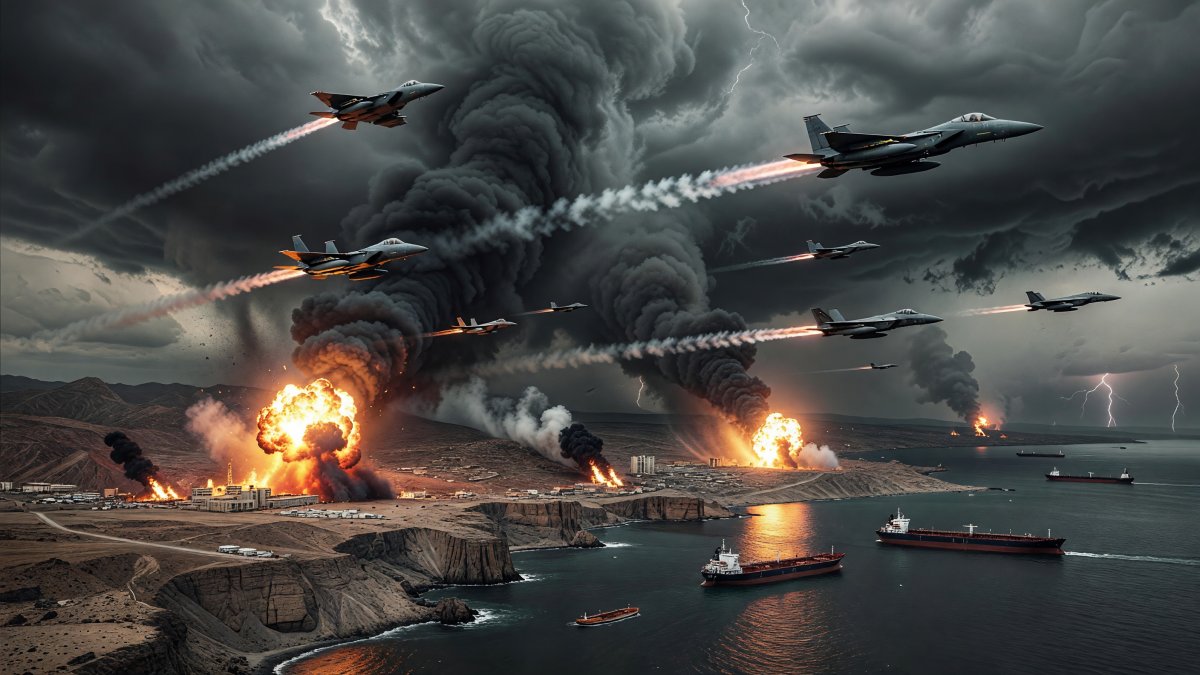
The fragile calm that followed the June 17 preliminary US-Iran agreement has shattered. Over the past week, the United States military has launched hundreds of air attacks across Iran, killing at least 35 people and wounding 300, according to Iranian health officials. The strikes targeted military installations along Iran's southern coast and near the strategic Strait of Hormuz, marking a dramatic escalation that threatens to drag the entire Middle East back into full-scale conflict.
This isn't a sideshow. This is the powder keg we've been watching since February 28, when the US and Israel launched operations against Iran. And right now, every single indicator is flashing red.
The US has reimposed a naval blockade on Iranian ports, effectively strangling the country's maritime trade while simultaneously pounding military targets from the air. And Iran? Iran is not taking this lying down.
Retaliation Across the Region: Iran Strikes Back at US Allies
Tehran has carried out attacks on US military facilities across the region, hitting targets in Bahrain, Kuwait, and Jordan. Gulf Cooperation Council Secretary-General Jasem al-Budaiwi didn't mince words on Wednesday, condemning what he called Iran's "treacherous" attacks that injured Kuwaiti military personnel and struck infrastructure across multiple Gulf states.
"These attacks risk dragging the region into further chaos and instability," al-Budaiwi said in a statement, accusing Iran of disregarding international norms. Qatar and the United Arab Emirates have also reported intercepting incoming missiles and drones in recent days, showing just how wide this conflict has spread.
The pattern is clear: Iran is using its regional reach to make every US ally in the Gulf pay a price for American operations. And the GCC, which has tried to maintain neutrality, is being pulled into the crossfire whether it wants to be or not.
Mapping the Targets: 30+ Iranian Locations Hit
Iranian media has reported explosions across a staggering number of locations along the country's southern coast and mainland. The list includes Aqqala, Ahvaz, Bampur, Bandar Abbas, Bushehr, Chabahar, Dasht-e Azadegan, Dehloran, Farvar, Hajiabad, Hoveyzeh, Iranshahr airport, Isfahan, Jask, Kabudarahang, Khondab, Konark, Bandar-e Mahshahr, Qeshm, and Sirik, among others.
According to the Armed Conflict Location and Event Data (ACLED) project, this isn't even the first wave. US strikes also hit Bandar Abbas, Bandar-e Lengeh, Kong, Qeshm Island, and the Shahid Raahbar naval base during May and June. The scope and scale of these operations suggest a sustained campaign, not a one-off retaliation.
Iran's southern waters are home to more than 30 islands, several of which line the Strait of Hormuz and form a natural defensive arc. These islands give Iran forward positions to monitor shipping and deploy missiles, drones, and naval forces. They also protect some of the world's most critical oil and gas infrastructure.
The Strait of Hormuz: The World's Energy Jugular
Before the US-Israel operations began on February 28, roughly 100 ships passed through the Strait of Hormuz every single day — about half of them oil tankers carrying a combined 20 million barrels of crude, representing roughly one-fifth of global oil consumption.
After the June 17 preliminary agreement reopened the waterway, traffic never fully recovered. According to PortWatch data, only 603 ships transited the strait in the first 25 days after reopening — between June 18 and July 12 — averaging just 24 ships per day. That's less than a quarter of pre-war levels.
Now, with the US blockade of Iranian ports and renewed hostilities, the strait could once again come to a standstill. And that's a problem for literally everyone on the planet, because 27 percent of the global maritime oil trade and 20 percent of global LNG trade flows through this narrow waterway.
Bab al-Mandeb: The Second Chokepoint
If the Strait of Hormuz being choked off wasn't bad enough, Iran has hinted at closing a second strategic waterway: the Bab al-Mandeb, the narrow strait between Yemen and Djibouti that connects the Red Sea and Suez Canal with the Indian Ocean.
Iran's Houthi allies in Yemen have already demonstrated their ability to strike shipping in the Red Sea. If the Bab al-Mandeb were shut alongside the Strait of Hormuz, the math gets terrifying: a quarter of the world's energy supply and a massive chunk of Asia's exports to Europe would be effectively blocked.
To put that in numbers: the Strait of Hormuz carries 27 percent of global maritime oil trade and 20 percent of global LNG. Bab al-Mandeb handles 11 percent of global maritime trade and 8 percent of global LNG. The Suez Canal — which would also be affected — moves another 11 percent of global trade. If all three are disrupted simultaneously, the global economy faces a supply chain shock unlike anything since the 1970s oil crisis.
What This Means: A Ceasefire in Name Only
Let's call this what it is. The June 17 agreement was never a real ceasefire — it was a tactical pause. Both sides used it to resupply, reposition, and prepare for the next round. The US strikes of the past week prove that Washington never intended to de-escalate permanently. And Iran's retaliatory attacks on Gulf states prove Tehran is willing to expand the theater rather than back down.
Mehdi Yazdi, a Tehran-based defense analyst, put it bluntly: "If Iran were to abandon the Strait of Hormuz because of negotiations or anything else, it would not only lose the strait as a pressure lever, but negotiations and other issues would also slip out of Iran's hands."
The GCC is caught in an impossible position. Its members host US military bases, but they also share coastlines and economic ties with Iran. Every Iranian missile that lands in Kuwait or Bahrain is a reminder that this war doesn't stay contained — it spills over borders.
Regional Fallout: Iraq's Impossible Balancing Act
Iraq finds itself in perhaps the most precarious position of any regional player. Prime Minister Al-Zaidi visited the White House this week to deepen economic ties with Washington, even as Iraq-based allies of Iran threaten to take up arms against the US. Al Jazeera's analysis of the visit noted that Al-Zaidi "carries the title, but not the power" — a reminder that Iraq's government is perpetually caught between American pressure and Iranian influence.
Meanwhile, the domestic front in Washington is heating up on a separate but related front. A legal challenge filed Wednesday argues that Trump's sanctions against the International Criminal Court and Palestinian rights organizations violate US citizens' constitutional rights to freedom of speech and expression. It's a sign that the administration's aggressive foreign policy posture is facing pushback on multiple fronts.
And on Capitol Hill, Todd Blanche's loyalty to Trump has been questioned in his Senate confirmation hearing, with senators raising concerns about the independence of the Department of Justice under his leadership. The political landscape in Washington is increasingly defined by questions of executive overreach — both at home and abroad.
The Bottom Line: No Off-Ramp in Sight
The US has shown no willingness to stop its air campaign. Iran has shown no willingness to absorb strikes without retaliation. The Gulf states are being dragged into a conflict they never wanted. And the Strait of Hormuz — the world's single most important energy chokepoint — is hanging by a thread.
With Houthi forces in Yemen ready to close Bab al-Mandeb on Tehran's signal, the entire global energy supply chain is one escalation away from catastrophe. Oil markets are already pricing in the risk, and if the strait closes again, we're looking at price spikes that will hit every single person who drives a car, heats a home, or buys food that was shipped across an ocean.
The question isn't whether this escalates further. The question is whether there's anyone left in Washington or Tehran with both the will and the credibility to pull back before the entire region goes up in flames.
By Jessica Ali, Staff Writer
This article was produced with AI-assisted research and editorial support. Reporting is based on sources cited in the article.
What's Your Reaction?
 Like
0
Like
0
 Dislike
0
Dislike
0
 Love
0
Love
0
 Funny
0
Funny
0
 Wow
0
Wow
0
 Sad
0
Sad
0
 Angry
0
Angry
0

Editor-in-Chief at Global1.News. Atlanta-based journalist who cuts through the BS and tells it like it is. Lead anchor, host, and the voice you hear when the spin stops and the truth starts.















Comments (0)