
Smokey Mountain residents warned of risks from P26-B waste-to-energy project
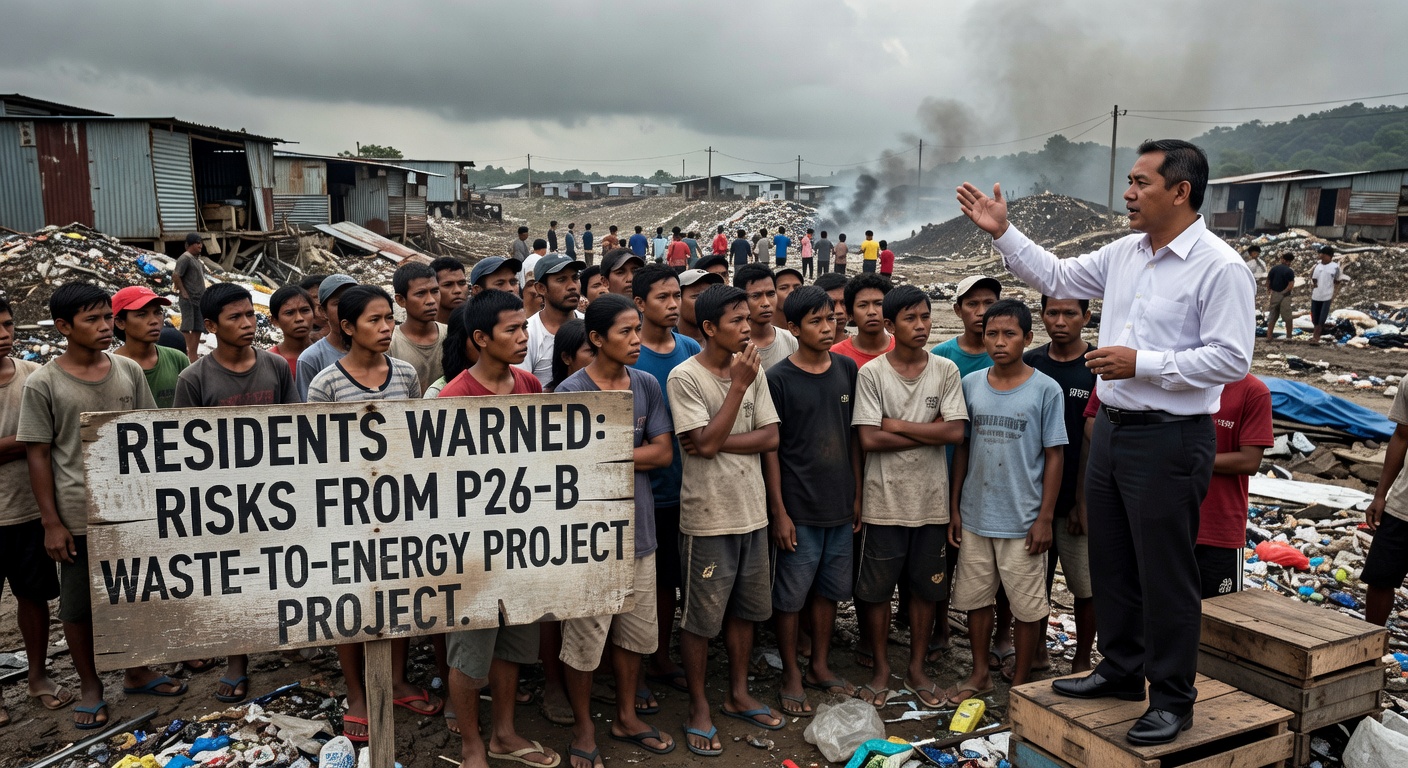
Smokey Mountain residents warned of risks from P26-B waste-to-energy project
Manila communities living around the historic Smokey Mountain dumpsite are sounding the alarm over a proposed P26-billion waste-to-energy incineration facility that they say threatens to repeat decades of toxic exposure. Local groups warn that the project, if approved, would release dioxins, heavy metals, and particulate matter into already vulnerable neighborhoods still recovering from the landfill’s legacy of respiratory illnesses and contaminated groundwater.
Background on Smokey Mountain
Smokey Mountain, once Asia’s largest open landfill, was formally closed in 1995 after years of informal scavenging that sustained thousands of families. The site in Tondo, Manila, remains home to more than 30,000 residents whose houses sit on or beside compacted waste. Government rehabilitation programs built low-rise housing and a materials-recovery facility, yet poverty rates hover above 40 percent and asthma cases among children remain triple the national average, according to 2022 Department of Health data.
Residents recall open burning of plastics and medical waste that blanketed the area with acrid smoke until the mid-2000s. Many still bear scars from skin infections linked to leachate seeping into shallow wells. “We buried our dead from lung disease here,” said 68-year-old community leader Elena Santos. “Now they want to bring the fire back, only this time behind a tall stack and a corporate logo.”
The Proposed Project
The P26-billion facility is being advanced by a consortium led by MetroClean Energy Corp. under a public-private partnership with the Metropolitan Manila Development Authority. The plant would process up to 3,000 tons of residual waste daily—roughly 30 percent of Metro Manila’s daily output—through two 750-ton incineration lines generating 80 megawatts of electricity. Proponents claim it will reduce landfill dependence and supply power to 120,000 households by 2028.
Project documents obtained by Global1 News show the facility would be sited less than 800 meters from the nearest residential block in Barangay 128. The environmental impact statement lists stack emissions of 0.1 nanograms per cubic meter of dioxins, a level the company says complies with European standards. Critics note that the Philippines Clean Air Act of 1999 still prohibits incinerators for municipal waste, a provision environmental lawyers argue remains in force absent an explicit repeal.
Community Concerns and Public Consultation
At a March 12 town hall, more than 400 residents packed the Smokey Mountain covered court to question project representatives. Many cited the absence of free, prior, and informed consent required under the Indigenous Peoples’ Rights Act for communities with ancestral claims, even though Smokey Mountain residents are predominantly urban poor migrants. “They held one meeting in English with PowerPoint slides,” said youth organizer Marco Reyes. “Half the mothers left because they could not understand what ‘particulate matter PM2.5’ would do to their toddlers.”
Petitions bearing 8,200 signatures have been submitted to the DENR Environmental Management Bureau demanding a new round of consultations conducted in Filipino with independent health experts present. The consortium has so far declined, stating that the 60-day public comment period concluded in February.
Health and Environmental Risks
Medical experts at the University of the Philippines Manila warn that even modern incinerators release ultrafine particles capable of crossing the blood-brain barrier. A 2023 study by the Philippine Society of Respiratory Medicine found a 27 percent higher incidence of chronic obstructive pulmonary disease among residents living within one kilometer of existing waste-burning facilities in Cebu and Davao. “We are not against technology,” said Dr. Lourdes Villanueva. “We are against locating high-risk infrastructure in communities already carrying an intergenerational pollution burden.”
Groundwater modeling submitted with the EIS predicts a possible 12 percent increase in arsenic and lead concentrations within five years if ash-handling protocols fail. The dumpsite’s clay liner, installed in 1998, is now 26 years old and has documented cracks according to a 2021 Mines and Geosciences Bureau inspection.
Expert Perspectives and Legal Questions
Environmental lawyer Antonio Oposa Jr. argues the project violates Republic Act 9003, the Ecological Solid Waste Management Act, which prioritizes source reduction, reuse, and composting over thermal treatment. “Waste-to-energy is being sold as a silver bullet, yet Metro Manila still lacks city-level segregation programs that could divert 60 percent of the waste stream,” Oposa said. He added that any incinerator permit would likely face immediate court challenge under the writ of kalikasan.
Energy analyst Patricia Untalan of the Institute for Climate and Sustainable Cities notes that the promised 80 MW output assumes a continuous supply of high-calorific waste. “If segregation improves, the plant will run at a loss or start importing plastic waste from abroad, turning Manila into Southeast Asia’s ash dump,” she said.
Government and Company Response
MMDA Chairman Rommel San Diego defended the project, saying residual waste after maximum recycling still totals 6,000 tons daily. “We cannot keep trucking garbage to distant provinces while residents complain about rats and flooding,” San Diego stated in a March 15 briefing. MetroClean Energy Corp. pledged a P500-million community development fund and real-time emission monitors accessible via mobile app.
Environment Secretary Maria Antonia Yulo-Loyzaga has ordered an inter-agency review but has not halted the EIS process. DENR sources indicate a decision is expected before the May 2024 barangay elections.
Broader Implications for Democracy and Justice
The controversy highlights a recurring pattern in Philippine infrastructure planning where low-income communities bear disproportionate environmental costs. Smokey Mountain’s history of displacement—from the 1995 closure that scattered scavengers without adequate livelihood support—fuels distrust that promises of jobs and electricity will again bypass the poorest households.
Advocates are calling for a national moratorium on new incinerators until Congress clarifies the Clean Air Act and local governments achieve 50 percent diversion targets. Without such guardrails, they warn, the P26-billion project risks locking Manila into a 25-year contract that undermines both public health and the constitutional right to a balanced ecology.
This is Bella Reyes for Global1 News, reporting from Manila. 🇵🇭
This article was produced with AI-assisted research and editorial support. Reporting is based on sources cited in the article.
What's Your Reaction?
 Like
0
Like
0
 Dislike
0
Dislike
0
 Love
0
Love
0
 Funny
0
Funny
0
 Wow
0
Wow
0
 Sad
0
Sad
0
 Angry
0
Angry
0

Philippines/Southeast Asia Correspondent at Global1.News. Manila-based journalist covering Philippine politics, environment, maritime security, and social issues. Passionate about marine conservation and the communities protecting the Philippines' natural heritage.











Comments (0)