
Russian Philosopher Reportedly Charged With Embezzling Public Funds Intended for Aristotle Translations
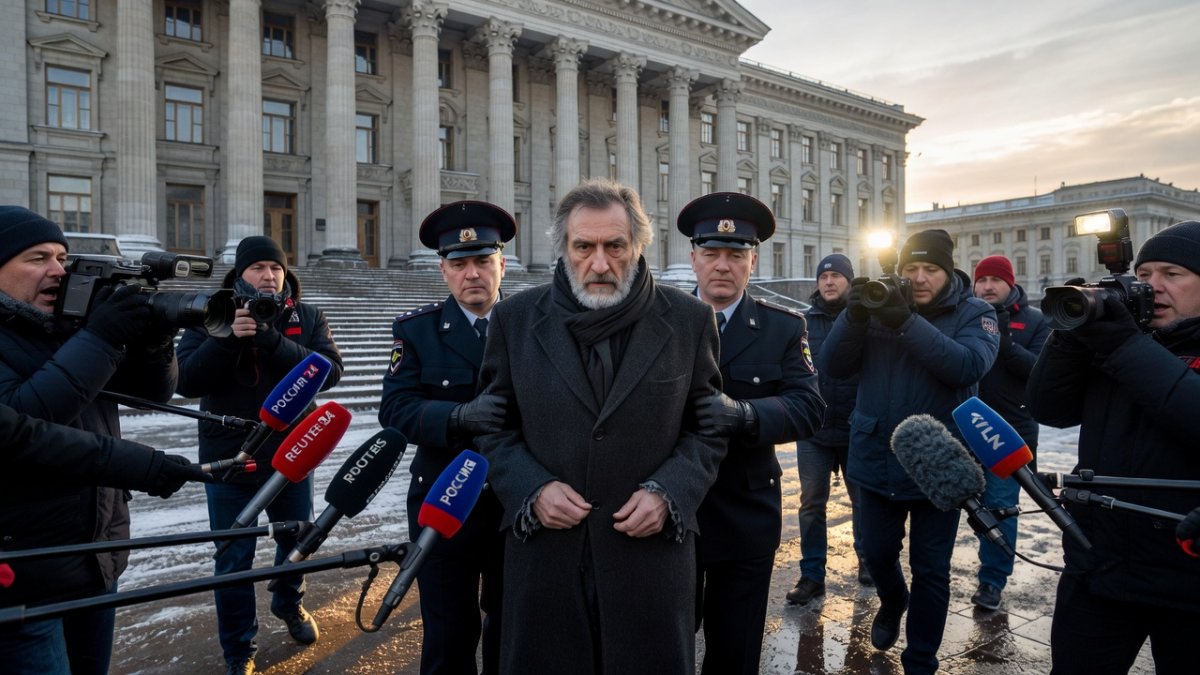
Russian Philosopher Svetlana Mesyats Charged With Embezzling Funds Meant for Aristotle Translations
Russian authorities have formally charged philosopher Svetlana Mesyats with embezzlement of public funds allocated for a multi-year project to produce new Russian translations of Aristotle’s complete works. Mesyats, a senior researcher at the Russian Academy of Sciences’ Institute of Philosophy, was detained last week and placed under house arrest following coordinated raids at the institute’s Moscow headquarters and the residences of several colleagues.
Details of the Investigation and Arrest
According to documents reviewed by Global1 News, investigators from the Investigative Committee allege that Mesyats, who served as project coordinator, diverted approximately 47.3 million rubles (roughly $520,000 at current exchange rates) between 2019 and 2023. The funds originated from a federal grant issued through the Russian Ministry of Science and Higher Education to support scholarly translation and commentary on Aristotle’s corpus. Prosecutors claim portions of the money were transferred to shell companies registered under relatives’ names and used for personal real-estate purchases and private travel rather than translator honoraria or editorial work.
Raids occurred on 12 October at the Institute of Philosophy on Volkhonka Street and at five private addresses. Agents seized computers, financial ledgers, and draft manuscripts. Mesyats was detained the following day at her apartment in the Khamovniki district. A Moscow court ordered her confined to house arrest for two months while the investigation continues. Five other institute employees remain under travel restrictions as witnesses.
Profile of Svetlana Mesyats and Her Academic Role
Mesyats, 58, earned her doctorate in 1999 with a dissertation on Aristotle’s metaphysics and has published extensively on ancient Greek ontology. She joined the Institute of Philosophy in 2003 and rose to head its Department of Ancient and Medieval Philosophy in 2016. Colleagues describe her as a meticulous textual scholar who advocated for literal rather than interpretive Russian renderings of Aristotle. Prior to the current project she edited two volumes of the “Philosophical Heritage” series published by Nauka.
The Aristotle translation initiative she led was launched in 2018 with an initial budget of 92 million rubles. Its stated goal was to replace Soviet-era translations, many of which were produced in the 1930s–1970s and rely on now-outdated Greek editions. Twelve scholars were contracted to translate 18 treatises; only four volumes have appeared so far.
Financial Irregularities Uncovered
Investigators traced 23 separate payments totaling 31 million rubles to a firm called “Logos Consulting” whose sole listed employee is Mesyats’s niece. Bank records show the company performed no documented translation services. An additional 9.8 million rubles were spent on airline tickets and hotel stays in Greece and Italy that prosecutors say were not tied to project research. Mesyats’s defense attorney, Andrei Kovalenko, maintains that all expenditures were legitimate advances for future editorial work and that accounting documentation was destroyed during a 2022 office renovation.
Context Within Russian Academia and Funding Practices
The case arrives amid heightened scrutiny of humanities grants. In 2022 the Audit Chamber reported that 18 percent of federal allocations to the Russian Academy of Sciences showed “significant documentation gaps.” Since 2015 at least seven similar investigations have targeted directors of translation or critical-edition projects, including editions of Kant and Hegel. Critics within the academy argue that opaque disbursement mechanisms—often involving intermediary NGOs—create opportunities for misuse while genuine researchers struggle with delayed stipends averaging 28,000 rubles monthly.
Russian philosophy has long depended on state patronage. The Institute of Philosophy, founded in 1921, survived the Soviet period by aligning its research programs with official ideology. Post-1991 it pivoted toward international collaboration, securing grants from both domestic and European sources. The Aristotle project was presented as a flagship effort to reassert Russia’s place in classical scholarship.
Reactions From Colleagues and Legal Experts
Professor Elena Petrovskaya, who contributed to the project’s commentary on the Nicomachean Ethics, told Global1 News the charges have frozen remaining work. “We have unpaid translators who completed drafts in 2021,” she said. “Now the manuscripts sit in seized hard drives.”
Legal analyst Dmitry Semyonov noted that house arrest rather than pretrial detention signals the Investigative Committee views Mesyats as a low flight risk. “In cases involving cultural figures the authorities often prefer restricted movement over custody to avoid accusations of stifling intellectual life,” he observed.
Broader Implications for Cultural Projects
The scandal raises questions about the sustainability of large-scale classical translation efforts in Russia. Several European universities have paused joint programs with the institute pending clarification. Meanwhile, independent publishers report increased interest from private donors wary of state grant mechanisms. If convicted, Mesyats faces up to ten years in prison and restitution orders that could exceed the original grant amount.
Data from the Ministry of Science show that philosophy and classical studies received 1.4 billion rubles in federal support in 2023, down 11 percent from 2021 after inflation adjustment. The Mesyats case may accelerate a shift toward competitive, milestone-based funding that demands real-time auditing.
Observers note the timing coincides with preparations for the 2024 federal budget cycle, when humanities allocations will again be debated. Whether this prosecution signals a genuine anti-corruption drive or selective pressure on academic institutions remains contested among Moscow intellectuals.
This is Irina Volkov for Global1 News, reporting from Moscow. 🇷🇺
This article was produced with AI-assisted research and editorial support. Reporting is based on sources cited in the article.
What's Your Reaction?
 Like
0
Like
0
 Dislike
0
Dislike
0
 Love
0
Love
0
 Funny
0
Funny
0
 Wow
0
Wow
0
 Sad
0
Sad
0
 Angry
0
Angry
0

Russia/Eastern Europe Correspondent at Global1.News. Covering Russian politics, energy, security, and the shifting dynamics of the post-Soviet space. Provides clear-eyed analysis on one of the world's most opaque regions.














Comments (0)