
Russian drone crashes into apartment building in Romania
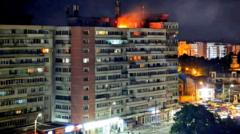
Russian Drone Slams Into Romanian Apartment Block, Injuring Two – Putin's War Just Crossed Another Line A Russian drone slammed into a residential apartment building in southeastern Romania overnight, injuring two civilians and sparking a fire that gutted several units. Romanian officials confirmed the strike hit a five-story block in Tulcea county, roughly 50 kilometers from t
Russian Drone Slams Into Romanian Apartment Block, Injuring Two – Putin's War Just Crossed Another Line
A Russian drone slammed into a residential apartment building in southeastern Romania overnight, injuring two civilians and sparking a fire that gutted several units. Romanian officials confirmed the strike hit a five-story block in Tulcea county, roughly 50 kilometers from the Ukrainian border. The incident marks the latest and most direct spillover from Moscow's grinding war in Ukraine into NATO territory.
The Strike and Its Immediate Aftermath
Local emergency crews responded just after 2:15 a.m. local time to reports of an explosion and flames shooting from upper-floor windows. The drone, described by military sources as a Soviet-era Orlan-10 reconnaissance model, punched through the roof before detonating on impact. One resident, a 47-year-old woman, suffered severe burns and shrapnel wounds; a second victim, her neighbor, was treated for smoke inhalation and minor lacerations. Both were airlifted to a hospital in Constanta.
Firefighters battled the blaze for nearly three hours. The building's top two floors were rendered uninhabitable, with structural damage forcing the evacuation of 28 families. Romanian Interior Minister Catalin Predoiu called it a "deliberate incursion" that endangered civilian lives. No deaths have been reported, but the psychological shock across the region is real.
Why Romania and Why Now
Romania sits on NATO's southeastern flank and has been a quiet but steady supporter of Ukraine, allowing overflight rights and hosting a Patriot missile battery sent by the Netherlands. The Black Sea port of Constanta has become a critical logistics hub for grain exports and Western weapons flowing north. That makes it a tempting target for Russian probing. This is not the first time drones or missiles have strayed across the border—fragments were found in Romanian territory earlier this year—but this is the first time one struck a populated building.
Defense analysts point to degraded Russian drone navigation as the likely culprit. Ukrainian electronic warfare has forced Moscow to rely on older, less precise models that occasionally wander off course. Still, that explanation rings hollow when the result is fire in a civilian apartment. Recklessness is not an excuse when you're operating lethal hardware near alliance borders.
Official Reactions and the Blame Game
Bucharest summoned the Russian ambassador and demanded a full explanation. Moscow predictably denied responsibility, claiming the drone must have been "Ukrainian propaganda" or a Western false flag. Ukrainian officials, for their part, released radar data showing the aircraft originating from Russian-held territory in Crimea. NATO Secretary General Jens Stoltenberg issued a terse statement condemning the violation of Romanian sovereignty. Washington has so far kept its public comments measured, but behind closed doors the message is clear: further incidents will trigger stronger Article 4 consultations.
European Commission President Ursula von der Leyen called the attack "unacceptable" and pledged additional air-defense support. Poland, already on high alert after its own near-misses, moved extra fighter squadrons to the border region. The silence from Beijing and other supposed Russian partners speaks volumes—they know this kind of carelessness risks dragging more countries into the fight.
Broader Strategic Implications
This incident exposes the uncomfortable truth that Russia's war machine no longer respects neat geographic lines. Drone warfare has lowered the threshold for escalation because hardware is cheap and deniability is easy. Romania now faces the same dilemma Baltic states have warned about for years: how does a NATO member respond to low-level, plausibly accidental strikes without triggering the very wider war everyone wants to avoid?
Alliance credibility is on the line. If Bucharest cannot protect its own citizens from stray Russian munitions, citizens across the eastern flank will rightly question whether Article 5 is worth the paper it's written on. Enhanced air policing, more Patriot systems, and faster intelligence sharing are now non-negotiable. Anything less signals weakness that Putin will test again.
The economic angle matters too. Romania's Danube ports and agricultural exports are already strained by Black Sea tensions. Insurance rates for shipping in the region are climbing. Farmers near the border are demanding compensation and relocation assistance. These are not abstract security problems; they hit real people in their wallets and their sense of safety.
What Happens Next
Romanian authorities have launched a joint investigation with NATO experts. Expect calls in parliament for accelerated purchases of short-range air-defense systems and perhaps even a public debate on hosting more permanent U.S. forces. The government has so far resisted panic, but public pressure is building fast.
Western capitals must decide whether to treat this as an isolated accident or part of a deliberate campaign of intimidation. History suggests the latter. Russia has repeatedly used "accidental" strikes and airspace violations to map out red lines and gauge responses. Every time the reaction is muted, the next probe goes further.
The war in Ukraine has already killed hundreds of thousands and displaced millions. Allowing it to metastasize into direct attacks on NATO civilians would represent a catastrophic failure of deterrence. Romania deserves better than empty statements. So does every other country living in the shadow of this conflict.
This is Jessica Ali for Global1 News. 🔥
This article was produced with AI-assisted research and editorial support. Reporting is based on sources cited in the article.
What's Your Reaction?
 Like
0
Like
0
 Dislike
0
Dislike
0
 Love
0
Love
0
 Funny
0
Funny
0
 Wow
0
Wow
0
 Sad
0
Sad
0
 Angry
0
Angry
0

Editor-in-Chief at Global1.News. Atlanta-based journalist who cuts through the BS and tells it like it is. Lead anchor, host, and the voice you hear when the spin stops and the truth starts.














Comments (0)