
Cracks in Russia's Economy Shine Through at SPIEF
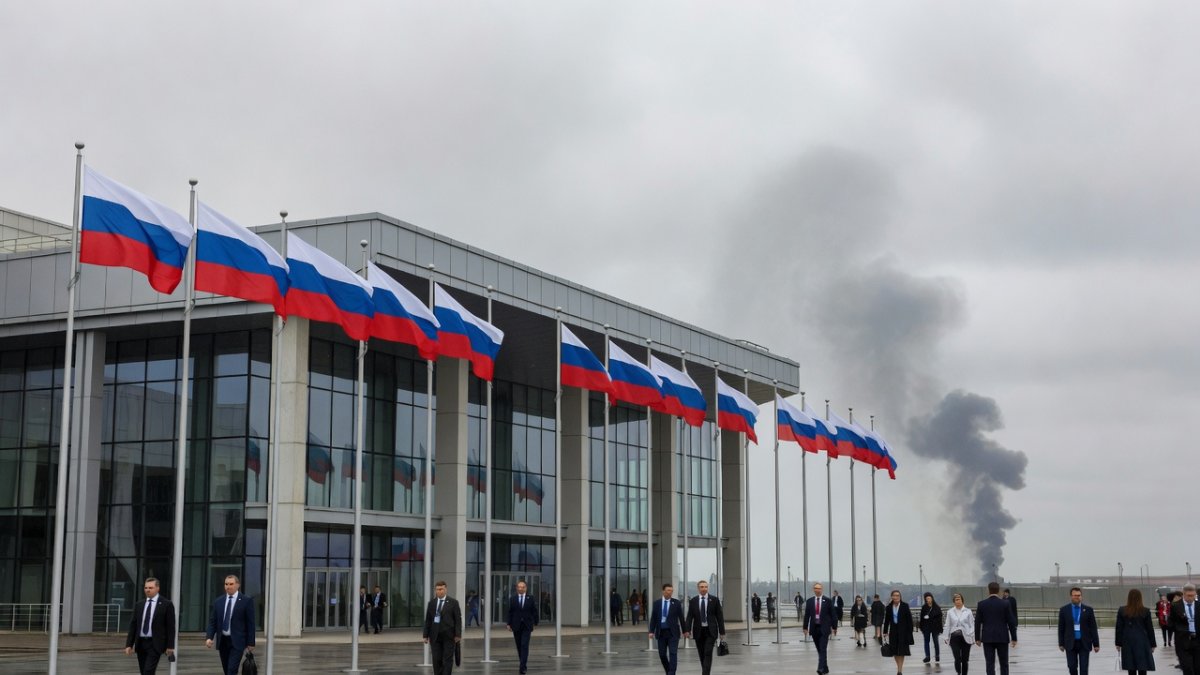
The Drone Strike Sets the Tone When black smoke rose over St. Petersburg this week during the opening of the St. Petersburg International Economic Forum, the image captured the mounting pressures on Russia’s wartime economy. The SPIEF gathering, long used by the Kremlin to showcase ties with non-Western partners and signal resilience, unfolded against visible signs of strain. U
The Drone Strike Sets the Tone
When black smoke rose over St. Petersburg this week during the opening of the St. Petersburg International Economic Forum, the image captured the mounting pressures on Russia’s wartime economy. The SPIEF gathering, long used by the Kremlin to showcase ties with non-Western partners and signal resilience, unfolded against visible signs of strain. Ukrainian drone activity near the venue underscored how the conflict continues to intrude on official displays of stability.
Officials from the Kremlin and major state-linked companies attended alongside foreign participants. Yet the forum avoided direct discussion of the Ukraine war in its main panels, focusing instead on investment climate and technology issues. This selective framing revealed the limits of projecting normalcy while defense spending dominates fiscal priorities.
GDP Downgrade Signals Managed Cooling
Deputy Prime Minister Alexander Novak announced last month that the government had lowered its 2026 GDP growth forecast from 1.3 percent to 0.4 percent. The revision marked a sharp departure from the 4.1 percent and 4.9 percent growth recorded in 2023 and 2024. Those earlier gains stemmed largely from Defense Ministry outlays that boosted industrial output even as Western sanctions restricted civilian sectors.
Kremlin economic aide Maxim Oreshkin described the current phase as one requiring adaptation to permanent separation from Western markets. Speaking on a Thursday panel, Oreshkin stated that officials should not expect sanctions to be lifted or the pre-war economic model to return. His remarks aligned with the shift from “overheating” to what officials now term “managed cooling.”
Public Criticism Emerges from Within
Communist Party lawmaker Renat Suleimenov offered rare open dissent days before the forum. The State Duma representative from Siberia questioned the value of continued military production, noting that tanks and shells generate no consumer benefit for the population. Suleimenov asked what genuine development or capital investment could occur under current conditions.
Such statements from a sitting parliamentarian highlight fractures inside established political structures. While the Defense Ministry continues to direct resources toward the war effort, voices from the Duma reflect concerns that prolonged spending crowds out civilian needs without delivering measurable returns for ordinary citizens.
Business Leaders Point to Demographics
At Sberbank’s invitation-only business breakfast on Friday, Aeon Corporation founder Roman Trotsenko described the business environment as performing poorly. Trotsenko attributed the slowdown not solely to wartime trade-offs but to a deeper demographic crisis. Russia recorded birth rates at a 200-year low last year, producing long-term constraints on labor supply and domestic consumption.
Trotsenko’s assessment diverged from the usual optimistic messaging at SPIEF. His comments suggested that structural population decline undermines the old growth model regardless of external sanctions or alliance shifts with partners in Asia and the Middle East.
Economists Question Sustainability
Economist Dmitry Nekrasov observed that Russia’s economy can sustain current military expenditure levels for an extended period. The greater uncertainty, he argued, lies in how any further increases in defense outlays would be financed if required. Nekrasov noted that working-class households, lacking representation at events like SPIEF, are likely to bear the eventual costs through inflation or reduced public services.
Nekrasov cautioned against interpreting forum rhetoric as a full picture of official thinking. Participants tend to emphasize fashionable topics while avoiding expressions of extreme pessimism that could unsettle investors from non-Western countries such as those in the CSTO orbit or major energy buyers.
Implications for Kremlin Decision-Making
The subdued tone at this year’s SPIEF illustrates how economic constraints now intersect with foreign policy choices. Maxim Oreshkin’s call for deeper investment ties with non-Western partners reflects an official strategy to offset Western isolation. Yet the absence of concrete mechanisms to reverse the growth downgrade leaves open questions about the durability of the current fiscal approach.
Analysts note that continued reliance on defense-driven stimulus risks amplifying imbalances already visible in labor shortages and demographic trends. For ordinary Russians, these dynamics translate into slower wage growth and tighter household budgets as resources remain concentrated in military production rather than broader economic diversification.
By Irina Volkov, Staff WriterThis article was produced with AI-assisted research and editorial support. Reporting is based on sources cited in the article.
What's Your Reaction?
 Like
0
Like
0
 Dislike
0
Dislike
0
 Love
0
Love
0
 Funny
0
Funny
0
 Wow
0
Wow
0
 Sad
0
Sad
0
 Angry
0
Angry
0
Russia/Eastern Europe Correspondent at Global1.News. Covering Russian politics, energy, security, and the shifting dynamics of the post-Soviet space. Provides clear-eyed analysis on one of the world's most opaque regions.









Comments (0)