
China-North Korea Treaty Marks 65 Years of Strategic Ties
The 65th anniversary of the China-DPRK Treaty of Friendship, Cooperation and Mutual Assistance, signed on 11 July 1961, has prompted a concentrated sequence of high-level diplomatic contacts in mid-2026.
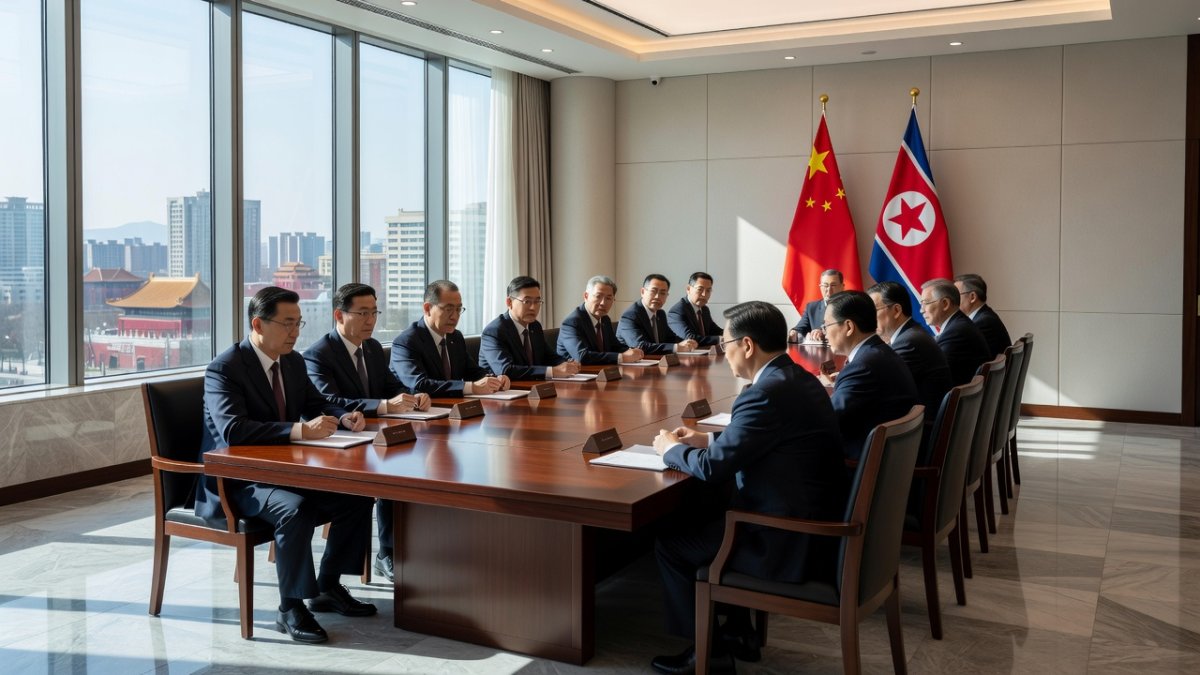
The 65th anniversary of the China-DPRK Treaty of Friendship, Cooperation and Mutual Assistance, signed on 11 July 1961, has prompted a concentrated sequence of high-level diplomatic contacts in mid-2026. These exchanges, occurring against the backdrop of North Korea’s reported economic expansion and sustained defense cooperation with Russia, illustrate the treaty’s continued operational relevance. Scholarly analysis situates the recent activity within longer patterns of Sino-Korean alignment that predate the current geopolitical configuration.
China-DPRK Treaty Anniversary Highlights Deepening Strategic Alignment
Seoul, South Korea — On 11 July 2026 the China-DPRK Treaty of Friendship, Cooperation and Mutual Assistance reached its 65th anniversary, prompting reciprocal high-level visits and messages that reaffirmed the bilateral relationship’s legal and political foundations. The sequence began with congratulatory exchanges between Xi Jinping and Kim Jong Un and continued through visits by North Korean Premier Pak Thae-song to Beijing and Chinese official Wang Huning to Pyongyang. These contacts occurred shortly after Xi Jinping’s state visit to the North Korean capital in June 2026, his first in seven years.
The 1961 Treaty and Its Enduring Significance
The treaty, concluded on 11 July 1961, contains a mutual-defense clause stipulating that each party shall come to the other’s assistance if attacked. Successive Chinese and North Korean governments have invoked this provision to frame their relationship as one possessing both legal and historical legitimacy. In 2026, Chinese officials explicitly linked the anniversary to the “militant friendship formed at the cost of blood,” thereby connecting contemporary diplomacy to the Korean War era. The document remains the sole formal treaty binding China and North Korea in a mutual-security commitment.
Congratulatory Exchanges Between Leaders
Xi Jinping and Kim Jong Un exchanged messages on the anniversary date, describing the relationship as “the most powerful and strategic relations.” Such language, while formulaic, signals continuity in the political signaling that has characterized the partnership since the treaty’s signing. The messages preceded the physical visits, establishing a rhetorical baseline for subsequent discussions.
Premier Pak Thae-song’s Visit to Beijing
North Korean Premier Pak Thae-song traveled to China from 10 to 12 July 2026. During the visit he met Chinese Premier Li Qiang and President Xi Jinping. A celebratory event at the Diaoyutai State Guesthouse was hosted by Cai Qi, the fifth-ranked member of the Chinese Communist Party Politburo Standing Committee. The timing, immediately preceding the anniversary, allowed both sides to demonstrate public commitment to the treaty framework.
Wang Huning’s Reciprocal Trip to Pyongyang
Wang Huning, Chairman of the Chinese People’s Political Consultative Conference and fourth-ranked CCP official, visited Pyongyang on 15–16 July 2026. He held talks with Jo Yong Won, a senior Workers’ Party of Korea official. Wang stated that China would implement agreements reached during Xi Jinping’s June 2026 visit and described the 65th anniversary as providing “a legal foundation for consolidating the militant friendship.” Jo Yong Won indicated North Korea’s interest in expanding “strategic communication and tactical cooperation” with Beijing.
Economic Context and Recent Performance
North Korea’s real GDP grew 3.7 percent in 2024, according to Bank of Korea estimates—the strongest annual expansion in eight years. China remains the DPRK’s largest trading partner, supplying essential goods and serving as the primary conduit for limited external commerce. While North Korea has concluded a strategic defense agreement with Russia and reportedly deployed troops to Ukraine, these developments have not displaced China’s dominant economic position.
According to Bank of Korea assessments, North Korea recorded 3.7 percent GDP growth in 2024, driven primarily by expanded economic linkages with Russia and sustained trade flows with China amid post-COVID recovery. These gains reflect increased cross-border activity in raw materials and infrastructure support, which helped offset earlier pandemic-related disruptions. Official data from the same source indicate that external partnerships played a central role in stabilizing output after years of contraction.
China remains North Korea’s largest trading partner, accounting for the bulk of energy imports, food supplies, and consumer goods that underpin daily economic functions. Yonhap reporting highlights how these sectoral exchanges have maintained continuity despite external sanctions, with Chinese ports serving as key conduits for essential commodities. Such patterns underscore Beijing’s structural position in Pyongyang’s external economic architecture.
The 65th anniversary of the 1961 treaty has provided a diplomatic framework that facilitates continued economic engagement by reinforcing high-level channels established during the recent sequence of visits. KCNA coverage of the commemorative exchanges notes explicit references to cooperative development, aligning with the treaty’s emphasis on mutual assistance and enabling further coordination in trade-related domains.
What This Means for Inter-Korean Relations
The recent exchanges occur against a backdrop of stalled inter-Korean dialogue. Seoul has observed the pattern of Sino-DPRK contacts with caution, noting that strengthened Beijing-Pyongyang coordination may reduce incentives for North Korea to engage directly with South Korean authorities. The treaty’s mutual-defense clause, though rarely invoked in public discourse, continues to shape South Korean strategic assessments regarding potential escalation scenarios on the peninsula. Analysts at institutions such as the University of North Korean Studies in Seoul interpret the 2026 activity as evidence of shared interest in maintaining stable bilateral channels rather than as an immediate shift in military posture.
South Korea’s Ministry of Foreign Affairs has consistently emphasized the need for coordinated international pressure alongside conditional engagement, a stance that faces new constraints from strengthened China-DPRK ties. Yonhap dispatches indicate that Seoul views the recent anniversary diplomacy as limiting its immediate leverage in bilateral channels. Policymakers must therefore calibrate responses that avoid direct confrontation while preserving deterrence credibility.
Deepened alignment between Beijing and Pyongyang reduces Seoul’s capacity to shape North Korean behavior through economic incentives alone. KINU analyses suggest that Chinese economic predominance narrows the window for South Korean initiatives aimed at incremental confidence-building measures. This dynamic compels a reassessment of leverage points that previously relied on multilateral economic inducements.
The Lee Jae Myung administration has pursued a pragmatic North Korea policy centered on dialogue resumption and risk reduction. In light of the treaty anniversary, this approach encounters heightened complexity regarding denuclearization talks, as Chinese involvement may prioritize stability over verifiable disarmament steps. Bank of Korea monitoring of regional economic indicators further illustrates how political frictions could dampen potential inter-Korean economic cooperation.
Regional Security Implications
The treaty’s mutual-assistance provision retains formal relevance within Northeast Asian security calculations. Chinese officials’ emphasis on implementing agreements from Xi Jinping’s June 2026 visit suggests an intention to manage the relationship through established diplomatic mechanisms. At the same time, North Korea’s concurrent defense ties with Russia introduce additional variables that regional actors, including the United States and Japan, must incorporate into contingency planning. The flurry of 2026 meetings therefore reflects both the durability of the 1961 framework and the complex overlay of multiple bilateral alignments.
US-ROK alliance coordination has intensified in response to the China-DPRK alignment signaled by the treaty anniversary. Joint statements from alliance mechanisms underscore the importance of extended deterrence and intelligence sharing to address evolving contingencies. Yonhap reporting on recent exercises notes explicit references to trilateral interoperability with Japan as a stabilizing factor.
Japan has expressed concern over the anniversary’s reinforcement of the mutual-defense clause, viewing it as a complicating element in regional contingency planning. Official Japanese assessments highlight the need for enhanced missile defense and supply-chain resilience. These perspectives align with broader efforts to diversify security partnerships beyond the immediate peninsula.
The 1961 treaty’s mutual-defense provisions introduce additional variables into alliance calculations, particularly when compared with the Russia-DPRK strategic defense agreement. KINU studies emphasize that simultaneous obligations from two major powers could constrain North Korean flexibility while prompting more integrated US-ROK-Japan planning. KCNA commentary on the anniversary, however, frames the treaty strictly within historical bilateral terms rather than broader adversarial alignments.
" alt="The Diaoyutai State Guesthouse in Beijing where treaty anniversary was celebrated" class="img-fluid">
Broader Geopolitical Alignments
Yang Moo-jin of the University of North Korean Studies has observed that the intensity of meetings in July 2026 mirrors a mutual desire to reinforce ties. This reinforcement takes place within a wider environment in which China seeks to preserve influence on its northeastern border while North Korea balances relations with both Beijing and Moscow. The treaty anniversary thus functions as a periodic occasion for both capitals to recalibrate expectations without altering the underlying legal instrument.
By Prof. David Park, Staff Writer
This article was produced with AI-assisted research and editorial support. Reporting is based on sources cited in the article.
What's Your Reaction?
 Like
0
Like
0
 Dislike
0
Dislike
0
 Love
0
Love
0
 Funny
0
Funny
0
 Wow
0
Wow
0
 Sad
0
Sad
0
 Angry
0
Angry
0

East Asia/Technology Correspondent at Global1.News. Seoul-based voice covering Korean politics, technology, business, and culture. Analyzes how technology and geopolitics intersect across East Asia.












Comments (0)