
Reviving Bilateral Naval Drills: Japan-South Korea SAREX Signals Deeper Strategic Realignment
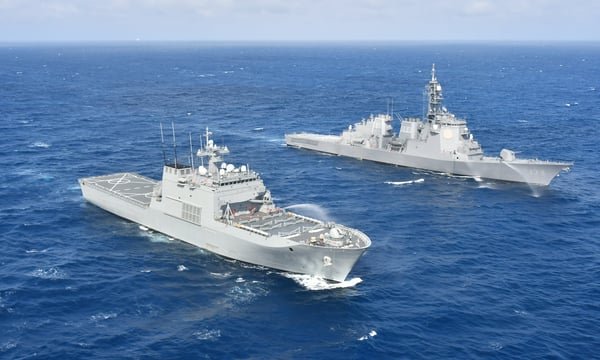
The June 2026 SAREX Exercise and Its Operational Scope The June 7, 2026, search and rescue exercise between the Japan Maritime Self-Defense Force and the Republic of Korea Navy marked the first such bilateral drill in nine years. Conducted west of Japan's Goto Islands, the event featured the JS Kongo Aegis destroyer and an SH-60K helicopter alongside the ROKS Cheon Ja Bong tank
The June 2026 SAREX Exercise and Its Operational Scope
The June 7, 2026, search and rescue exercise between the Japan Maritime Self-Defense Force and the Republic of Korea Navy marked the first such bilateral drill in nine years. Conducted west of Japan's Goto Islands, the event featured the JS Kongo Aegis destroyer and an SH-60K helicopter alongside the ROKS Cheon Ja Bong tank landing ship. Beyond core search and rescue procedures, participants executed a link exercise for tactical data sharing, cross-deck helicopter operations, and a photo exercise, all of which enhance interoperability in ways that extend well beyond humanitarian scenarios.
Japanese officials described the drill as an initial step toward renewed practical cooperation. The inclusion of data-link and helicopter procedures demonstrates how even modest exercises can lay groundwork for more complex joint operations in the future.
From Radar Lockdown to Ministerial Agreements: The Path to Resumption
Bilateral defense exchanges froze after the December 2018 incident in which a South Korean destroyer allegedly directed fire-control radar at a Japanese P-1 patrol aircraft. The resulting diplomatic chill lasted until the 2024 Shangri-La Dialogue, where defense ministers agreed on mechanisms to prevent recurrence. The January 2026 Yokosuka meeting then formalized the return of SAREX alongside commitments to annual ministerial consultations and exploratory work on artificial intelligence, unmanned systems, and space cooperation.
These steps reflect a deliberate, incremental approach rather than rapid institutionalization. Japanese Defense Minister Koizumi Shinjiro's characterization of the exercise as the start of a new chapter underscores Tokyo's interest in steady normalization, while Seoul proceeds with greater caution shaped by domestic political realities.
President Lee Jae-myung's Domestic Constraints and Historical Sensitivities
President Lee Jae-myung's June 8, 2026, press conference highlighted the tension between strategic necessity and public sentiment. While acknowledging the practical value of an Acquisition and Cross-Servicing Agreement for logistics support, Lee noted that emotional acceptance remains difficult due to the legacy of Japanese colonial rule. His reference to past suffering illustrates how historical memory continues to constrain policy options even when operational requirements point toward closer coordination.
This stance reflects broader Korean political dynamics. Any move toward formalized logistics arrangements risks being framed as insufficiently attentive to historical grievances, limiting the speed at which defense ties can advance regardless of external security pressures.
Regional Security Drivers: North Korea, China, and Alliance Uncertainty
North Korea's advancing nuclear and missile programs, coupled with its expanding military ties to Russia and renewed Chinese engagement, provide the official rationale for renewed Japan-South Korea coordination. Yet China's growing naval activity across the East China Sea and waters around Taiwan, alongside questions about long-term U.S. commitments, supply additional incentives that neither capital publicly emphasizes. The January 2026 joint statement referred only to the "increasingly severe security environment," avoiding explicit naming of any single actor.
For South Korea, these developments intersect with existing defense modernization efforts. The need to maintain credible deterrence on the peninsula while monitoring wider regional contingencies creates pressure for pragmatic engagement with Japan, even as political rhetoric remains measured.
Implications for South Korea's Defense Posture and Inter-Korean Dynamics
Closer naval coordination with Japan carries direct consequences for Seoul's overall defense architecture. Enhanced interoperability could improve South Korea's ability to operate alongside U.S. and Japanese forces in contingencies that extend beyond the immediate peninsula, potentially complicating Pyongyang's calculations. At the same time, any perception that Seoul is prioritizing trilateral alignment risks domestic criticism that such moves undermine the priority of inter-Korean engagement.
Historical precedent shows that South Korean administrations have balanced these pressures by advancing functional cooperation while maintaining rhetorical distance on politically sensitive issues. The current revival of SAREX fits this pattern, allowing incremental gains in maritime coordination without immediate movement on more symbolically charged agreements such as ACSA.
Future Trajectories and the Limits of Symbolic Politics
Japanese Prime Minister Takaichi Sanae's expected visit to Seoul later in June 2026 offers an opportunity to test whether the current momentum can be sustained. Progress will likely remain incremental, focused on low-visibility technical exchanges rather than headline-grabbing institutional breakthroughs. The gap between Japanese analysts who view ACSA as a routine administrative tool and Korean observers who see it as politically charged illustrates the persistent asymmetry in how each side frames the relationship.
Over the longer term, sustained North Korean missile activity and Chinese naval expansion may gradually shift Korean public opinion toward greater acceptance of practical defense measures. Until then, Seoul's approach will continue to emphasize operational utility while navigating the enduring constraints of historical memory and domestic politics.
By Prof. David Park, Staff WriterThis article was produced with AI-assisted research and editorial support. Reporting is based on sources cited in the article.
What's Your Reaction?
 Like
0
Like
0
 Dislike
0
Dislike
0
 Love
0
Love
0
 Funny
0
Funny
0
 Wow
0
Wow
0
 Sad
0
Sad
0
 Angry
0
Angry
0

East Asia/Technology Correspondent at Global1.News. Seoul-based voice covering Korean politics, technology, business, and culture. Analyzes how technology and geopolitics intersect across East Asia.















Comments (0)