
President Lee Jae-myung's European Tour Revives Hopes for Korean Peninsula Peace
**Meta Description:** South Korean President Lee Jae-myung's first European tour since June 2025 includes Vatican diplomacy and G7 engagement, seeking international support to restart dialogue with North Korea amid persistent nuclear tensions. **Keywords:** Lee Jae-myung, South Korea, North Korea, Vatican, Pope Leo XIV, inter-Korean relations, G7 summit, Korean Peninsula peace,
South Korean President Lee Jae-myung embarked on his first overseas journey since assuming office in June 2025, directing his European itinerary toward the deliberate cultivation of international backing for renewed engagement on the Korean Peninsula. The tour strategically combined high-profile religious diplomacy at the Vatican with bilateral economic discussions in Italy before culminating at the G7 summit in France. By selecting these venues, Lee sought to frame peninsula issues within broader global conversations on peace and multilateral cooperation. This approach reflected a calculated effort to leverage external platforms at a moment when direct channels with Pyongyang remained closed. The itinerary underscored Seoul's intent to integrate security outreach with scientific and technological partnerships across Europe.
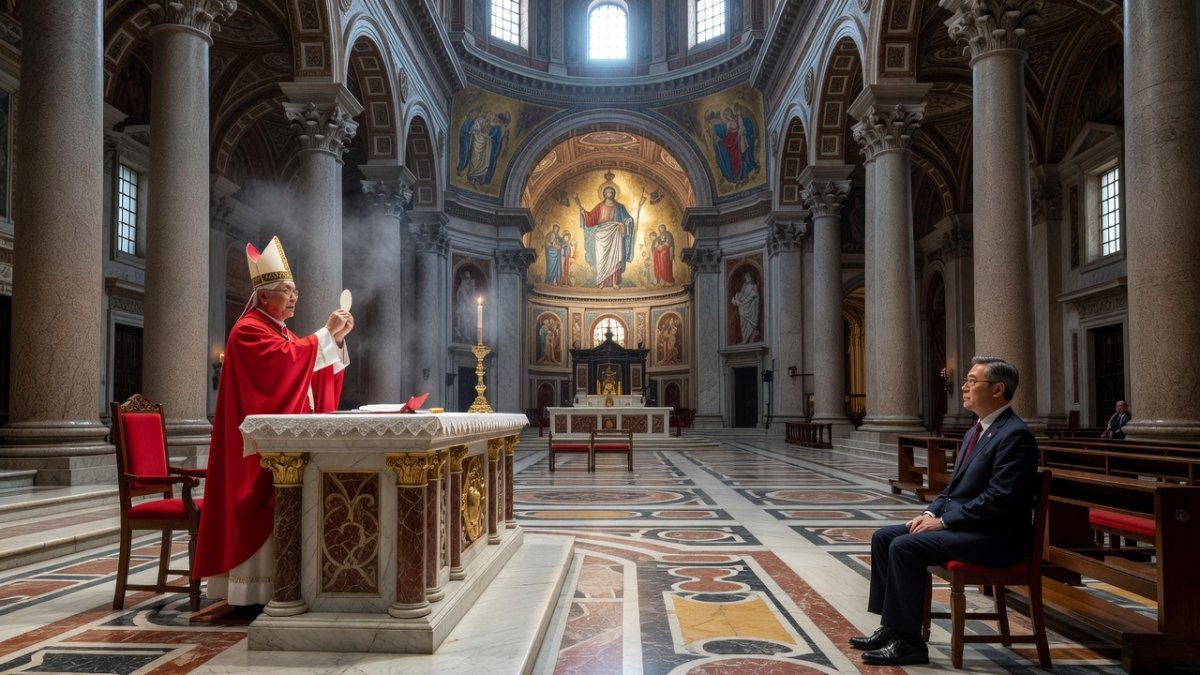
On June 14, 2026, Lee attended a special Mass at the Basilica of Saint Paul Outside the Walls in Rome, celebrated by South Korea-born Cardinal Lazzaro You Heung-sik under the explicit theme of peace and solidarity. The setting in Rome carried layered symbolism, positioning the ancient center of Catholicism as a neutral stage for messages aimed at both domestic and international audiences concerned with Korean stability. Cardinal You's participation added a personal dimension, linking the ceremony to the Korean Catholic community and its historical presence on the peninsula. The event allowed Lee to embed his diplomatic signals within a framework of shared moral and humanitarian values rather than purely political rhetoric. Such a venue choice highlighted the administration's willingness to explore unconventional avenues for conveying continuity in engagement policies.
The Ember of Hope: Reviving the 2000 Summit Legacy
During the Mass, Lee expressed his conviction that the ember of hope for dialogue with North Korea remains alive, framing this sentiment as a guiding principle for his administration's approach to Pyongyang. The statement emerged within the solemn context of the basilica gathering, lending it a tone of measured optimism rather than immediate expectation of breakthrough. By invoking this imagery, Lee signaled a preference for patient, incremental steps over dramatic gestures that had characterized earlier cycles of engagement. The remark also served to reassure domestic constituencies that his government would not abandon the pursuit of reduced tensions despite North Korea's recent declarations. This positioning established a rhetorical foundation for subsequent policy announcements during the tour.
Lee described the June 15, 2000 inter-Korean Joint Declaration as a historic turning point that produced the first family reunions and sustained humanitarian cooperation between the two Koreas. That summit marked the initial meeting between the leaders of North and South Korea, opening avenues for limited economic and social exchanges that persisted for several years afterward. The declaration's legacy includes the establishment of reunion centers at the Mount Kumgang resort and expanded cross-border aid programs that addressed urgent humanitarian needs in the North. Lee referenced these outcomes to underscore the tangible benefits that can arise when both sides prioritize dialogue over confrontation. Such historical anchoring reinforced his argument that past agreements retain relevance even amid current stalemates.
Lee's administration has suspended propaganda loudspeaker campaigns directed toward Pyongyang while explicitly rejecting any pursuit of unification by absorption or unilateral ideological competition. These measures aim to lower the immediate risk of accidental military incidents along the demilitarized zone. By halting the broadcasts, Seoul removed one source of daily friction that had intensified in recent years. The rejection of absorption-based unification further clarified that the government seeks coexistence rather than regime change as its operating framework. Together these steps represent concrete adjustments designed to create space for future talks without preconditions that Pyongyang has previously dismissed.
Vatican Diplomacy and the Papal Audience
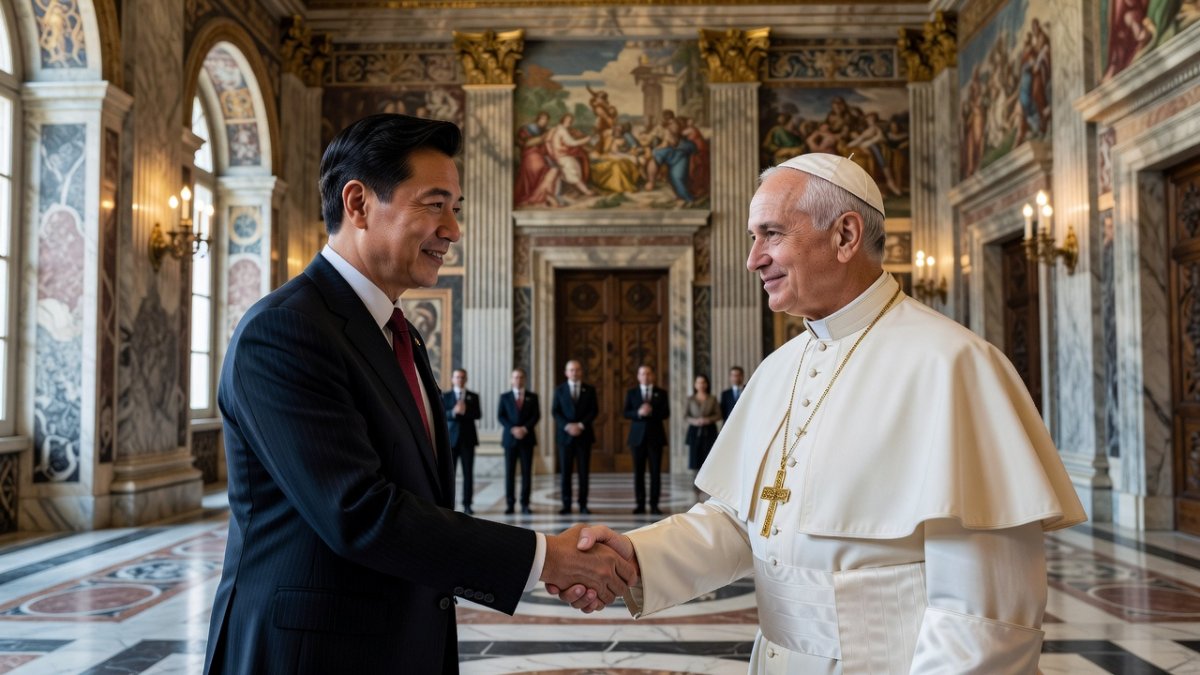
On June 15, Lee met with Pope Leo XIV at the Vatican and requested the Holy See's support for peace initiatives on the Korean Peninsula. The audience provided an opportunity to present Seoul's engagement strategy to an institution with longstanding interest in global conflict resolution. Lee emphasized the moral dimensions of reducing tensions, aligning his appeal with the Vatican's tradition of advocating dialogue in divided regions. The meeting occurred shortly after the basilica Mass, allowing the president to build upon the symbolic momentum generated the previous day. This sequence illustrated a coordinated effort to secure endorsements from influential non-state actors.
Lee extended an official invitation to Pope Leo XIV to visit South Korea for World Youth Day 2027, an event that National Security Adviser Wi Sung-lac later confirmed during a press briefing. The invitation positioned the papal visit as a potential catalyst for broader international attention on peninsula issues. Lee also held discussions with Vatican Secretary of State Pietro Parolin, covering practical aspects of bilateral cooperation on humanitarian and peace-related matters. These exchanges highlighted the operational dimension of the Vatican channel beyond ceremonial elements. The confirmation by Wi underscored the administration's intent to treat the invitation as a formal diplomatic initiative rather than a symbolic gesture alone.
Vatican engagement carries particular weight in Korean diplomacy because the Holy See maintains a unique position as a neutral actor with established channels to both Koreas and a historical Catholic presence on the peninsula dating back centuries. This neutrality allows the Vatican to serve as a discreet intermediary when official government-to-government contacts stall. Past papal visits to the region have occasionally created openings for humanitarian gestures that political actors alone could not achieve. Lee's outreach therefore draws on this institutional capacity while adapting it to contemporary security challenges. The approach reflects recognition that diversified diplomatic tools are necessary when traditional negotiations remain frozen.
Bilateral Partnerships and the G7 Summit
During his time in Italy, Lee met with Prime Minister Giorgia Meloni and signed memoranda of understanding focused on advanced science cooperation, expanding the economic dimension of the European tour. These agreements target joint research in emerging technologies that could strengthen South Korea's industrial competitiveness while deepening political ties with a key European partner. The MOUs complement the security-focused elements of the itinerary by demonstrating that engagement policies can coexist with tangible economic gains. Italy's role as host for the initial leg of the tour allowed Lee to test this integrated approach before proceeding to the larger G7 gathering. The bilateral outcomes thus served both immediate and longer-term strategic objectives.
The European tour forms part of South Korea's broader preparation for the G7 summit in France, where Lee will represent the country amid discussions on global economic governance and security coordination. South Korea's participation in such forums has evolved from observer status to more active contribution, reflecting its growing influence in technology supply chains and regional stability matters. By sequencing the Vatican and Italian stops ahead of the summit, the administration sought to arrive with demonstrated diplomatic momentum. This sequencing also allowed Lee to gather endorsements that could inform his interventions at the multilateral table. The overall itinerary therefore links bilateral, religious, and summit-level diplomacy into a single coherent narrative.
Seoul is actively diversifying its partnerships beyond traditional security allies by linking technology cooperation with outreach on peninsula issues. The Italy agreements illustrate how economic collaboration can generate goodwill that indirectly supports peace messaging. This diversification reduces reliance on any single diplomatic channel while expanding the constituency invested in Korean stability. European partners bring distinct perspectives on multilateralism that can complement the U.S.-ROK alliance framework. Such broadening of ties represents a pragmatic adaptation to an international environment where great-power competition increasingly intersects with regional conflicts.
North Korea's Unyielding Posture
North Korea has remained unresponsive to Lee's overtures, continuing to label South Korea a hostile state and declaring its nuclear status irreversible. These positions have been reiterated through official statements that reject any return to negotiation formats previously explored. Pyongyang's stance has also included condemnation of the Seoul-EU joint statement that rejected its nuclear status and criticized military ties with Moscow. The absence of reciprocal signals has left Lee's conciliatory gestures without immediate counterpart from the North. This dynamic places the burden of sustaining momentum on the South Korean side alone.
The Seoul-EU joint declaration explicitly rejected recognition of North Korea's nuclear status and condemned its expanding military cooperation with Russia, thereby hardening the international position that Lee must navigate. The statement aligned European partners with longstanding U.S. and South Korean assessments of the nuclear program. Its release during the European tour amplified the diplomatic pressure on Pyongyang while simultaneously complicating Lee's efforts to project openness. The declaration thus served as both a show of solidarity and a constraint on the flexibility of engagement policies. Its impact on inter-Korean dynamics lies in narrowing the perceived space for unilateral South Korean initiatives.
Lee's conciliatory signals stand in marked asymmetry to Pyongyang's entrenched positions, creating challenges for maintaining domestic support for continued engagement. South Korean public opinion has historically fluctuated with the pace of North Korean responses, often turning skeptical when reciprocity fails to materialize. The administration must therefore balance its outreach with clear demonstrations that security remains uncompromised. Sustaining this balance requires careful calibration of both rhetoric and concrete measures such as the suspended loudspeaker operations. The European tour provided an external platform to articulate this balance to international audiences less familiar with domestic political constraints.
Historical Context: Engagement Cycles on the Peninsula
Lee's approach draws from the Sunshine Policy era of the late 1990s and early 2000s, which produced the 2000 summit and the subsequent 2007 inter-Korean meeting before engagement largely collapsed under later administrations. Those earlier periods demonstrated that sustained dialogue could yield humanitarian and economic exchanges even without resolution of the nuclear issue. However, the breakdown that followed illustrated the vulnerability of such processes to shifts in leadership priorities and external geopolitical pressures. Lee's selective revival of elements from that legacy reflects an attempt to learn from both successes and failures of prior cycles. The current emphasis on low-risk measures such as broadcast suspensions represents one such adaptation.
Lee's policies differ from progressive predecessors by incorporating explicit safeguards against absorption scenarios while also diverging from conservative successors through the maintenance of engagement channels rather than their outright closure. This hybrid positioning seeks to avoid the polarization that has characterized South Korean approaches to the North over the past two decades. The suspension of loudspeaker campaigns, for instance, reverses a measure often associated with periods of heightened tension. At the same time, the rejection of unilateral ideological competition signals a departure from maximalist unification rhetoric. These adjustments aim to create a more durable framework less susceptible to rapid reversal with changes in government.
External powers continue to shape the parameters of inter-Korean diplomacy, with the U.S.-ROK alliance providing the security foundation, China maintaining its traditional relationship with Pyongyang, and Russia-North Korea military cooperation adding a new complicating factor. Lee's European outreach implicitly acknowledges that progress requires managing these overlapping influences rather than focusing solely on bilateral contacts. The Seoul-EU statement's criticism of Moscow ties reflects awareness of how third-party relationships can undermine peninsula stability. Balancing these external dynamics while advancing engagement remains a central challenge for the administration. The tour offered opportunities to coordinate positions with European actors who share concerns about proliferation and regional order.
Looking Ahead: Prospects for Korean Peninsula Diplomacy
The Rome visit yielded symbolic endorsements and concrete bilateral agreements, yet left the core impasse with Pyongyang unresolved. Lee's meetings secured expressions of support from the Vatican and Italy without producing immediate reciprocal gestures from North Korea. The invitation for World Youth Day 2027 stands as a longer-term marker that could sustain international attention if accepted. These outcomes demonstrate the value of diversified diplomacy even when direct results remain elusive. The tour thus achieved incremental gains within the constraints imposed by North Korea's current posture.
Realistic prospects for renewed inter-Korean dialogue hinge on whether Pyongyang perceives sufficient incentives to reconsider its declared irreversible nuclear status and hostile-state framing of the South. The nuclear impasse continues to block the comprehensive agreements that characterized earlier engagement periods. External condemnations of military ties with Moscow further reduce the likelihood of quick shifts in North Korean calculations. Lee's administration will need to sustain low-risk confidence-building measures while preparing for extended periods without visible progress. Domestic political support will depend on demonstrating that engagement policies do not compromise security.
Lee's European tour fits into the longer arc of Korean diplomacy as another attempt to internationalize peninsula issues at moments when bilateral channels are blocked. Historical patterns suggest that such internationalization can preserve momentum until conditions for direct talks improve. Markers to watch in coming months include any response to the World Youth Day invitation, adjustments in North Korean rhetoric, and the outcomes of the G7 discussions on regional security. The administration's ability to maintain consistency across these fronts will determine whether the ember of hope Lee invoked can translate into substantive movement. Continued monitoring of both symbolic gestures and policy adjustments will provide the clearest indicators of trajectory.
By Prof. David Park, Staff Writer
This article was produced with AI-assisted research and editorial support. Reporting is based on sources cited in the article.
What's Your Reaction?
 Like
0
Like
0
 Dislike
0
Dislike
0
 Love
0
Love
0
 Funny
0
Funny
0
 Wow
0
Wow
0
 Sad
0
Sad
0
 Angry
0
Angry
0
East Asia/Technology Correspondent at Global1.News. Seoul-based voice covering Korean politics, technology, business, and culture. Analyzes how technology and geopolitics intersect across East Asia.










Comments (0)