
Padilla defends online voting so fugitive Bato dela Rosa can keep 'working' while hiding
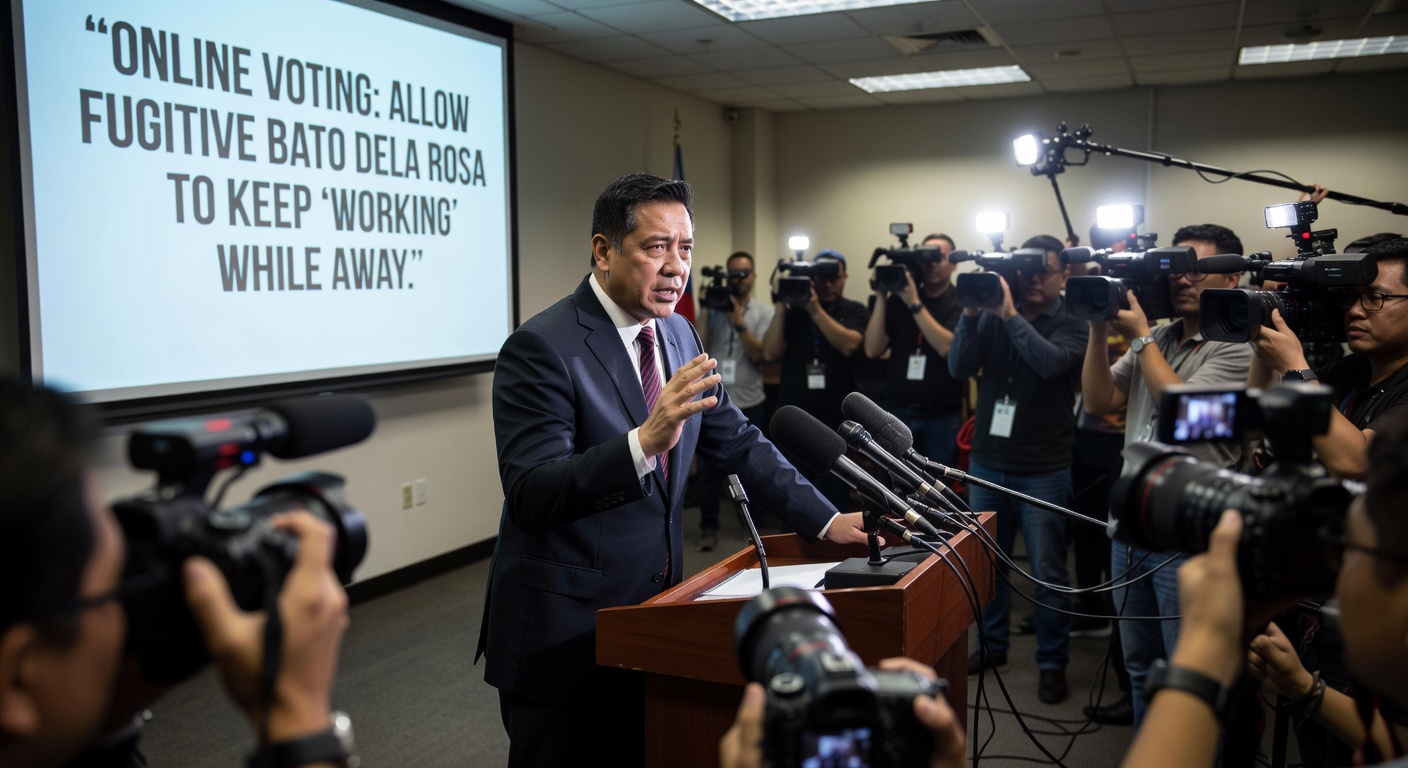
Padilla Defends Online Voting to Allow Fugitive Bato Dela Rosa to 'Work' While in Hiding
MANILA — Senator Robin Padilla on Thursday pushed his colleagues to amend Senate rules for remote voting, arguing that the measure would let fugitive Senator Ronald “Bato” dela Rosa continue performing his duties even as he evades an International Criminal Court arrest warrant over his role in the deadly war on drugs.
Padilla Frames Remote Voting as a Matter of Senate Functionality
During a Senate session, Padilla stated that dela Rosa “deserves to keep working for the people who elected him” and warned that denying online participation would punish constituents rather than the senator himself. “We are talking about representation here, not about guilt or innocence,” Padilla said, according to the official transcript. He urged the Senate leadership to fast-track the rule change before the next voting session on pending bills.
The proposal would allow senators under “extraordinary circumstances” to cast votes electronically after verification by the Senate Secretary. Padilla presented the measure as a technical adjustment, but critics immediately linked it to dela Rosa’s status as the first sitting Philippine senator sought by the ICC.
Dela Rosa’s Status and the ICC Warrant
Dela Rosa, who served as Philippine National Police chief from 2016 to 2018, oversaw the launch of President Rodrigo Duterte’s war on drugs. Official government data recorded more than 6,200 deaths during anti-drug operations in that period, while human-rights groups and the ICC estimate the toll reached 12,000 to 30,000 when vigilante killings are included. The ICC issued an arrest warrant in 2023 charging dela Rosa with crimes against humanity, citing his public statements encouraging police to use lethal force.
The Philippines withdrew from the Rome Statute in 2019, yet the ICC maintains jurisdiction over crimes committed while the country was still a member. Dela Rosa has remained inside the country but has not appeared publicly since the warrant became known, prompting speculation that he is moving between secure locations to avoid arrest. No Philippine court has ordered his detention, leaving the Senate without an automatic mechanism to suspend him.
Legal and Procedural Questions Raised by the Proposal
Constitutional experts note that the 1987 Constitution requires a senator’s physical presence for quorum in most circumstances, though it leaves internal rules to each chamber. Senate President Juan Miguel Zubiri has formed a small committee to study the remote-voting request, but several members have already signaled opposition. “We cannot create special accommodations that appear designed to shield a colleague from accountability,” Senator Risa Hontiveros told reporters after the session.
Padilla countered that the Senate has previously allowed remote participation during the COVID-19 pandemic and that the current proposal merely codifies that precedent. He cited internal data showing that 14 senators participated electronically at least once between 2020 and 2022 without controversy.
Expert Perspectives on Rule of Law and Institutional Integrity
University of the Philippines law professor Antonio La Viña described the timing of the proposal as “deeply troubling.” He argued that allowing a senator facing international charges to vote remotely without first addressing the warrant risks normalizing evasion. “This is not about technology; it is about whether the Senate will treat an ICC indictment as a serious matter or as an inconvenience to be worked around,” La Viña said in an interview.
Political analyst Ramon Casiple of the Institute for Political and Electoral Reform added that the move could further erode public trust in institutions already strained by perceptions of elite impunity. Surveys by Pulse Asia in June showed that 67 percent of respondents believe high-ranking officials involved in the drug war have not been held accountable.
Implications for Philippine Democracy and International Standing
If the Senate adopts remote voting under these circumstances, it would set a precedent that future legislators facing domestic or international legal jeopardy could invoke. Opposition groups warn that such flexibility might discourage voluntary surrender or cooperation with investigations. International observers, including the United Nations Human Rights Council, have already flagged the Philippines’ handling of the drug-war cases as a test of its commitment to transitional justice.
Domestically, the debate highlights the tension between legislative independence and the principle that no public official is above the law. Advocacy groups such as the Movement for Truth and Accountability have called for public hearings before any rule change, arguing that the public deserves a transparent accounting of how senators intend to balance representation with accountability.
Public Reaction and Next Steps
Social-media monitoring by the Center for Media Freedom and Responsibility recorded more than 48,000 posts within 24 hours of Padilla’s statement, with roughly 62 percent expressing opposition to the remote-voting idea. Several hashtags linking the proposal to “protecting war criminals” trended in Manila and Cebu.
The Senate committee is scheduled to report its findings within two weeks. Any rule change would still require a majority vote on the floor, where at least four other senators have publicly questioned the necessity of the measure while dela Rosa remains at large.
This is Bella Reyes for Global1 News, reporting from Manila. 🇵🇭
This article was produced with AI-assisted research and editorial support. Reporting is based on sources cited in the article.
What's Your Reaction?
 Like
0
Like
0
 Dislike
0
Dislike
0
 Love
0
Love
0
 Funny
0
Funny
0
 Wow
0
Wow
0
 Sad
0
Sad
0
 Angry
0
Angry
0

Philippines/Southeast Asia Correspondent at Global1.News. Manila-based journalist covering Philippine politics, environment, maritime security, and social issues. Passionate about marine conservation and the communities protecting the Philippines' natural heritage.













Comments (0)