
Netanyahu orders expansion of Israeli control to 70% of Gaza
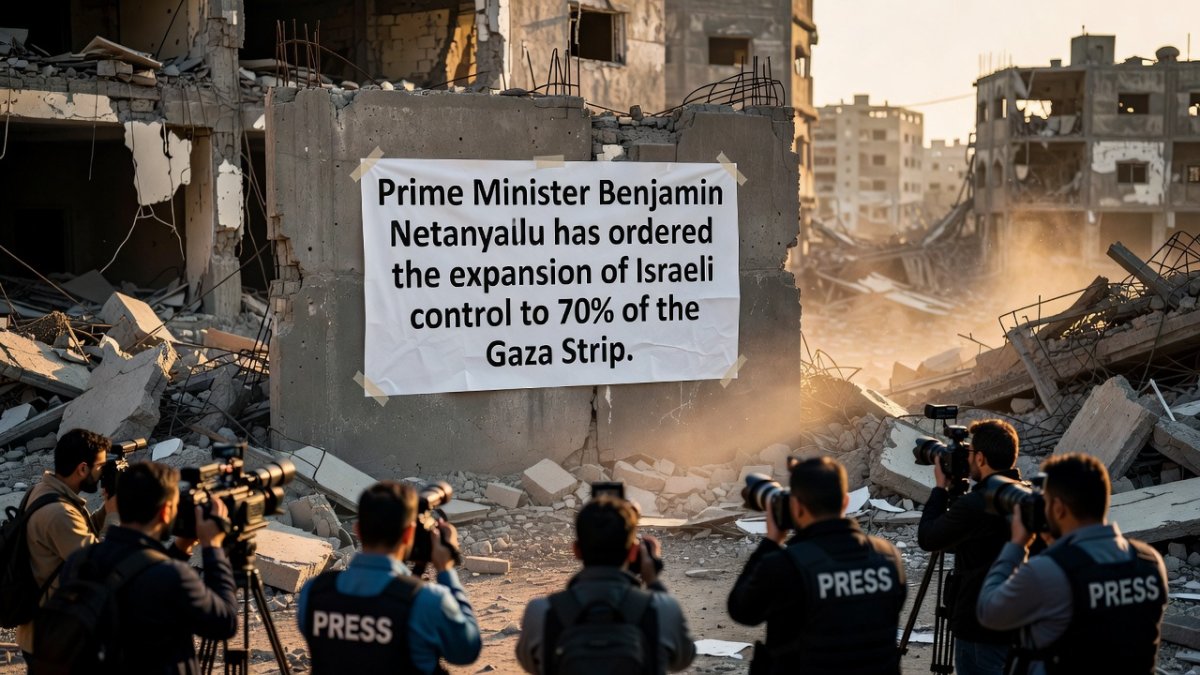
Netanyahu Orders Expansion of Israeli Control to 70 Percent of Gaza Strip, Signaling Prolonged Military Campaign
By Sarah Okafor | Global1 News, Lagos
The Breaking Directive
Israeli Prime Minister Benjamin Netanyahu has instructed the military to expand operational control across 70 percent of the Gaza Strip, according to remarks broadcast by Channel 12 on Thursday. In the footage, Netanyahu stated that Israeli forces currently control significant portions of the territory and must now consolidate gains to prevent future threats from regrouping. This directive marks a sharp escalation in the ongoing campaign that began after the October 7, 2023 attacks.
The announcement arrives as Israeli troops push deeper into central and southern Gaza, areas previously described as limited in scope. Netanyahu emphasized that partial control would leave Israel vulnerable, framing the move as essential for long-term security. Military analysts note that achieving 70 percent would require sustained operations in densely populated zones like Khan Younis and Rafah corridors.
Current Battlefield Realities and Resource Strain
Israeli Defense Forces currently report holding roughly 45 percent of Gaza under direct influence, concentrated along the northern border and key access routes. Expanding to 70 percent would encompass most of the Strip’s 365 square kilometers, leaving limited space for civilian movement or humanitarian corridors. Ground operations have already displaced over 1.9 million residents, according to UN figures released this month.
Logistical demands are mounting. The Israel Defense Forces have mobilized more than 300,000 reservists since the conflict’s onset, with equipment depletion reported in armored units. Fuel and ammunition expenditures exceed $300 million monthly, placing pressure on Israel’s defense budget that reached $24 billion in the latest fiscal year.
Historical Context and Shift in Strategy
The Gaza Strip has been under varying degrees of Israeli blockade since 2007, following Hamas’s takeover. Previous operations, including 2014’s Protective Edge, focused on targeted degradation rather than territorial seizure. Netanyahu’s current approach diverges by prioritizing permanent buffer zones and control of high ground, a strategy reminiscent of earlier West Bank policies but unprecedented in scale for Gaza.
Egyptian-mediated ceasefire talks have stalled repeatedly. Cairo and Qatar, key intermediaries, have expressed frustration over the absence of a timeline for withdrawal. Netanyahu’s remarks suggest negotiations will now proceed from a position of expanded territorial leverage.
Economic Ripple Effects on Global Markets and Nigeria
Energy traders immediately factored the escalation into oil pricing models. Brent crude rose 2.8 percent in early trading following the broadcast, driven by fears of supply disruptions through the Red Sea and potential Iranian involvement. Nigeria, Africa’s largest oil producer, stands to gain from higher export revenues but faces downside risks if global demand contracts amid broader instability.
The Central Bank of Nigeria has already modeled scenarios where sustained Middle East tension pushes oil above $95 per barrel. Such levels could strengthen the naira and boost federation account allocations, yet imported inflation on refined products and wheat would offset gains for households. Forward-looking economists in Lagos warn that reconstruction costs in Gaza, estimated at $40-50 billion by World Bank preliminary assessments, may divert international capital away from African infrastructure projects.
International Reactions and Diplomatic Fallout
The United States reaffirmed its support for Israel’s right to self-defense while urging restraint to avoid civilian casualties. European Union foreign ministers scheduled emergency talks in Brussels, with Germany and France signaling possible conditions on future arms exports. China and Russia issued statements calling for an immediate halt to operations, highlighting their growing influence in Global South forums.
African Union Commission Chair Moussa Faki Mahamat condemned the expansion as disproportionate, urging member states to coordinate humanitarian aid through existing channels. Nigeria’s Ministry of Foreign Affairs has yet to issue a formal response but is expected to align with non-aligned positions emphasizing Palestinian statehood aspirations.
Humanitarian and Long-Term Reconstruction Outlook
Humanitarian agencies report acute shortages of medical supplies and clean water inside Gaza. With 70 percent control, delivery routes would narrow further, complicating efforts by the World Food Programme that currently reaches only 30 percent of needed caloric intake for residents. Disease outbreaks, including polio and acute respiratory infections, have already been documented in displacement camps.
Looking ahead, any future reconstruction would require unprecedented coordination among donors, potentially modeled on post-2003 Iraq frameworks but with stricter governance conditions. Israeli officials have floated plans for demilitarized zones under international oversight, though Palestinian Authority involvement remains contested. For Nigerian businesses eyeing post-conflict opportunities in logistics and energy, early positioning in regional funds could prove advantageous once stability metrics improve.
Expert Perspectives on Regional Stability
Dr. Aisha Bello, senior fellow at the Nigerian Institute of International Affairs, notes that prolonged conflict risks emboldening non-state actors across the Sahel, where economic grievances already fuel insurgencies. She argues that higher global commodity volatility could accelerate diversification efforts within ECOWAS economies toward renewables and intra-African trade.
Meanwhile, Tel Aviv-based security analyst Yossi Klein observes that Netanyahu’s political survival hinges on demonstrating tangible territorial achievements before elections scheduled for late 2026. This domestic calculus may extend operations beyond initial projections, affecting investor sentiment in Israeli tech and defense sectors listed on global exchanges.
The directive underscores a fundamental recalibration in Israeli strategic doctrine, one with cascading consequences for energy security, migration patterns, and development financing across emerging markets. As operations unfold, monitoring fiscal indicators in Abuja and commodity desks in London will reveal the true breadth of impact.
This is Sarah Okafor for Global1 News, reporting from Lagos. 🇳🇬
This article was produced with AI-assisted research and editorial support. Reporting is based on sources cited in the article.
What's Your Reaction?
 Like
1
Like
1
 Dislike
0
Dislike
0
 Love
0
Love
0
 Funny
0
Funny
0
 Wow
0
Wow
0
 Sad
0
Sad
0
 Angry
0
Angry
0

Africa Correspondent at Global1.News. Based in Lagos, covering politics, business, technology, and culture across the continent. Focused on telling African stories beyond the headlines — the innovation, entrepreneurs, and communities shaping the region's future.












Comments (0)