
NEET UG 2026 Re-Exam: 22 Lakh Candidates, 5 Lakh Security Personnel
Today, June 21, 2026, over 22 lakh candidates — enough to fill a city the size of Chandigarh — are sitting for the NEET UG re-examination across 551 Indian cities and 14 international locations, in what is being described as the most heavily secured entrance test in the nation's history. The 2:00 PM to 5:15 PM pen-and-paper examination comes barely six weeks after the original
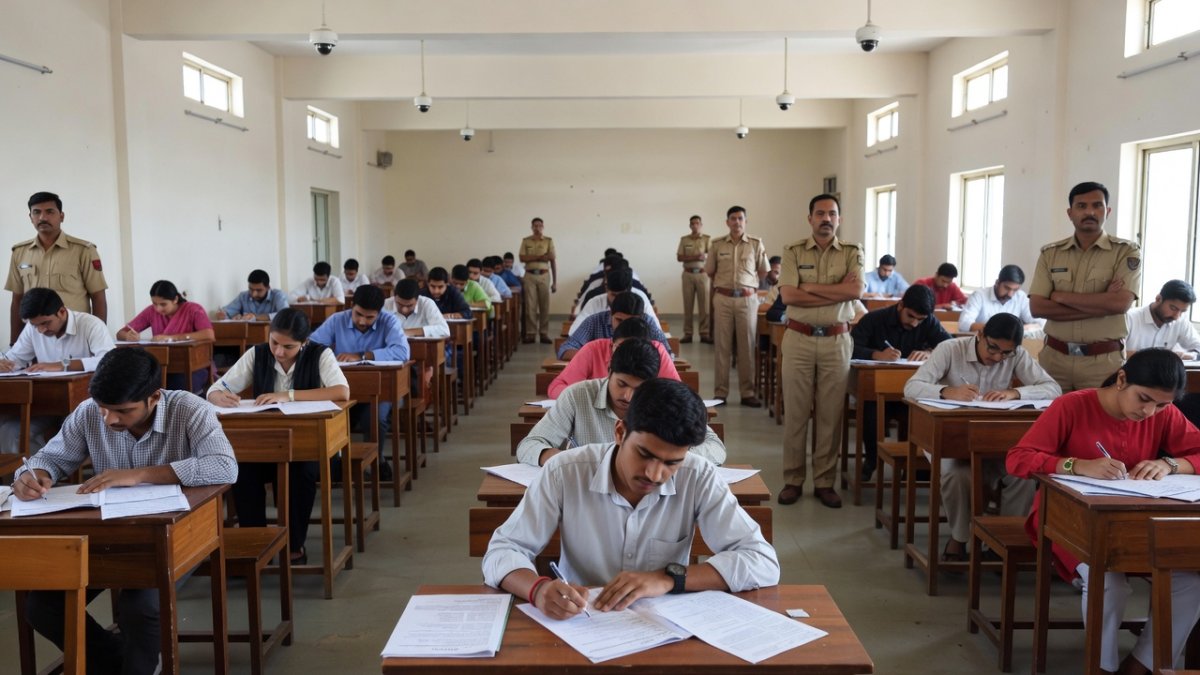
Today, June 21, 2026, over 22 lakh candidates — enough to fill a city the size of Chandigarh — are sitting for the NEET UG re-examination across 551 Indian cities and 14 international locations, in what is being described as the most heavily secured entrance test in the nation's history. The 2:00 PM to 5:15 PM pen-and-paper examination comes barely six weeks after the original May 2026 test was cancelled amid credible allegations of question paper leaks, triggering nationwide protests, a Supreme Court petition, and an overhaul of the National Testing Agency's operational framework that has now placed 5 lakh security personnel on duty for a single day.
NEET UG 2026 Re-Exam: 22 Lakh Candidates, 5 Lakh Security Personnel — India's Most Heavily Guarded Medical Entrance Test Begins Today
New Delhi, India – June 21, 2026 — The examination, conducted under the National Testing Agency (NTA) which reports to the Ministry of Education, will determine admissions to 1.08 lakh MBBS seats along with BDS and AYUSH programmes through a single pen-and-paper test running from 2:00 PM to 5:15 PM. Admit cards were released on June 14 via the NTA portal, and the syllabus remains strictly limited to NCERT Class 11 and 12 topics in physics, chemistry and biology. Over 24 lakh candidates originally registered, with more than 22 lakh appearing today after accounting for withdrawals and absences.
The Massive Scale: Breaking Down the Numbers
The sheer arithmetic of today’s re-examination underscores why it has been labelled the largest single-day, high-stakes test ever mounted in India. More than 22 lakh candidates—roughly the population of Chandigarh—are spread across 551 Indian cities and 14 overseas centres including Dubai, Riyadh, Kathmandu and Kuala Lumpur. This translates into 95,000-plus examination rooms, each requiring separate invigilation teams, sealed question-paper packets and independent CCTV feeds. Competition ratios remain brutal: for every available MBBS seat under the 1.08 lakh national pool, approximately 20 aspirants are vying, with state-level variations pushing the ratio above 30:1 in Uttar Pradesh, Bihar and Rajasthan. Maharashtra, Tamil Nadu, Karnataka and Delhi together account for nearly 40 percent of the registered candidates, reflecting both population density and the concentration of coaching hubs. The original registration figure of 24 lakh-plus had already strained NTA logistics; the six-week postponement forced a complete reallocation of centres, transport manifests and biometric schedules. Analysts note that such scale exceeds even the combined daily footfall of India’s busiest airports, demanding military-grade coordination simply to move question papers and answer sheets without incident. The demographic skew toward first-generation learners from smaller towns further amplifies the social stakes, as a single examination now functions as the primary gateway to upward mobility through medical education.
Three-Tier Security: From Biometrics to Live CCTV
Security architecture for the re-examination has been deliberately engineered in three concentric layers, each designed to eliminate the vulnerabilities exposed in May. The outermost ring comprises 5 lakh personnel drawn from state police, central paramilitary forces and rapid-action teams deployed at every centre perimeter. Inside this cordon, biometric authentication paired with facial-recognition cameras verifies each candidate against the June 14 admit-card database before entry. The innermost layer consists of high-definition CCTV cameras streaming live to a central control room in Delhi, where AI algorithms flag unusual movement or device signals within seconds. Paper setters themselves were placed under complete digital isolation for 72 hours preceding the test, stripped of internet access and monitored by independent observers. All electronic devices are banned inside the examination halls, while jammers and drone surveillance cover a 500-metre radius around each venue. This multi-layered model represents an unprecedented escalation; never before has a single-day academic examination in India mobilised half a million security personnel. The system also incorporates real-time social-media monitoring across WhatsApp, Telegram and X, with dedicated cells authorised to act on any leaked images or coordination chatter. Officials claim the framework reduces the probability of organised malpractice to near zero, though independent observers caution that human ingenuity has historically outpaced technological safeguards in high-pressure environments.
What Went Wrong: The May 2026 Cancellation
The chain of events that necessitated today’s re-examination began in early May when credible evidence of question-paper leaks surfaced from centres in Bihar and Uttar Pradesh. Within 48 hours, social-media clips purporting to show solved papers circulated widely, triggering student protests in Delhi, Patna and Chennai that quickly spread to other state capitals. The National Testing Agency initially denied systemic failure, but forensic audits confirmed that at least one set of papers had been compromised 48 hours before the scheduled date. A Supreme Court petition filed by affected candidates forced the government to cancel the examination outright, marking the first time in NEET’s 17-year history that an entire national test was scrapped after registration. The episode exposed long-standing weaknesses in the NTA’s operational chain, including inadequate paper-setting isolation and insufficient last-mile verification at remote centres. Political pressure mounted rapidly, with opposition parties demanding a Joint Parliamentary Committee probe. The six-week window between cancellation and re-examination was used to overhaul protocols, enact stricter criminal provisions and recruit the massive security contingent now in place. For the 22 lakh candidates who had already invested months of preparation, the cancellation represented not merely a logistical setback but an emotional and financial blow, with many families forced to rearrange travel and accommodation twice within the same summer.
Operational Deployment: How 5 Lakh Personnel Secure 551 Cities
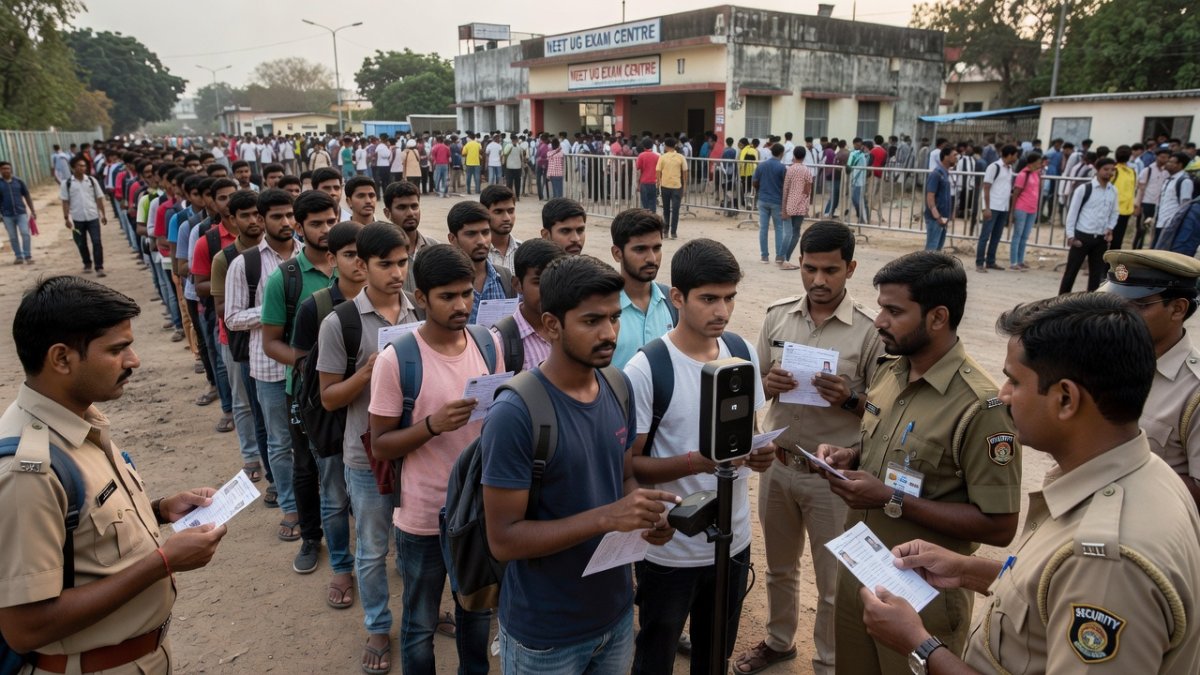
Translating the three-tier security plan into ground reality required meticulous inter-state coordination. Each of the 551 cities was mapped into confidential transport corridors known only to a handful of senior officers; sealed question-paper trunks moved under armed escort along routes that changed daily. State police forces in Uttar Pradesh, Bihar, Maharashtra, Tamil Nadu, Delhi, Rajasthan and Karnataka were placed under unified command for the 24-hour window, with real-time communication links to the NTA war room. Social-media surveillance teams monitored encrypted groups on WhatsApp and Telegram, empowered to request immediate takedowns or local police intervention. In overseas centres, Indian embassies coordinated with host-country authorities to replicate biometric and CCTV standards. The logistics extended to feeding and housing 5 lakh personnel, many of whom were deployed from distant states and required temporary cantonments near examination clusters. Fuel, food and medical support for this force alone rivalled the scale of a medium-sized disaster-relief operation. Observers note that such coordination tests the federal fabric of Indian governance, as state governments temporarily ceded operational control to a central agency for a single day. Any breakdown in the chain—whether a delayed convoy or a jammed communication link—could have cascading effects on thousands of candidates waiting inside sealed halls.
The 2024 Act and Its First Major Test
The Public Examinations (Prevention of Unfair Means) Act, 2024, receives its first large-scale application today. The legislation criminalises leakage, possession of unauthorised devices and collusion between candidates and intermediaries, with penalties extending up to ten years’ imprisonment and hefty fines. For the first time, organised gangs and coaching centres that facilitate leaks can be prosecuted under conspiracy provisions rather than merely local unfair-means rules. Legal experts view the re-examination as a critical stress test: successful enforcement will deter future attempts, while any high-profile breach could undermine the Act’s credibility before it is even fully operationalised. The Supreme Court has already indicated that it will monitor compliance reports, ensuring that the new criminal framework is not reduced to a paper tiger. Candidates have been explicitly warned that even sharing a single question on social media can invite prosecution, shifting the risk calculus dramatically from previous years. The Act also mandates time-bound investigation and trial, promising resolution within six months—an ambitious timeline given India’s judicial backlog. Its success will hinge on whether investigative agencies can convert digital footprints and CCTV evidence into watertight cases within the stipulated period.
What This Means for India's Medical Education Pipeline
Beyond immediate security concerns lies the larger question of how one examination shapes India’s future healthcare workforce. The 1.08 lakh MBBS seats, supplemented by BDS and AYUSH quotas, remain grossly insufficient relative to 22 lakh aspirants, perpetuating a narrow funnel that privileges coaching-intensive preparation over broader aptitude. State-wise seat distribution reveals stark imbalances: southern states enjoy higher per-capita availability, while Uttar Pradesh and Bihar continue to face acute shortages despite high candidate volumes. Successful candidates will feed into All India Quota counselling conducted by the Medical Counselling Committee and parallel state-quota rounds, determining not only institutional allocation but also eventual rural service obligations. The re-examination therefore functions as a gatekeeper for the entire medical-education pipeline, influencing doctor distribution across primary-health centres years down the line. Critics argue that repeated disruptions erode trust in the system and may discourage meritorious students from under-resourced backgrounds who lack the financial buffer to absorb repeated examination cycles. Conversely, a clean and transparent process could restore some institutional legitimacy and encourage states to expand seat capacity in underserved regions.
The Bottom Line
Today’s re-examination sets a precedent whose ripple effects will extend far beyond 2026. If the three-tier security model and the 2024 Act succeed in delivering an unblemished result, they may become the template for all future national entrance tests, from JEE to CUET. Institutional trust, however, is harder to rebuild than logistical frameworks; the NTA must demonstrate not only operational competence but also sustained transparency in result processing and grievance redressal. The 22 lakh candidates who sit for the test today carry the weight of an entire generation’s aspirations for a medical career. Their performance will determine not merely individual futures but the credibility of India’s examination ecosystem itself. Should the day pass without incident, it will mark a significant, albeit costly, step toward restoring faith in merit-based selection. Should any breach occur, the consequences for medical education governance could be far-reaching and long-lasting. The coming weeks will reveal whether the extraordinary mobilisation of resources has truly transformed a compromised system or merely papered over deeper structural vulnerabilities.
— By Dr. Raj Patel, Staff WriterThis article was produced with AI-assisted research and editorial support. Reporting is based on sources cited in the article.
What's Your Reaction?
 Like
0
Like
0
 Dislike
0
Dislike
0
 Love
0
Love
0
 Funny
0
Funny
0
 Wow
0
Wow
0
 Sad
0
Sad
0
 Angry
0
Angry
0

India/South Asia Correspondent at Global1.News. Analytical voice with a background in science and health journalism. Based in New Delhi, covering Indian politics, education, healthcare, technology, and policy. Breaks down complex data into clear, actionable reporting.












Comments (0)