
Myanmar’s junta chief turned president heads to India, with an eye on China
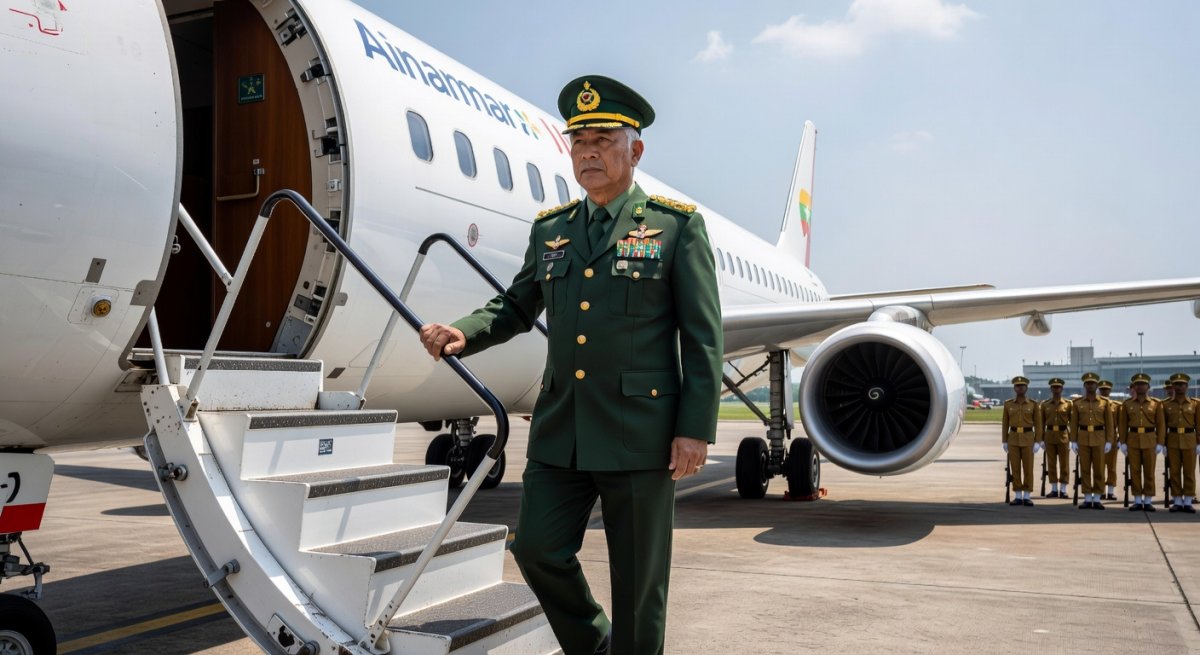
In a development signaling Myanmar’s tentative reentry into regional diplomacy, the country’s junta leader—now serving as president—is undertaking a five-day visit to India. The trip, the first overseas engagement by the military government’s top figure since the 2021 coup, highlights a slow thawing of relations with neighbors that largely isolated Myanmar for five years. It also carries an implicit strategic dimension: balancing Myanmar’s deepening ties with China while testing new avenues of cooperation with India.
The timing is significant. Five years after the military seized power and triggered widespread condemnation, economic sanctions, and exclusion from ASEAN-led forums, the visit reflects a pragmatic recalibration by both Myanmar’s rulers and their counterparts in New Delhi. India, which shares a long border with Myanmar and maintains longstanding security and connectivity interests in the region, appears willing to engage despite the junta’s international pariah status. For the Myanmar leadership, the journey offers a chance to project legitimacy and diversify partnerships beyond Beijing’s orbit.
India’s Strategic Calculus
New Delhi’s decision to host the Myanmar president underscores its long-term interests in the Bay of Bengal and the broader Indo-Pacific. India has pursued infrastructure projects such as the Kaladan Multi-Modal Transit Transport Project and the India-Myanmar-Thailand Trilateral Highway, both designed to improve connectivity to Southeast Asia and counterbalance China’s regional influence. A stable, if imperfect, relationship with Myanmar’s authorities helps safeguard these investments and addresses cross-border concerns including insurgencies and refugee flows. The five-day format suggests a deliberate, measured approach rather than a full-throated endorsement. Indian officials are likely to emphasize economic cooperation and border management while avoiding public statements that could be interpreted as legitimizing the 2021 power grab. This calibrated stance mirrors India’s broader foreign-policy preference for engagement over isolation, even when dealing with governments facing international criticism.Balancing Beijing’s Shadow
The visit also carries an unmistakable China dimension. Since the coup, Myanmar has grown more reliant on Chinese investment, arms supplies, and diplomatic cover at the United Nations. Beijing’s Belt and Road projects, including pipelines and port facilities, give it substantial leverage. Yet this dependence has created unease within Myanmar’s military leadership, which seeks to avoid becoming overly beholden to any single power. By traveling to India, the junta signals an interest in maintaining strategic autonomy. New Delhi offers an alternative source of technology, markets, and security cooperation without the same degree of political conditionality sometimes attached to Western engagement. The move does not represent a rupture with China—Beijing remains Myanmar’s most consequential neighbor—but it introduces modest competition into a relationship previously tilted heavily toward the north.Five Years of Isolation and the Slow Return
Following the February 2021 coup, most Southeast Asian governments and Western capitals distanced themselves from Myanmar’s military rulers. ASEAN suspended Myanmar’s participation in high-level meetings, and many countries imposed targeted sanctions. The resulting economic contraction and humanitarian crisis left the junta with limited options for external validation. The India trip therefore marks a modest but notable step toward re-engagement. It is not a wholesale return to pre-2021 norms; Myanmar remains excluded from key regional mechanisms and continues to face domestic armed resistance. Still, the willingness of a major democracy such as India to receive the junta chief-turned-president illustrates how pragmatic interests can gradually erode earlier isolation. Other neighbors may watch closely to see whether the visit produces tangible outcomes in trade, security, or infrastructure.Regional Ripple Effects
The engagement carries implications beyond bilateral ties. ASEAN’s unity has already been strained by differing approaches to Myanmar; a visible India-Myanmar rapprochement could complicate efforts to maintain a coherent regional position. At the same time, it may encourage quiet diplomacy aimed at reducing violence and opening channels for humanitarian access. For India, deeper involvement in Myanmar fits into its Act East policy and its desire to shape outcomes in a region where China’s influence has grown. Success will depend on whether concrete deliverables—such as progress on stalled connectivity projects or improved border security—emerge from the five-day program. Failure to produce results could reinforce skepticism about the value of engagement.Looking Ahead
The coming months will reveal whether this visit is an isolated gesture or the start of a more sustained diplomatic opening. Myanmar’s leadership will likely seek additional high-level contacts, while India will weigh the benefits of incremental cooperation against reputational risks. China, for its part, will monitor developments to ensure its strategic position is not eroded. Ultimately, the trajectory of Myanmar’s regional relationships hinges less on any single trip and more on internal political dynamics and the willingness of external actors to sustain engagement despite unresolved governance questions. The India visit demonstrates that isolation is not absolute, yet it also underscores how limited and conditional renewed acceptance remains five years after the coup.By Kenji Tanaka, Staff Writer
This article was produced with AI-assisted research and editorial support. Reporting is based on sources cited in the article.
What's Your Reaction?
 Like
0
Like
0
 Dislike
0
Dislike
0
 Love
0
Love
0
 Funny
0
Funny
0
 Wow
0
Wow
0
 Sad
0
Sad
0
 Angry
0
Angry
0

Kenji Tanaka
Japan Correspondent at Global1.News. Tokyo-based voice covering Japanese politics, technology, economy, and culture. Tracks the intersection of tradition and innovation in one of the world's most dynamic societies.














Comments (0)