
Mogami frigate talks anchor first Japan, Australia, N.Z. trilateral defense chiefs’ meeting
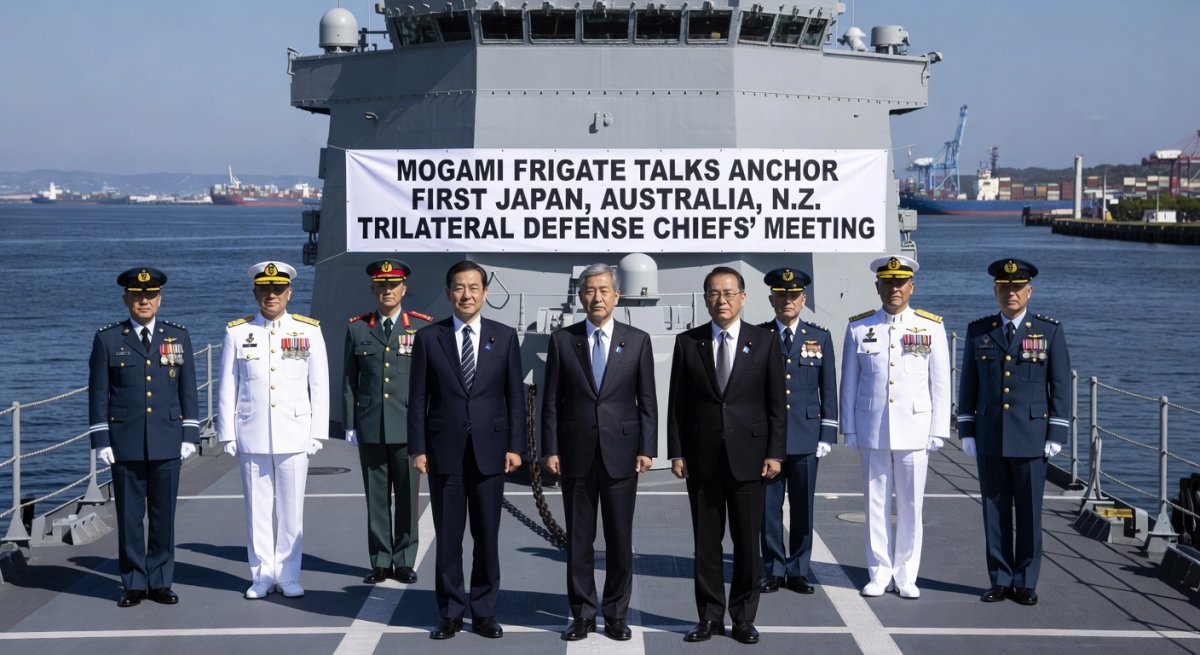
The first trilateral meeting of defense chiefs from Japan, Australia, and New Zealand marks a clear shift toward tighter coordination among three Indo-Pacific democracies that share concerns over maritime stability and supply-chain resilience. Anchored by discussions on expanding Japan’s Mogami-class frigate program to all three nations, the gathering signals the birth of a new minilateral security format that blends operational planning with advanced naval technology development.
This format arrives at a moment when regional governments are reassessing how best to maintain credible deterrence while managing the costs of next-generation platforms. By placing the Mogami frigate at the center of their agenda, the three countries are testing whether a single hull design can serve as a common backbone for interoperable fleets—an approach that could reduce duplication, shorten acquisition timelines, and create shared maintenance ecosystems.
The Emergence of a Trilateral Defense Format
The meeting itself represents more than a diplomatic milestone. It formalizes a working channel that previously existed only through overlapping bilateral arrangements. Japan maintains long-standing defense dialogues with both Australia and New Zealand; however, bringing all three defense chiefs together for the first time creates a dedicated forum for synchronized capability planning. The focus on the Mogami program gives this forum a concrete deliverable: exploring whether the vessel’s modular architecture can be adapted to meet the distinct operational requirements of each navy while preserving a common industrial base.
Such alignment matters because naval procurement cycles now stretch across decades. A platform chosen today must remain relevant amid rapid advances in sensors, propulsion, and unmanned systems. By pooling technical evaluations early, the three countries can identify shared requirements before individual procurement decisions lock in divergent specifications.
Mogami-Class Technology as a Shared Platform
The Mogami-class frigate was developed with an emphasis on automation, reduced crew size, and flexible mission modules. These characteristics make the design attractive for medium-sized navies that must balance high-end combat capability against constrained personnel numbers and budgets. In trilateral talks, officials examined how the same modular payload bays could accommodate Australian or New Zealand sensor suites, weapons, or unmanned vehicles without requiring entirely new hull variants.
This discussion extends beyond the ship itself. It touches on the digital architecture that allows rapid software updates and the logistics networks needed to sustain forward-deployed units. If the three countries agree on common data standards and maintenance protocols, they could create a de facto regional sustainment hub—an outcome that would lower long-term operating costs for all participants while strengthening collective readiness.
Strategic Context and Industrial Implications
The timing of the trilateral format reflects broader changes in defense-industrial policy. Governments across the region are seeking to diversify suppliers and deepen technology partnerships that keep critical know-how onshore or within trusted alliances. Japan’s decision to open the Mogami program to international partners fits this pattern, offering a pathway for co-development or licensed production that spreads both risk and opportunity.
Australia and New Zealand bring complementary strengths. Australia’s experience with large-scale surface combatant programs and New Zealand’s focus on patrol and constabulary roles could shape different mission packages built around the same core hull. The resulting economies of scale would benefit Japanese shipyards while giving the partner navies earlier access to proven technology than would be possible through purely domestic development.
Background Drivers Behind Closer Alignment
Maritime domain awareness remains a shared priority. All three nations rely on secure sea lanes for trade and resource imports. Expanding a common frigate design supports not only combat operations but also persistent surveillance, search-and-rescue, and disaster-response missions. The Mogami’s reduced crewing requirements further align with demographic trends in each country, where aging populations and competition for skilled personnel constrain traditional manning models.
The trilateral channel also provides a mechanism for harmonizing export-control policies and technology-transfer safeguards. As the three governments explore joint production, they must establish clear rules governing sensitive subsystems. Early alignment on these issues reduces friction that has historically delayed collaborative programs.
Forward Outlook and Next Steps
Officials are expected to continue technical working groups that will assess detailed requirements, cost-sharing models, and timelines for potential co-production. Any decision to proceed will likely involve phased milestones, beginning with shared evaluation of mission modules before moving to full industrial cooperation. The outcome will influence not only the composition of the three fleets but also the template for future minilateral defense projects in the region.
By anchoring their first collective meeting in a tangible technology program, Japan, Australia, and New Zealand have established a practical test case for deeper integration. The coming months will reveal whether the Mogami frigate can evolve from a national project into a shared capability that strengthens collective maritime security without requiring each partner to develop its own bespoke solution.
By Kenji Tanaka, Staff Writer
This article was produced with AI-assisted research and editorial support. Reporting is based on sources cited in the article.
What's Your Reaction?
 Like
0
Like
0
 Dislike
0
Dislike
0
 Love
0
Love
0
 Funny
0
Funny
0
 Wow
0
Wow
0
 Sad
0
Sad
0
 Angry
0
Angry
0

Kenji Tanaka
Japan Correspondent at Global1.News. Tokyo-based voice covering Japanese politics, technology, economy, and culture. Tracks the intersection of tradition and innovation in one of the world's most dynamic societies.













Comments (0)