
2027: Aisha Yesufu denies dropping out of FCT senatorial race
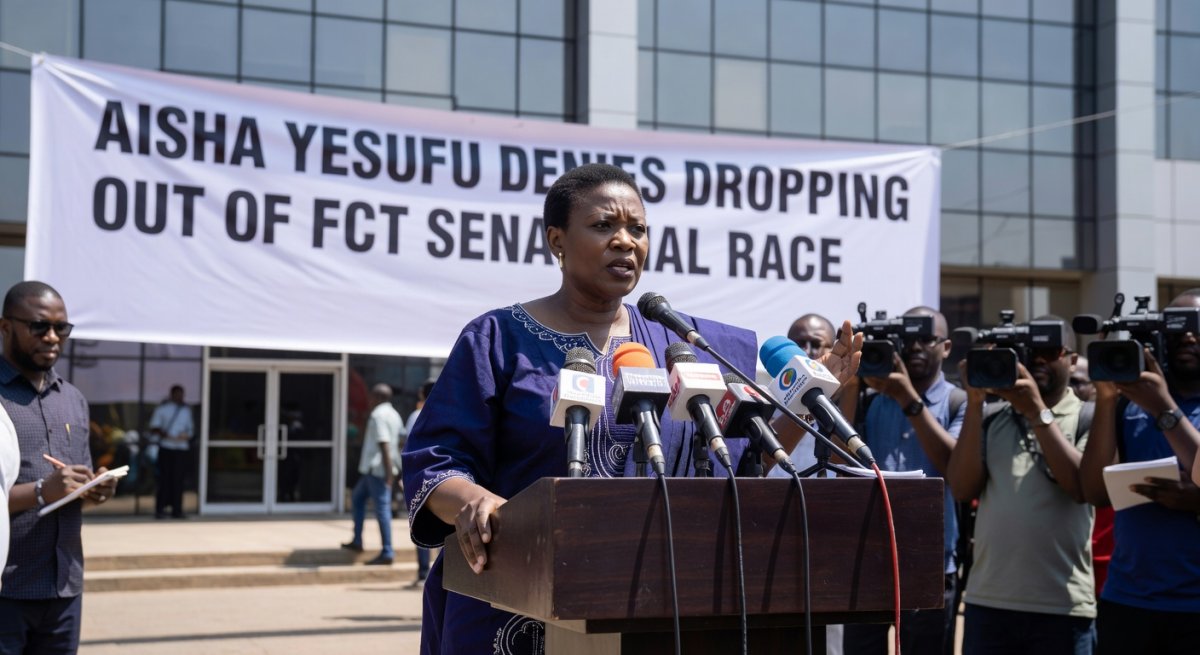
As Nigeria prepares for the 2027 general elections, the political landscape in the Federal Capital Territory continues to attract intense scrutiny, particularly around high-profile candidates whose participation could reshape opposition dynamics. Human rights activist Aisha Yesufu has now directly addressed and denied circulating claims that she has withdrawn from the FCT senatorial contest under the Nigeria Democratic Congress, reinforcing her intention to remain actively engaged in the race.
In a detailed statement shared on her verified X account, Yesufu clarified that she stayed in the contest through to the conclusion of relevant processes, countering suggestions of an early exit. This clarification arrives at a moment when electoral preparations are accelerating, with parties positioning themselves ahead of primaries and broader campaign seasons. The denial underscores the fluid nature of candidate commitments in Nigeria’s evolving political environment, where public figures often face rapid speculation amplified by social media.
The Significance of Clarifying Candidacy in FCT Politics
The Federal Capital Territory occupies a unique position in Nigeria’s federal structure, serving as both the seat of national government and a microcosm of the country’s diverse demographic and economic interests. A senatorial seat here carries weight beyond typical state representation, influencing debates on urban development, security, and federal resource allocation. Yesufu’s decision to affirm her continued involvement highlights how individual candidate statements can influence perceptions of party strength within this strategic constituency. Speculation about withdrawals often emerges during the pre-primary phase, driven by shifting alliances, funding considerations, and internal party negotiations. By addressing these rumors directly, Yesufu contributes to greater transparency at a time when voters and observers seek clarity on who will ultimately contest. This move also reflects broader patterns in Nigerian politics, where activists-turned-candidates must navigate both public expectations and the practical demands of electoral machinery.Background on Activist Engagement in Electoral Contests
Human rights advocates have increasingly entered Nigeria’s political arena in recent cycles, bringing attention to issues such as governance accountability, citizen rights, and institutional reform. Yesufu’s profile as an activist provides a distinct lens through which her senatorial ambitions are viewed, emphasizing continuity between advocacy work and legislative aspirations. The Nigeria Democratic Congress, as her platform, represents one of several smaller parties seeking to carve space in a landscape traditionally dominated by larger organizations. Such transitions from civil society to partisan politics are not without challenges. Activists often encounter questions about their ability to operate within party structures while maintaining independence on core issues. Yesufu’s public denial of withdrawal serves as an early signal of resolve, potentially setting the tone for how she intends to manage future narratives around her campaign. It also illustrates the role social media platforms now play in candidate communication, allowing direct rebuttals that bypass traditional media filters.Electoral Implications and Party Dynamics
The timing of this clarification carries implications for the Nigeria Democratic Congress and its positioning ahead of 2027. Party supporters may interpret the statement as evidence of internal cohesion, while opponents could view it as an opportunity to probe further on organizational readiness. In the FCT specifically, where voter turnout and demographic diversity can sway outcomes, consistent messaging from candidates helps consolidate support bases. Analysts note that early rumors of exits can affect fundraising, volunteer mobilization, and media coverage. By pushing back against such claims, Yesufu helps stabilize the narrative around her participation. This development also invites examination of how smaller parties build visibility in high-stakes races, often relying on recognizable figures to attract attention in an environment where established political brands hold considerable sway.Challenges and Opportunities in the Road to 2027
Contesting a senatorial seat in the FCT involves navigating complex layers of federal bureaucracy, local stakeholder interests, and national policy debates. Infrastructure deficits, security concerns, and economic pressures remain perennial topics that any candidate must address. Yesufu’s activist background positions her to foreground governance and rights-based perspectives, though translating advocacy into electoral appeal requires sustained engagement with diverse voter groups. Looking ahead, the coming months will likely feature intensified party conventions and candidate screening exercises. Yesufu’s affirmation of continued participation suggests she intends to engage these processes fully. Observers will watch how the Nigeria Democratic Congress leverages such public commitments to strengthen its overall profile, particularly as larger parties finalize their own lineups. The interplay between individual candidate statements and broader party strategy will shape much of the pre-election discourse. Ultimately, developments like this clarification remind stakeholders that candidate fields remain subject to adjustment until formal nomination deadlines pass. Yesufu’s direct communication on the matter provides one data point in an unfolding story whose full contours will emerge through subsequent primaries and campaign activities.By Sarah Okafor, Staff Writer
This article was produced with AI-assisted research and editorial support. Reporting is based on sources cited in the article.
What's Your Reaction?
 Like
0
Like
0
 Dislike
0
Dislike
0
 Love
0
Love
0
 Funny
0
Funny
0
 Wow
0
Wow
0
 Sad
0
Sad
0
 Angry
0
Angry
0

Sarah Okafor
Africa Correspondent at Global1.News. Based in Lagos, covering politics, business, technology, and culture across the continent. Focused on telling African stories beyond the headlines — the innovation, entrepreneurs, and communities shaping the region's future.













Comments (0)