
Mortar shell drops from concrete truck, sending workers fleeing
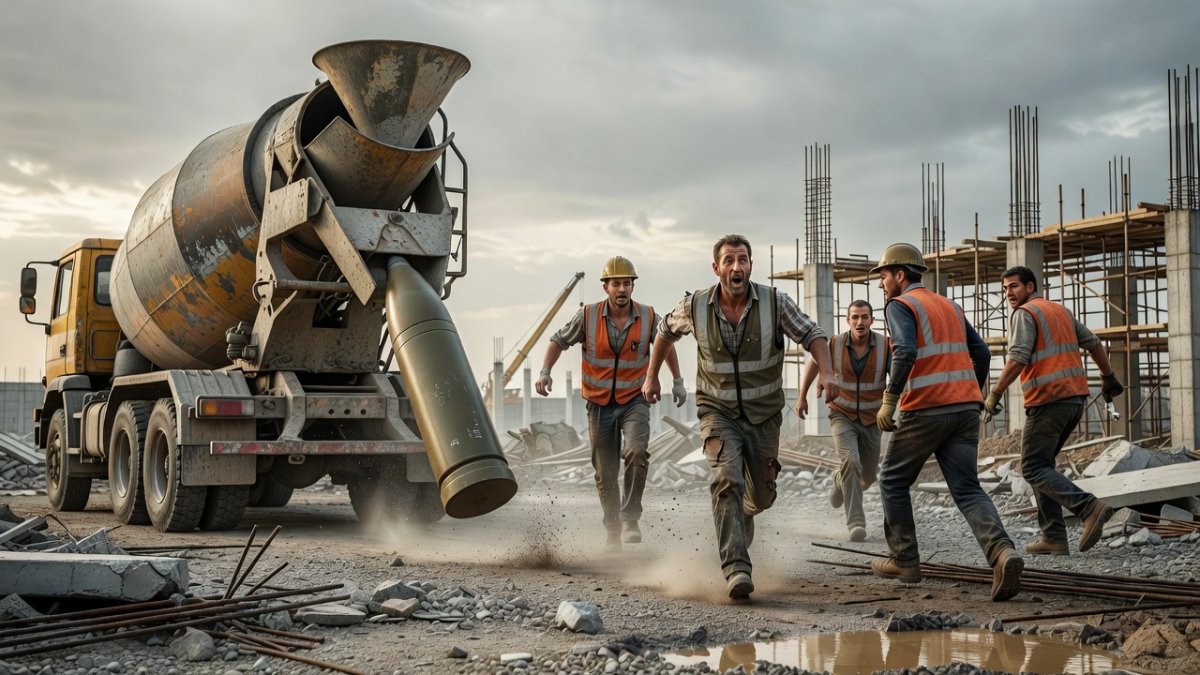
Mortar Shell Tumbles from Concrete Truck at Amnat Charoen Weir, Prompting Swift Evacuation and Renewed Calls for Safety Vigilance
The Incident Unfolds at Dawn
On the morning of 28 May 2026, a routine concrete pour at the Huai Pla Kang reservoir weir construction site in Amnat Charoen province turned into a moment of collective alarm. Workers watched in disbelief as a rusted mortar shell tumbled from the chute of a ready-mix truck and landed softly in the freshly poured foundation. Within seconds, the site foreman shouted for everyone to move back, and the 47 laborers on shift retreated to a safe distance beyond the perimeter fence.
Local police and the Royal Thai Army’s Explosive Ordnance Disposal unit arrived within forty minutes. Captain Somchai Rattanapong, who led the team, later confirmed that the 60-millimeter shell appeared to date from mid-twentieth-century military stockpiles. “It was inert at the time of discovery, yet any unexploded ordnance demands the highest caution,” he told Global1 News. The shell was transported to a controlled detonation area outside the district and rendered safe by 11:15 a.m.
Life in Amnat Charoen’s Quiet Northeast
Amnat Charoen sits in Thailand’s Isan heartland, where rice fields stretch toward the Mekong and small reservoirs anchor entire tambon economies. The Huai Pla Kang weir, now 68 percent complete, is slated to irrigate an additional 2,400 rai of farmland once operational in late 2027. For families who have farmed these sandy soils for generations, the project represents both hope and livelihood security in a region where annual rainfall can swing by 40 percent.
Construction supervisor Nongluck Srisawat—no relation—described the morning’s tension. “We pour 18 cubic meters every shift. The truck arrived at 6:40. When the shell dropped, I thought first of the young men who had just climbed down from the forms. Their safety is my only thought.”
Historical Context of Unexploded Ordnance in Thailand
Thailand’s northeastern provinces still encounter remnants from earlier decades of regional conflict and domestic military training. The Thailand Mine Action Center reports that between 2018 and 2025, 312 explosive remnants were recovered across seven Isan provinces, the majority 60-millimeter and 81-millimeter mortars. Amnat Charoen itself accounts for 19 documented finds since 2020, most discovered during road widening or irrigation works.
Dr. Prasert Wongchai, a Chiang Mai University geographer who studies post-conflict landscapes, notes that many shells entered the local environment through informal scrap-metal networks decades ago. “Material from old firing ranges sometimes gets mixed into aggregate sources. Modern screening technology exists, yet smaller suppliers in rural areas may not always apply it,” he explained.
Worker Testimonies and Immediate Response
Twenty-three-year-old mason Prawit Inthachak recalled the collective breath held after the shell appeared. “We all stepped back together—no one ran in panic, but we moved with purpose. The older men made sure the newest apprentices were counted first.” Such quiet coordination reflects the community-oriented spirit that defines Isan work sites.
Within an hour, the Provincial Public Works Department ordered a temporary halt. Concrete already poured around the discovery point will be core-sampled next week to confirm structural integrity. The remaining 320 cubic meters scheduled for the week have been rescheduled, costing the project an estimated 480,000 baht in delays and equipment repositioning.
Regulatory and Industry Implications
Thailand’s Department of Labour Protection and Welfare mandates that construction sites within former military training zones conduct magnetometer sweeps before excavation. The Huai Pla Kang contractor, however, had relied on aggregate sourced from a quarry 18 kilometers away whose license does not list proximity to historical ranges. An inter-agency review will examine whether current permitting rules sufficiently trace material origins.
Industry analyst Khunying Suchada Limthongkul argues that the episode highlights a broader need for digital traceability. “If every load ticket carried GPS-tagged quarry data and batch screening certificates, incidents like this would drop sharply. The technology is affordable; adoption in smaller provinces is the missing piece.”
Community Perspective and Cultural Resonance
At the nearby Ban Nong Hin temple, Abbot Phra Khru Somchai offered morning blessings for the workers’ safety. “We live close to the land. When something from the past surfaces, it reminds us to care for one another first,” he said. Villagers gathered at the temple grounds later expressed gratitude that no one was injured and voiced continued support for the weir, which they believe will bring water security to 1,150 households.
Local farmer Somsak Meesuk, whose paddies lie 400 meters from the site, sees the event as a teachable moment. “Our children will operate the weir gates one day. They must learn that progress and caution walk together.”
Looking Ahead
Provincial authorities have requested additional funding for handheld detectors and training for site supervisors. The Ministry of Interior is considering a pilot program requiring quarry operators in eight northeastern provinces to submit quarterly UXO risk assessments. For now, work at Huai Pla Kang resumes tomorrow under heightened monitoring, with daily briefings that begin, as always, with a moment of collective silence for safety.
The mortar shell itself has been logged, photographed, and archived at the Amnat Charoen army base museum, where students on field trips learn both the region’s history and the quiet diligence required to build its future.
This is Ann Srisawat for Global1 News, reporting from Bangkok. 🇹🇭
This article was produced with AI-assisted research and editorial support. Reporting is based on sources cited in the article.
What's Your Reaction?
 Like
0
Like
0
 Dislike
0
Dislike
0
 Love
0
Love
0
 Funny
0
Funny
0
 Wow
0
Wow
0
 Sad
0
Sad
0
 Angry
0
Angry
0

Southeast Asia Correspondent at Global1.News. Based in Bangkok, covering Thai and Southeast Asian politics, economy, technology, and culture. Deep regional perspective on one of the world's most dynamic regions.













Comments (0)