
Lukashenko Apologizes to Zelensky: Belarus Backs Away from Putin's War
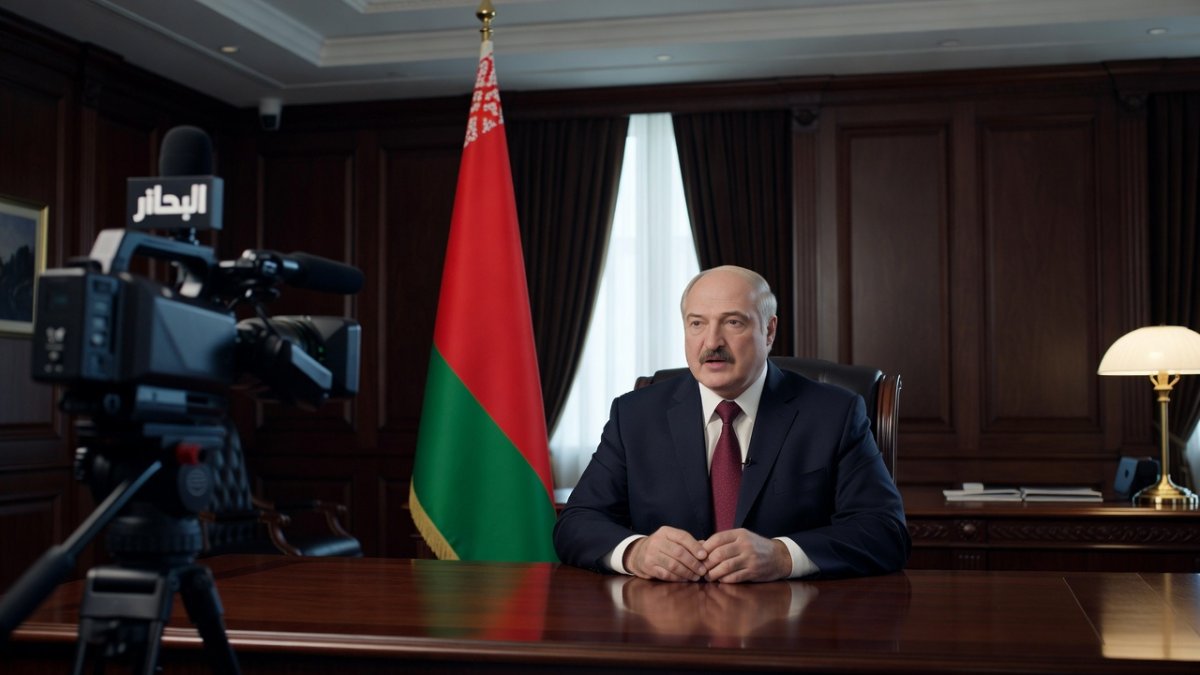
The Al Arabiya Interview That Reshaped the Northern Front On June 16, 2026, Belarusian President Alexander Lukashenko sat down with Al Arabiya, the Saudi-based Arabic news channel, and did something no one expected. He apologized directly to Ukrainian President Volodymyr Zelensky. According to Meduza's report of the interview, Lukashenko said: "If Vladimir Alexandrovich took of
The Al Arabiya Interview That Reshaped the Northern Front
On June 16, 2026, Belarusian President Alexander Lukashenko sat down with Al Arabiya, the Saudi-based Arabic news channel, and did something no one expected. He apologized directly to Ukrainian President Volodymyr Zelensky. According to Meduza's report of the interview, Lukashenko said: "If Vladimir Alexandrovich took offense, I apologize to him for those words. Maybe it wasn't necessary, given that he is, after all, fighting a war." The apology referred to earlier harsh comments Lukashenko had made in late May. But he did not stop there. Lukashenko admitted Belarus is "very vulnerable" militarily, called drawing his country deeper into Russia's war "unacceptable," and told Kyiv to "calm down" because no attack from Belarusian territory would occur. He then made an even more striking claim: neither Russia nor Ukraine can win this war militarily, because both sides are running out of soldiers. The interview, also reported by UNN and CiberCuba, represents the most significant public break between Lukashenko and the Kremlin's war narrative since the invasion began in 2022.
The strategic weight of this interview cannot be overstated. Lukashenko has ruled Belarus for more than three decades and was sworn into his seventh term in May 2026. He is the man who allowed Russian forces to use Belarusian territory as the staging ground for the assault on Kyiv in February 2022. Without that northern corridor, Russia's initial invasion would have been even more constrained. For the same leader to now sit before an Arabic television audience and publicly apologize to the man Russian state media calls a "neo-Nazi" represents a tectonic shift in the alliance dynamics that have shaped this war from day one.
The apology itself was carefully worded but unambiguous. Lukashenko did not qualify it or walk it back mid-sentence. He acknowledged that Zelensky is "fighting a war" and that perhaps his own harsh words were unnecessary. In the context of a leader known for bluster and threats, this was as close to a diplomatic olive branch as Lukashenko has ever extended to Kyiv.
Why an Apology Matters More Than a Battlefield Win
Lukashenko's apology carries outsized weight because he personally enabled Russia's opening thrust against Kyiv in February 2022. Belarusian territory served as the primary staging area for the northern axis, allowing Russian armor and airborne units to cross the border and race toward the Ukrainian capital. Without that corridor, Moscow's initial plan would have been far narrower and more vulnerable to early Ukrainian counter-moves. By publicly distancing himself now, Lukashenko has altered the strategic map in ways a single battlefield victory could not.
The northern flank has always represented Russia's shortest route to Kyiv. Belarusian airfields, rail lines, and roads offered rapid access that bypassed heavily defended eastern approaches. If Minsk becomes an unreliable partner, Russia loses the ability to reconstitute that axis without first securing political guarantees or deploying additional forces to police its own ally. Ukrainian planners can therefore shift resources away from the northern border, concentrating instead on the east and south where fighting remains most intense.
More broadly, the apology signals that Lukashenko values regime survival over alliance loyalty. His admission that deeper involvement is unacceptable tells Kyiv and Western capitals that Belarusian territory is no longer automatically available for Russian operations. This recalibration reduces the risk of a renewed northern offensive and forces Moscow to plan without its most convenient geographic advantage. In strategic terms, one carefully worded interview has achieved what months of attritional fighting have not: it has narrowed Russia's operational options without a single additional shot being fired.
What "Very Vulnerable" Actually Means on the Ground
Belarus maintains roughly 45,000 active-duty troops equipped with aging Soviet-era armor, artillery, and aircraft whose maintenance has been chronically underfunded. Much of this equipment dates to the 1980s and lacks modern electronics or precision munitions. Training levels remain low, and the force has not conducted large-scale combined-arms exercises since before the 2022 invasion. Lukashenko's description of Belarus as "very vulnerable" therefore reflects concrete readiness shortfalls rather than diplomatic posturing.
Domestic political realities compound these material weaknesses. Public opposition to joining Russia's war runs near universal levels across Belarusian society. Conscription already faces widespread evasion, and any order to deploy units into Ukraine would likely trigger mass desertions or internal unrest. Lukashenko has watched Russian forces suffer heavy losses and knows his own smaller, less capable army would fare even worse. His televised admission serves as an implicit warning to Moscow that Belarus cannot absorb the casualties or the political cost of deeper participation.
On the ground, these constraints translate into limited border coverage and reliance on static defenses rather than mobile reserves. Air-defense systems are sparse and poorly integrated, leaving Belarusian airspace exposed. The combination of obsolete hardware, hollow units, and hostile public opinion means any Russian attempt to pressure Minsk into renewed cooperation would encounter both military and political friction. Lukashenko's words accurately describe a force that is present on paper but largely unavailable for sustained offensive operations.
Zelensky's Ultimatum: June 19 Demand and June 21 Escalation
Ukraine's response to the apology has been deliberately measured and conditional. On June 19, President Zelensky publicly demanded the immediate removal of Russian-supplied drone jammers positioned along the Belarusian border. These systems have restricted Ukrainian reconnaissance and strike drones, giving Belarusian and Russian forces an asymmetric advantage in monitoring cross-border activity. Zelensky framed the demand as a concrete test of Minsk's new posture rather than an acceptance of verbal assurances.
Two days later, on June 21, Zelensky escalated the rhetoric by stating that Ukraine would act unilaterally if the jammers remained in place. This warning signaled that Kyiv views the Al Arabiya interview as cheap talk until physical changes occur on the ground. Ukrainian forces have already demonstrated the capacity to strike targets inside Belarusian territory when necessary, and the ultimatum serves as both a diplomatic signal and a military planning benchmark.
The sequence illustrates how Kyiv treats diplomatic gestures from Minsk: as reversible statements that require verification through hardware movement. By setting a short timeline and threatening independent action, Zelensky has placed the burden of proof on Lukashenko. Any failure to comply risks renewed Ukrainian strikes and further erosion of Belarusian sovereignty claims. The approach keeps pressure on Minsk while preserving Ukrainian freedom of action along the northern frontier.
Troop Shortages: Lukashenko Confirms What Analysts Have Been Saying
Lukashenko's assertion that neither Russia nor Ukraine can achieve military victory because both face acute troop shortages aligns with assessments long circulated by independent military analysts. Russia has sustained massive casualties since 2022, with estimates of killed and wounded exceeding 500,000. These losses have forced Moscow to rely on poorly trained convict units, foreign mercenaries, and increasingly coercive mobilization measures that have strained domestic stability.
Ukraine, meanwhile, continues to struggle with replacing its most experienced formations. Early volunteers and professional soldiers have been depleted by years of high-intensity combat, while newer recruits often lack equivalent training or unit cohesion. Kyiv's decision to lower the mobilization age and tighten deferment rules reflects the same demographic pressure Lukashenko identified. Both sides are therefore locked in an attritional contest where incremental territorial gains come at unsustainable human cost.
The Belarusian leader's public confirmation adds weight to these observations because it comes from a figure with direct insight into Russian planning. By stating that military victory is impossible for either side, Lukashenko has effectively endorsed the view that the war has entered a prolonged stalemate phase. This assessment undercuts Russian propaganda narratives of inevitable triumph and simultaneously cautions Ukrainian hardliners against expecting a decisive battlefield breakthrough. The result is a more realistic appraisal of the conflict's trajectory shared across adversarial capitals.
Moscow's Dilemma: The Alliance Is Not What It Used to Be
Putin's closest formal ally has now freelanced on Arabic television, undercutting years of Russian propaganda about unbreakable Slavic unity. State media in Moscow has portrayed the Belarusian-Russian relationship as a model of strategic partnership, yet Lukashenko's apology and vulnerability claims expose the limits of that narrative. The interview reveals a leader willing to prioritize his own political survival over automatic alignment with Kremlin war aims.
If Belarus restricts access to its territory or airfields, Moscow loses the northern axis entirely. Russian planners would then face the choice of either accepting a permanently narrowed front or attempting to coerce Minsk through economic pressure and security guarantees. Both options carry significant costs: the first reduces operational flexibility, while the second risks further alienating an already reluctant partner. The result is a more complicated logistics picture for any future Russian offensive planning.
More damaging still is the precedent. Other post-Soviet states watching the interview may conclude that public deviation from Moscow's line carries fewer consequences than previously assumed. Lukashenko's move has introduced daylight into an alliance previously presented as monolithic, forcing Russian diplomats to expend energy reassuring nervous partners rather than projecting strength. The long-term erosion of alliance cohesion may prove more consequential than any single tactical adjustment along the northern border.
What Americans Need to Watch in the Weeks Ahead
Three developments will determine whether Lukashenko's interview produces lasting change. First, will Belarus actually remove the Russian drone jammers along the border? Compliance would represent tangible proof that Minsk intends to reduce its role in the conflict; continued presence would confirm the apology as empty rhetoric. Observers should track satellite imagery and open-source reporting for signs of equipment movement in the coming weeks.
Second, can Zelensky enforce his ultimatum without triggering wider escalation? Ukrainian strikes on Belarusian territory remain possible but carry risks of Russian retaliation. The manner in which Kyiv calibrates any response will reveal how seriously it treats the northern flank as a potential de-escalation zone. Third, what happens to U.S. aid calculations if the northern threat genuinely softens? Reduced pressure on that axis could allow Washington to adjust munitions flows or encourage Ukrainian force reallocations elsewhere.
Folks, monitoring these three indicators will clarify whether the Al Arabiya interview marks a genuine strategic shift or merely another episode of Lukashenko's long-running balancing act.
By Jessica Ali, Global 1 News
This article was produced with AI-assisted research and editorial support. Reporting is based on sources cited in the article.
What's Your Reaction?
 Like
0
Like
0
 Dislike
0
Dislike
0
 Love
0
Love
0
 Funny
0
Funny
0
 Wow
0
Wow
0
 Sad
0
Sad
0
 Angry
0
Angry
0

Editor-in-Chief at Global1.News. Atlanta-based journalist who cuts through the BS and tells it like it is. Lead anchor, host, and the voice you hear when the spin stops and the truth starts.











Comments (0)