
Strengthening Bilateral Defense Ties: Koizumi Shinjiro's Seoul Visit Marks Milestone in Japan-South Korea Relations
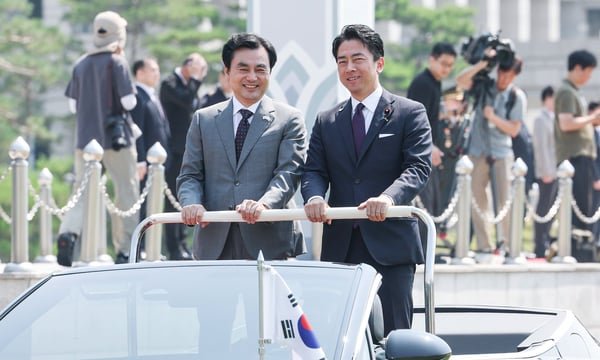
Historical Context of Defense Minister Exchanges The recent two-day visit by Japanese Defense Minister Koizumi Shinjiro to Seoul on June 27-28 represents a notable development in the trajectory of Japan-South Korea defense relations. This trip, which included direct talks with South Korean counterpart Ahn Gyu-back, reciprocated Ahn's earlier visit to Tokyo in January. For the t
Historical Context of Defense Minister Exchanges
The recent two-day visit by Japanese Defense Minister Koizumi Shinjiro to Seoul on June 27-28 represents a notable development in the trajectory of Japan-South Korea defense relations. This trip, which included direct talks with South Korean counterpart Ahn Gyu-back, reciprocated Ahn's earlier visit to Tokyo in January. For the two ministers personally, the Seoul meetings constituted their fourth face-to-face encounter since last November, out of six total meetings to date.
These interactions build upon a prior high-level engagement in September 2025, when then-Japanese Defense Minister Nakatani Gen traveled to Seoul to meet his South Korean counterpart Han Min-koo. That earlier visit had symbolized the conclusion of a decade-long diplomatic hiatus between the two countries. The latest exchanges further underscore a pattern of resumed high-level contact, occurring as the second instance in history, repeated after 23 years, in which Japanese and South Korean defense ministers have exchanged visits within a single year.
Symbolic Actions and Unprecedented Joint Activities
During the visit, Koizumi and Ahn jointly visited South Korea's Black Eagles aerobatic team at the Wonju Air Base in an action described as unprecedented for a foreign defense minister. This gesture carried particular weight given the history of similar engagements. The previous comparable visit occurred in September 2025 under Nakatani, highlighting how such activities now serve as markers of normalized interaction following earlier strains.
The joint statement issued after the talks emphasized continued development of cooperation between the aerobatic teams of both nations, specifically referencing Japan's Blue Impulse and South Korea's Black Eagles. This commitment stands in contrast to Japan's earlier refusal to provide refueling support for the Black Eagles in November 2025, an episode linked to the Dokdo/Takeshima territorial dispute involving one of the aircraft. While the new statement does not establish regular refueling arrangements for South Korean military aircraft, it illustrates incremental movement on an issue long tied to bilateral frictions.
Upgrades in Institutional Cooperation Frameworks
Beyond symbolism, the talks reflected ongoing institutional enhancements in defense cooperation. Just weeks prior, Tokyo and Seoul had resumed joint maritime search-and-rescue exercises, known as SAREX, after a nine-year interruption. These exercises followed the first "2+2" vice-ministerial talks between the foreign and defense ministries of both countries, held in Seoul on May 7 and representing an elevation from the director-general level format initiated in 1998.
Such developments point to a steady normalization of defense authority interactions since the 2018 incident involving a South Korean naval vessel and a Japanese Maritime Self-Defense Force patrol plane. The ministers reaffirmed shared objectives of complete denuclearization of the Korean Peninsula and permanent peace in the region, a statement issued one day after a joint China-Russia air drill near the peninsula. This timing conveyed coordinated messaging amid broader regional pressures, including North Korea's nuclear program, Russia-North Korea military cooperation, and Beijing's military buildup.
The ACSA Question and Its Political Sensitivities
One notable absence from the joint statement concerned any reference to concluding an Acquisition and Cross-Servicing Agreement, or ACSA, a military logistics support pact that Japan has long sought with Seoul. Japan had pursued such an agreement during South Korea's Lee Myung-bak administration in 2012, yet the proposal encountered strong public disapproval in South Korea at the time. Lingering concerns in South Korea center on the possibility that an ACSA could facilitate the deployment of Japanese forces on South Korean territory.
Despite this history, ACSA discussions have resurfaced in recent months amid shifting regional security conditions. If concluded, such an agreement would enhance interoperability and support joint activities between the two forces, particularly in emergencies requiring logistical assistance for U.S. forces stationed in Japan and South Korea. Seoul has approached the matter with caution, recognizing its political sensitivity and the potential for the scope of cooperation to expand over time.
Implications for South Korean Foreign Policy and Inter-Korean Dynamics
These defense engagements occur against the backdrop of the Lee Jae-myung administration's efforts to maintain balanced relations with the United States, Japan, China, and Russia. The administration seeks support for resuming talks and improving ties with Pyongyang, making any perception of tightened trilateral cooperation with Washington and Tokyo a matter of careful calibration. Beijing or Pyongyang could interpret expanded arrangements as deliberate alignment, with potential detrimental effects for South Korea's diplomatic positioning.
Historical resentments stemming from Japanese colonial rule between 1910 and 1945 continue to influence public understanding in South Korea, adding layers of complexity to deeper military coordination. The visit thus illustrates how defense cooperation advances alongside these domestic and regional considerations, particularly as the United States has pressed allies including Japan and South Korea for greater burden-sharing.
Strategic Significance and Outlook for Northeast Asian Security
The sequence of visits, exercises, and institutional upgrades signals proactive coordination by Tokyo and Seoul to address common security challenges in Northeast Asia. By engaging at multiple levels, from aerobatic team collaboration to vice-ministerial formats, the two countries demonstrate a pattern of incremental trust-building that extends beyond immediate crisis response.
Future progress on issues such as ACSA will depend on securing broader public understanding in South Korea while ensuring that expanded cooperation remains focused on peninsula-specific contingencies. This approach allows Seoul to navigate its strategic environment without compromising its objectives regarding inter-Korean relations or balanced great-power engagement. The overall trajectory suggests sustained, if measured, advancement in bilateral defense ties with direct relevance to stability on the Korean Peninsula.
By Prof. David Park, Staff WriterThis article was produced with AI-assisted research and editorial support. Reporting is based on sources cited in the article.
What's Your Reaction?
 Like
0
Like
0
 Dislike
0
Dislike
0
 Love
0
Love
0
 Funny
0
Funny
0
 Wow
0
Wow
0
 Sad
0
Sad
0
 Angry
0
Angry
0

East Asia/Technology Correspondent at Global1.News. Seoul-based voice covering Korean politics, technology, business, and culture. Analyzes how technology and geopolitics intersect across East Asia.













Comments (0)