
Indian Joint Air Defense Doctrine: Implications for South Asian and Northeast Asian Stability
Release and Strategic Context The Indian Joint Air Defense Doctrine was released on May 29, 2026, by Chief of Defence Staff General Anil Chauhan, who retired the following day. This timing placed the publication immediately after the May 2025 India-Pakistan crisis, during which Operation Sindoor and Marka-e-Haq demonstrated the risks of rapid escalation involving drones and pre
Release and Strategic Context
The Indian Joint Air Defense Doctrine was released on May 29, 2026, by Chief of Defence Staff General Anil Chauhan, who retired the following day. This timing placed the publication immediately after the May 2025 India-Pakistan crisis, during which Operation Sindoor and Marka-e-Haq demonstrated the risks of rapid escalation involving drones and precision strikes. The doctrine emerged within a year of Prime Minister Narendra Modi’s Sudarshan Chakra initiative, which seeks to establish an indigenous equivalent to systems such as Iron Dome. Issued by Headquarters Integrated Defence Staff, it constitutes the sixth joint doctrine, following earlier publications on multi-domain operations, cyberspace, amphibious operations, special forces, and airborne forces. In the South Asian context, the document responds to saturation threats observed in the 2025 crisis while advancing long-term structural reforms. The release underscores India’s effort to codify integrated air defense at a moment when regional deterrence dynamics remain fragile. By linking operational lessons from the recent standoff to institutional change, the doctrine signals a deliberate move toward theater command structures. Its appearance also reflects broader strategic calculations about how defensive modernization may influence stability calculations between India and Pakistan, with potential ripple effects extending to other Asian theaters where similar capability developments are under way.
Architecture of the Air Defense Doctrine
The doctrine centers on a kill-web architecture that integrates sensors, command nodes, and effectors across the three services. This networked approach enables real-time data sharing and coordinated engagement against diverse aerial threats, including drones, loitering munitions, precision-guided munitions, cruise missiles, ballistic missiles, and saturation attacks. Layered defense principles guide the allocation of assets to different altitude and range bands, allowing flexible responses calibrated to threat profiles. The framework directly supports India’s theater command ambitions by establishing common operating procedures that transcend single-service boundaries. As the sixth joint doctrine produced by Headquarters Integrated Defence Staff, it builds upon prior work in multi-domain operations and cyberspace to create a coherent joint operational culture. In practice, the kill-web concept reduces service-specific silos and prepares the ground for future integrated commands. Within South Asia, this architecture is intended to enhance defensive resilience following the 2025 crisis. At the same time, the emphasis on joint integration mirrors parallel efforts elsewhere in Asia, where states are similarly seeking to synchronize air and missile defense assets under unified command arrangements to manage complex threat environments.
India's Ballistic Missile Defense Buildup
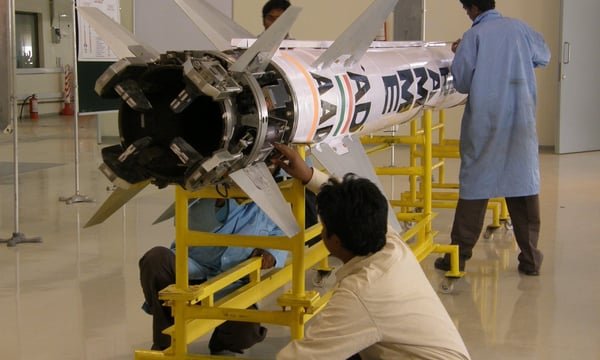
India’s ballistic missile defense capabilities form a core component of the new doctrine. Five Russian S-400 batteries have already been delivered, with five additional units approved for acquisition. Indigenous systems include the Prithvi Air Defence (PAD) interceptor, designed for exo-atmospheric engagements between 50 and 180 kilometers, and the Ashwin Advanced Air Defence (AAD) interceptor, optimized for endo-atmospheric intercepts at 20 to 40 kilometers. Complementing these are the Akash medium-range surface-to-air missile and the SPYDER system for shorter-range threats. The doctrine provides the conceptual framework for integrating these disparate platforms into a unified kill-web. Command nodes are tasked with fusing data from multiple sensors to assign engagements across the layered architecture. This integration addresses gaps that became evident during the 2025 crisis and supports the Sudarshan Chakra vision of an indigenous, multi-tiered shield. In the South Asian setting, the combination of imported and domestic systems illustrates India’s dual-track approach to capability development. The doctrine’s emphasis on interoperability among these assets represents a concrete step toward the theater command model, while also highlighting the technical and organizational challenges of merging Russian-origin equipment with Indian-designed interceptors under a single operational doctrine.
Strategic Stability Concerns in South Asia
Defensive systems of the type outlined in the doctrine can generate negative stability outcomes in South Asia, as noted in the document’s own analysis. By compressing escalation ladders, integrated air defenses may encourage preemptive or saturation strikes designed to overwhelm protective layers before they can be fully activated. Pakistan is likely to pursue countermeasures, including expanded missile inventories and electronic warfare capabilities, potentially fueling an arms race dynamic. Deterrence theory suggests that when one side perceives its defensive shield as robust, the other may seek to restore credibility through offensive enhancements, thereby raising overall instability. The May 2025 crisis already illustrated how quickly air and missile exchanges can intensify; the new doctrine risks institutionalizing this pattern. In the regional context, these developments affect not only India-Pakistan calculations but also broader perceptions of strategic balance. States observing the evolution of Indian capabilities may adjust their own force postures accordingly. The doctrine therefore presents a paradox: while intended to enhance security, its layered architecture and kill-web integration could inadvertently accelerate competitive modernization cycles across South Asia, with implications that extend beyond the immediate bilateral relationship.
Parallels with South Korean Air and Missile Defense
India’s tri-service integration under the kill-web model invites comparison with South Korea’s Korea Air and Missile Defense (KAMD) system and the forthcoming L-SAM interceptor. Whereas India is consolidating assets across army, navy, and air force commands, South Korea operates within the combined command structure of the Republic of Korea Ministry of National Defense and Joint Chiefs of Staff, closely coordinated with United States Forces Korea. Both approaches seek to fuse sensors and effectors against ballistic and cruise missile threats, yet India’s doctrine emphasizes indigenous jointness while Korea relies on alliance interoperability. Technology cooperation between the two countries remains limited but could expand in areas such as radar and command software, given shared concerns about saturation attacks. Arms race dynamics on the Korean Peninsula, documented in studies by the Korea Institute for Defense Analyses, demonstrate how defensive buildups can prompt quantitative and qualitative responses from the Democratic People’s Republic of Korea. Similar patterns are observable in South Asia. The Asan Institute and KIDA analyses highlight how integrated air defense developments in one theater can influence procurement decisions in another, creating interconnected security ecosystems across Asia. India’s doctrinal evolution thus offers a reference point for Korean planners assessing the long-term implications of their own layered defense architecture.
Broader Asian Security Implications
The diffusion of integrated air defense doctrines across Asia is reshaping threat perceptions and capability development trajectories. South Asian and Northeast Asian security ecosystems are becoming increasingly interconnected through shared concerns over missile proliferation, drone swarms, and command integration. The Indian doctrine’s focus on kill-web architecture parallels ongoing efforts in other capitals to achieve cross-service coordination. Think tanks such as the Asan Institute and KIDA play a central role in analyzing these linkages, producing studies that trace how defensive modernization in one region influences strategic choices elsewhere. In this environment, India’s move toward theater commands may encourage parallel institutional reforms in Northeast Asia, while Korean and Japanese investments in systems such as L-SAM and Aegis Ashore could feed back into South Asian calculations. The result is a more densely coupled regional security architecture in which developments in ballistic missile defense and joint doctrine are no longer viewed in isolation. Cautious observers note that these interconnections raise the stakes for miscalculation, as actions taken to strengthen national defenses may be interpreted as threatening by multiple actors simultaneously. The doctrine released on May 29, 2026, therefore forms part of a wider Asian pattern whose full implications will unfold over the coming decade.
By Prof. David Park, Staff WriterThis article was produced with AI-assisted research and editorial support. Reporting is based on sources cited in the article.
What's Your Reaction?
 Like
0
Like
0
 Dislike
0
Dislike
0
 Love
0
Love
0
 Funny
0
Funny
0
 Wow
0
Wow
0
 Sad
0
Sad
0
 Angry
0
Angry
0

East Asia/Technology Correspondent at Global1.News. Seoul-based voice covering Korean politics, technology, business, and culture. Analyzes how technology and geopolitics intersect across East Asia.















Comments (0)