
Hilton's California Governor Race and Cameron Legacy
Steve Hilton’s insurgent bid for California governor has thrust his David Cameron-era playbook back into sharp focus, with a Channel 4 News interview exposing how the former No 10 strategist now blames Democrat governance for petrol prices worse than those during the Iran conflict. Anushka Asthana’s 17 June 2026 grilling laid bare the 24.7 percent primary showing that left Hilt
Steve Hilton’s insurgent bid for California governor has thrust his David Cameron-era playbook back into sharp focus, with a Channel 4 News interview exposing how the former No 10 strategist now blames Democrat governance for petrol prices worse than those during the Iran conflict. Anushka Asthana’s 17 June 2026 grilling laid bare the 24.7 percent primary showing that left Hilton trailing Xavier Becerra by roughly 360,900 votes, yet still positioned to test whether his radical tax-slashing and smartphone-ban platform can dent the Democrat 52-31 lead heading into November. The race carries direct resonance for British voters still grappling with the legacy of the 2010-2015 coalition’s localism drive and welfare overhaul, policies Hilton helped shape before renouncing citizenship in 2019. His claim that California’s $5.89 per gallon petrol stems from regulatory excess rather than global events mirrors ongoing Treasury debates over fuel duty freezes and their effect on household budgets from Newcastle to Birmingham. As the former “Huskies and Hoodies” rebrander courts Trump’s endorsement, Westminster observers note uncomfortable parallels with current Conservative struggles to articulate a post-Brexit growth story amid stagnant real wages.
From No 10 to Sacramento: Steve Hilton’s California Gamble Revives Cameron-Era Questions
London, UK – 18 June 2026 — Hilton’s California campaign has forced renewed scrutiny of the precise mechanisms through which his 2010-2012 strategy unit operated inside the Cabinet Office.
Hilton’s Influence Inside Cameron’s No 10
Between 2010 and 2012 Steve Hilton directed the Prime Minister’s Strategy Unit, a small team of roughly fifteen advisers housed within the Cabinet Office that reported directly to Oliver Letwin and worked alongside Treasury officials including permanent secretary Nicholas Macpherson. The unit drove the Big Society narrative that underpinned the Localism Act 2011, transferring planning powers to neighbourhood forums and parish councils while simultaneously advancing the Welfare Reform Act 2012 that introduced universal credit under Iain Duncan Smith’s Department for Work and Pensions. Hilton’s weekly meetings with Cabinet Office implementation teams monitored progress on community budgets piloted in Essex and Cheshire, measures explicitly designed to reduce central government headcount by 2015. These same decentralisation instincts now animate his California housing deregulation pledge, yet critics in both countries argue the approach failed to arrest rising rents and widening regional inequality. The Treasury’s own distributional analysis of the 2012 Act showed working-age households in the bottom two income deciles facing average annual losses of £1,200 once transitional protections expired, figures that continue to shape Labour’s attack lines on Conservative fiscal credibility today.
Renunciation and the Move West
After leaving Downing Street in 2012 Hilton relocated permanently to California, appearing regularly on Fox News before formally renouncing British citizenship in 2019 to pursue business and media interests. His April 2025 campaign launch and subsequent April 2026 endorsement from Donald Trump reframed the former Conservative moderniser as an anti-establishment outsider, a positioning that has unsettled former colleagues who recall his role in the 2015 general election victory. The decision to surrender his UK passport removed any lingering diplomatic complications yet also severed formal ties to the Conservative Party structures that once nurtured his rapid ascent. British diplomats in Washington noted the move with quiet concern, aware that Hilton’s subsequent media commentary frequently criticised both Theresa May’s and Boris Johnson’s governments on regulatory matters now central to his Sacramento platform.
Primary Performance and November Outlook
On 2 June 2026 Hilton secured 24.7 percent of the Republican primary vote, finishing second to former attorney general Xavier Becerra and trailing by approximately 360,900 ballots in a contest that drew unusually high turnout for an off-year primary. Current polling conducted by the Public Policy Institute of California shows Becerra maintaining a 52-31 lead among likely November voters, with Hilton’s support concentrated in inland counties where petrol prices and housing costs bite hardest. The 31 percent figure nevertheless represents a ceiling that would require unprecedented crossover from independent voters disillusioned by Sacramento’s handling of energy costs and homelessness. Westminster strategists monitoring the race see echoes of the 2019 European Parliament elections, when insurgent candidates briefly threatened established party machines before collapsing under the weight of first-past-the-post realities.
Platform Promises and the Channel 4 Exchange
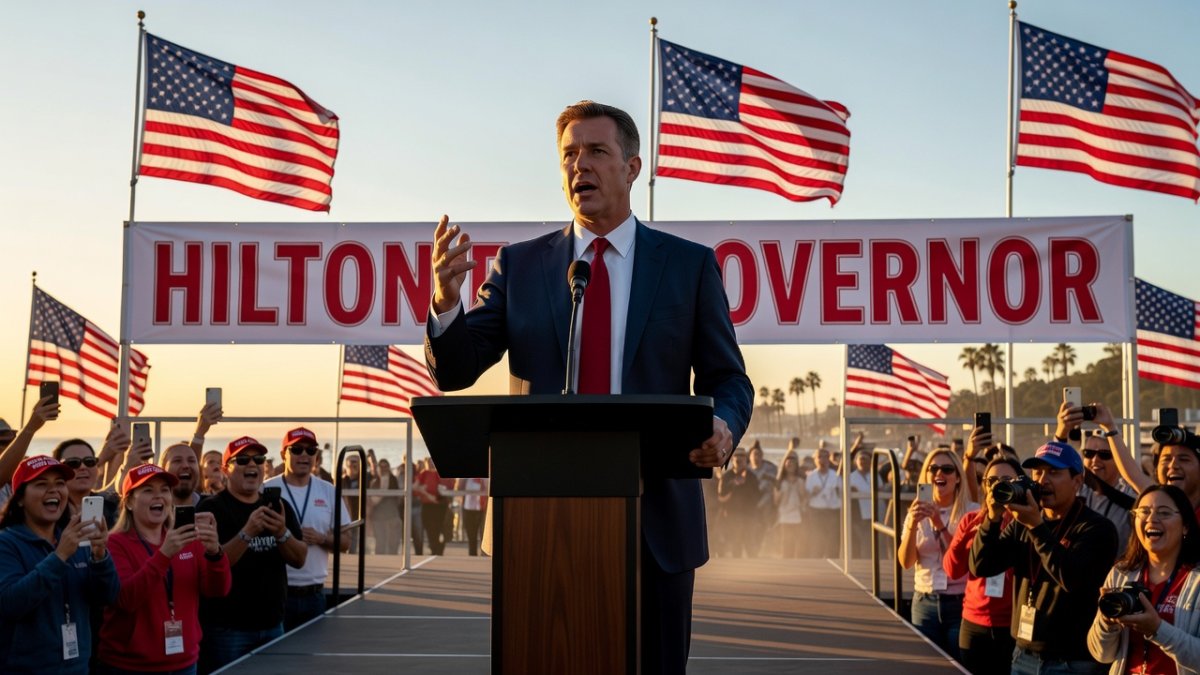
Hilton’s core pledges include abolishing California’s state income tax at an estimated annual revenue cost of twelve billion dollars, removing planning restrictions projected to deliver five hundred thousand new housing units within five years, and banning smartphone ownership for under-sixteens amid data showing seventy-two percent of teenagers already exceeding four hours of daily screen time. During the Channel 4 interview he repeatedly invoked the “California Dream turned nightmare,” arguing that regulatory accumulation since 2010 had driven median rents to consume forty-two percent of household income. These proposals deliberately echo the deregulatory thrust of the 2011 Localism Act, yet scale them to a state whose economy exceeds that of the entire United Kingdom. Treasury modelling of similar tax cuts in the UK context suggests such measures would widen the deficit unless offset by deep spending reductions, a trade-off Hilton has so far declined to detail in public.
Petrol Prices and Transatlantic Echoes
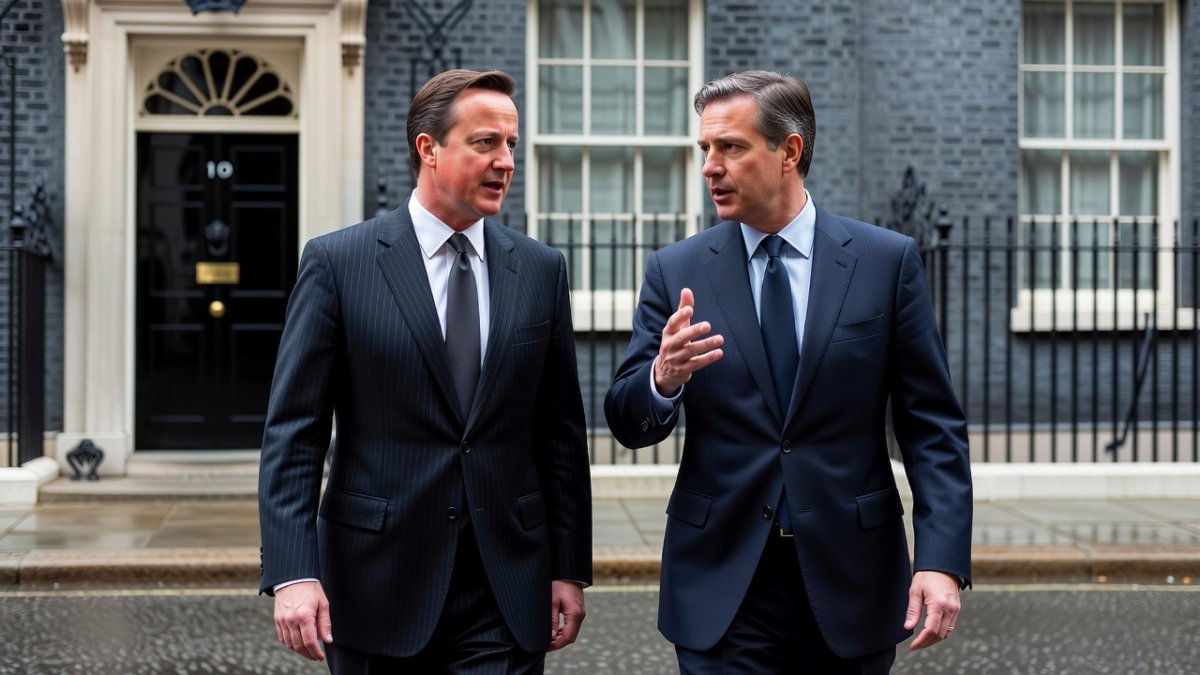
California’s average petrol price of 5.89 dollars per gallon stands 2.47 dollars above the national average of 3.42 dollars, a gap Hilton attributes squarely to state environmental rules rather than refinery outages or global crude movements. He told Anushka Asthana that Democrat policies inflict greater damage on motorists than the 2019 Iran crisis ever did. The comparison lands awkwardly in Britain, where petrol currently averages 142 pence per litre and Treasury officials continue to resist calls from the Office for Budget Responsibility to restore the fuel duty escalator frozen since 2011. Families in the North East and West Midlands already allocate more than eight percent of disposable income to transport fuel, according to ONS household expenditure data, rendering any further price shock politically toxic for whichever party holds power after the next general election.
UK Cost-of-Living Parallels
Office for National Statistics figures released last month show private rents rising 8.6 percent year-on-year while domestic energy bills remain 31 percent higher in real terms than in 2021. In the North East, median weekly earnings for full-time employees stand at 562 pounds, barely above 2019 levels once inflation is stripped out, according to Treasury distributional analysis. Similar stagnation affects public-sector workers in the West Midlands, where NHS and teaching pay settlements have lagged private-sector awards. Hilton’s California diagnosis that excessive regulation drives both housing shortages and energy costs therefore resonates with British households confronting identical pressures, even if the institutional remedies on offer differ sharply between Sacramento and Westminster.
Westminster Reaction and Conservative Unease
Inside the Conservative Party, Hilton’s trajectory has prompted quiet discomfort among former Cabinet colleagues who fear his radicalism will be read as an implicit critique of the 2010-2015 record. The Centre for Policy Studies published an analysis last week warning that wholesale income-tax abolition would require spending cuts equivalent to 1.8 percent of GDP, a scale not attempted since the 1980s. Meanwhile the Constitution Unit at UCL has cautioned that any successful Hilton governorship could embolden similar outsider challenges to established party machines on both sides of the Atlantic, potentially accelerating the fragmentation already visible in recent UK by-elections. The episode therefore tests whether the Conservative Party’s post-Cameron modernisation project retains any residual authority over its most prominent alumni.
Impact on Working Households
Nurses in Fresno and teachers in Riverside currently spend forty-two percent of take-home pay on median rents, a burden that has doubled since 2010 according to California Housing Partnership data. Logistics workers in Long Beach face similar pressures, with shift patterns and childcare costs compounding the effect of rising fuel prices. These lived realities mirror the experience of NHS staff in Sunderland and teaching assistants in Coventry, where real-terms pay has fallen 4.2 percent since 2021 per ONS earnings statistics. Hilton’s platform therefore speaks directly to a transatlantic constituency of public-sector and lower-middle-income households whose economic security has eroded under both Democratic and Conservative administrations.
November Stakes for UK Policy Debate
Whatever the November outcome, Hilton’s campaign has already exported a distinctive strain of Anglo-American conservative thinking that challenges both fiscal orthodoxy and cultural regulation. Should he close the current 21-point deficit, British Conservatives may face renewed pressure to adopt similarly sweeping tax and planning reforms ahead of the next general election. Conversely, a decisive defeat could reinforce the view inside Treasury and Cabinet Office circles that incremental welfare and housing measures remain the safer political course. Either result will shape how future UK governments weigh the trade-offs between deregulation, revenue and household living standards that Steve Hilton once helped design in Downing Street and now seeks to reinvent in Sacramento.
By Erica Thornton, Staff WriterThis article was produced with AI-assisted research and editorial support. Reporting is based on sources cited in the article.
What's Your Reaction?
 Like
0
Like
0
 Dislike
0
Dislike
0
 Love
0
Love
0
 Funny
0
Funny
0
 Wow
0
Wow
0
 Sad
0
Sad
0
 Angry
0
Angry
0

US Politics and Policy Correspondent at Global1.News. Based in Washington DC, covering American politics, policy, elections, and the courts. Knows how the system works and tells you what it actually means.















Comments (0)