
Gaza City hospitals say several killed in strike, as Israel targets Hamas leaders
Gaza Hospitals Report Multiple Deaths in Israeli Strike Aimed at Hamas Commander; Five Children Among Victims Gaza City hospitals are reporting at least several deaths, including five children, from an overnight Israeli airstrike that targeted a senior Hamas military commander in a densely populated neighborhood. The strike, which hit a residential building early Tuesday, has o
Gaza Hospitals Report Multiple Deaths in Israeli Strike Aimed at Hamas Commander; Five Children Among Victims
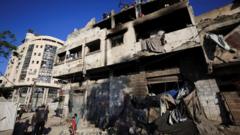
Gaza City hospitals are reporting at least several deaths, including five children, from an overnight Israeli airstrike that targeted a senior Hamas military commander in a densely populated neighborhood. The strike, which hit a residential building early Tuesday, has once again thrown fuel on an already raging conflict where civilian casualties continue to mount despite repeated Israeli claims of precision targeting.
The Strike and Immediate Aftermath
Local medical officials at Al-Shifa and Al-Ahli hospitals confirmed the toll after treating survivors pulled from rubble. The target appears to have been a mid-level Hamas commander responsible for rocket logistics in northern Gaza, according to Israeli military statements released hours later. Witnesses described a single powerful explosion that leveled part of a four-story apartment block, sending dust and debris across adjacent streets where families were sleeping.
Video verified by multiple sources shows rescue workers using flashlights to dig through concrete slabs while calling out names. At least three of the child victims were under age ten. No independent confirmation of the commander's status has emerged yet, but the pattern matches previous operations where Israel has struck urban targets to eliminate Hamas operatives embedded among civilians.
Broader Context of Israel's Campaign
Israel's stated goal remains the dismantling of Hamas command structures following the October 7 attacks that killed over 1,200 Israelis. Senior officials in Tel Aviv argue that commanders like the one reportedly hit Tuesday continue to direct operations from civilian areas, using hospitals and schools as shields. Yet the repeated outcome—dead children and flattened homes—has drawn sharp criticism even from Israel's closest allies.
This latest incident fits a months-long pattern. Since the ground operation expanded into Gaza City, the Israel Defense Forces have conducted thousands of strikes. Data from the UN Office for the Coordination of Humanitarian Affairs shows civilian death ratios that exceed those in many prior urban conflicts, though exact figures remain disputed because Hamas controls casualty reporting.
Humanitarian Impact on the Ground
Conditions inside Gaza City have deteriorated further. Fuel shortages have forced hospitals to ration generator time, meaning some operating rooms run on backup batteries. Aid convoys remain bottlenecked at the Rafah crossing, where Egyptian and Israeli security checks add days of delay. Families displaced multiple times now shelter in schools already damaged by earlier strikes.
The five children killed Tuesday join thousands of others documented by local health authorities since the war began. Independent analysts note that high population density and Hamas's tunnel network make clean separation of military and civilian targets nearly impossible without massive intelligence advantages that Israel claims but rarely demonstrates publicly.
International Reactions and Diplomatic Fallout
The White House expressed "deep concern" over civilian casualties while reiterating support for Israel's right to target Hamas leadership. European Union foreign ministers scheduled emergency talks, with several members pushing for stronger language on proportionality. Qatar and Egypt, the primary mediators, warned that such strikes complicate hostage negotiations still ongoing.
China and Russia used the incident to highlight what they call Western double standards on civilian protection. Meanwhile, street protests erupted in several Arab capitals, though governments largely kept official statements measured to avoid escalation.
Analysis: Targeting Leaders Versus Strategic Outcomes
Israel's approach of hunting individual commanders has produced tactical successes but questionable strategic gains. Removing one logistics officer rarely disrupts an entire brigade when replacements stand ready and tunnels allow rapid reconstitution. The political cost, however, grows with each civilian death broadcast worldwide.
Opinionated take: Precision munitions and warnings via phone calls or "roof knocking" do not erase the reality that operating in one of the world's most crowded territories guarantees collateral damage. Hamas bears primary responsibility for embedding fighters among families, yet Israel's leadership must answer why alternatives—such as sustained pressure on smuggling routes or targeted ground raids with better civilian evacuation corridors—receive less emphasis.
Both sides have shown little interest in de-escalation. Hamas continues firing rockets when possible and holding hostages. Israel continues operations that flatten neighborhoods while promising eventual victory. The result is a grinding war where each new strike, like Tuesday's, resets the cycle of outrage without advancing a political horizon.
Global1 sources inside Gaza indicate the targeted commander had survived at least two prior attempts on his life, suggesting Hamas maintains redundancy in its ranks. That resilience, paired with Israel's determination to keep striking, points to more such incidents ahead rather than fewer.
This is Jessica Ali for Global1 News. 🔥
This article was produced with AI-assisted research and editorial support. Reporting is based on sources cited in the article.
What's Your Reaction?
 Like
0
Like
0
 Dislike
0
Dislike
0
 Love
0
Love
0
 Funny
0
Funny
0
 Wow
0
Wow
0
 Sad
0
Sad
0
 Angry
0
Angry
0

Editor-in-Chief at Global1.News. Atlanta-based journalist who cuts through the BS and tells it like it is. Lead anchor, host, and the voice you hear when the spin stops and the truth starts.














Comments (0)