
Free AI Video Generation Tools Expand With Voice Cloning and Video Extension
The open-source AI video generation space is accelerating at a pace that challenges paid platforms, with new capabilities in voice cloning and clip extension emerging from community-driven projects. Demonstrations from channels like Aitrepreneur highlight how these tools now integrate features once limited to enterprise services, shifting the economics of video production. This
The open-source AI video generation space is accelerating at a pace that challenges paid platforms, with new capabilities in voice cloning and clip extension emerging from community-driven projects. Demonstrations from channels like Aitrepreneur highlight how these tools now integrate features once limited to enterprise services, shifting the economics of video production. This development carries both opportunity and serious governance questions for creators and regulators alike.
Free AI Video Generation Tools Expand With Voice Cloning and Video Extension
Atlanta, GA – June 9, 2026 — Open-source projects are closing the gap with commercial AI video services through integrated voice cloning and video extension features, according to recent technical demonstrations. These capabilities allow users to extend clips by 5-15 seconds and clone voices across more than 600 languages while operating on consumer hardware starting at 8GB VRAM. The changes are reshaping access for independent creators who previously relied on subscription-based platforms.
Market Landscape
Free and open-source AI video tools are now positioned to compete directly with paid services such as ElevenLabs by offering comparable voice synthesis and generation quality without recurring fees. Demonstrations show these systems handling text-to-video conversion, lip-sync accuracy, and multi-language output that match or approach the fidelity of proprietary offerings. The competitive edge stems from community fine-tuning that adapts models to niche accents and dialects faster than centralized development teams can release updates.
Specific implementations allow users to generate short video segments with synchronized audio, then refine outputs through iterative prompting. This reduces the cost barrier that previously limited small studios and freelancers to basic editing software. Market data from early 2026 indicates rising downloads of these repositories, reflecting demand from users seeking alternatives to monthly subscriptions that can exceed several hundred dollars annually for professional tiers. The absence of usage caps in many open-source releases further pressures commercial providers to justify their pricing through exclusive features or enterprise support.
Technical Convergence
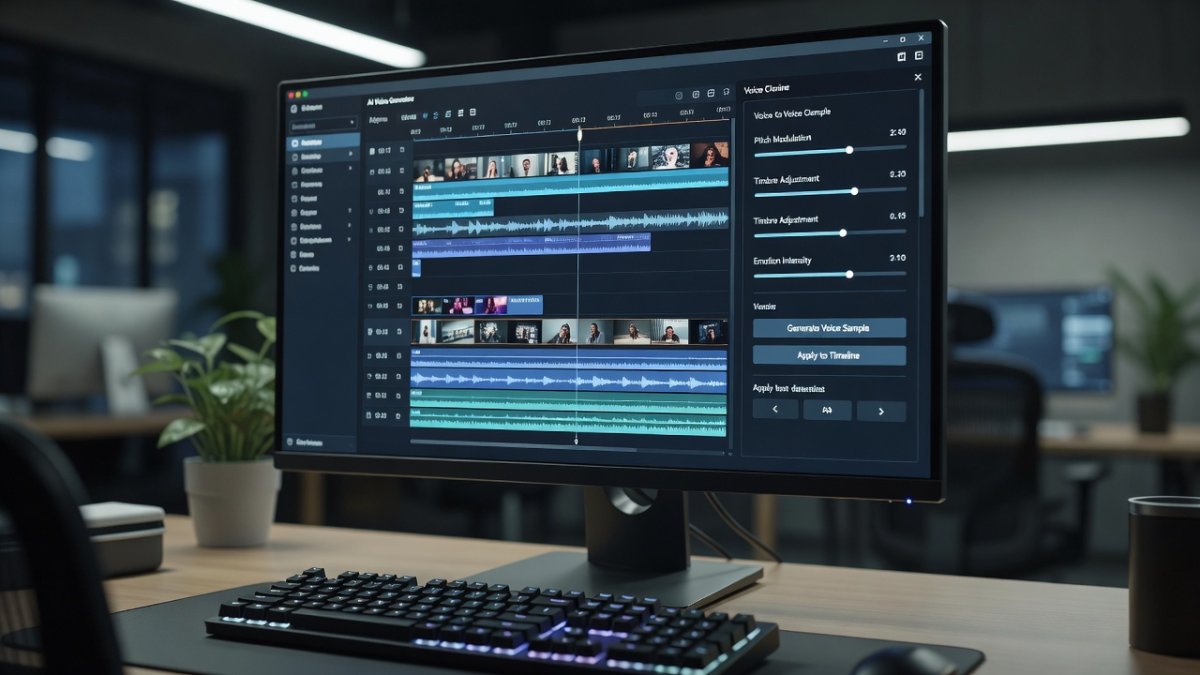
Video extension and voice cloning functions are converging within unified platforms that run locally on GPUs with 8GB or more VRAM. Extension tools append 5-15 seconds of coherent motion and audio to existing clips by analyzing preceding frames and generating plausible continuations. Voice cloning modules support over 600 languages, enabling dubbing and narration in languages that lack commercial support from major vendors.
This integration reduces workflow friction because creators no longer need separate applications for visual and audio generation. Technical reports note that quantization techniques and optimized inference libraries have lowered hardware thresholds, allowing mid-range consumer cards to handle 720p outputs at acceptable speeds. The result is a single pipeline where an uploaded clip can be lengthened and voiced in one session, a capability previously requiring cloud credits or high-end workstations.

Democratization Impact
Lowered costs and language coverage expand participation for content creators, small businesses, educators, and non-English speakers who could not sustain premium subscriptions. Educators in regions with limited internet or budgets can now produce localized instructional videos without translation services. Small businesses gain the ability to create product demonstrations in multiple languages, reaching diaspora markets that were previously uneconomical to target.
Non-English speakers benefit from voice models trained on diverse corpora, reducing the English-centric bias that characterized earlier commercial releases. This shift supports independent journalists and community organizations producing public-interest content in local languages. The hardware requirement of 8GB VRAM remains a constraint for the lowest-end devices, yet the threshold is low enough that many existing laptops and desktops can participate without new purchases.
Risk & Regulation
Deepfake risks intensify as accessible tools combine realistic video extension with high-fidelity voice cloning. Detection remains difficult because outputs can be tuned to evade watermarking and forensic analysis. YouTube has announced AI labeling requirements effective May 2026 that mandate disclosure for synthetically altered or generated content, yet enforcement depends on voluntary compliance and platform detection systems still under development.
Broader regulatory efforts in multiple jurisdictions focus on consent requirements for voice and likeness use, but open-source distribution complicates enforcement since models can be downloaded and modified offline. Policymakers face the challenge of balancing innovation with safeguards against non-consensual content, while technical communities debate built-in detection mechanisms that could be circumvented by subsequent forks.
Public Sentiment
Public unease about AI-driven job displacement surfaced at the University of Arizona’s May 2026 commencement, where former Google CEO Eric Schmidt was booed during remarks on AI’s employment effects. An Associated Press video of the event captured audible audience reaction, underscoring generational anxiety over automation in creative and technical fields. This response aligns with surveys showing growing skepticism toward rapid AI adoption without corresponding labor protections.
The incident reflects broader sentiment that technological capability has outpaced societal preparation. While proponents emphasize new roles in prompt engineering and model curation, critics highlight displacement in voice acting, video editing, and translation services. The open-source nature of these tools amplifies both the speed of adoption and the difficulty of containing unintended uses.
Innovation Pace

New open-source models appear on a weekly cadence, driven by distributed contributors who share weights, training scripts, and evaluation benchmarks. This community model accelerates iteration on voice cloning accuracy and temporal consistency in extended clips. Repositories frequently incorporate user-submitted datasets that improve performance for underrepresented languages and cultural contexts.
Upcoming developments are expected to focus on longer coherent extensions beyond the current 5-15 second range and tighter integration with real-time streaming. The pace creates a moving target for commercial competitors and regulators, as features demonstrated in one week often become baseline expectations the next. Sustained participation depends on volunteer maintenance of infrastructure and documentation, which has proven resilient but remains uneven across projects.
What to Know
Open-source AI video tools now deliver voice cloning across 600+ languages and 5-15 second clip extensions on 8GB+ VRAM hardware. These capabilities directly challenge paid platforms while raising deepfake and labeling compliance issues ahead of YouTube’s May 2026 requirements. Public reaction, including the May 2026 University of Arizona commencement incident documented by the Associated Press, signals rising concern over labor impacts. Weekly community releases continue to expand access for educators, small businesses, and non-English creators, though hardware and detection challenges persist.
By Jessica Ali, Staff Writer
This article was produced with AI-assisted research and editorial support. Reporting is based on sources cited in the article.
What's Your Reaction?
 Like
0
Like
0
 Dislike
0
Dislike
0
 Love
0
Love
0
 Funny
0
Funny
0
 Wow
0
Wow
0
 Sad
0
Sad
0
 Angry
0
Angry
0

Editor-in-Chief at Global1.News. Atlanta-based journalist who cuts through the BS and tells it like it is. Lead anchor, host, and the voice you hear when the spin stops and the truth starts.















Comments (0)