Few Japan firms take steps toward economic security, government paper finds
**Few Japan firms take steps toward economic security, government paper finds**
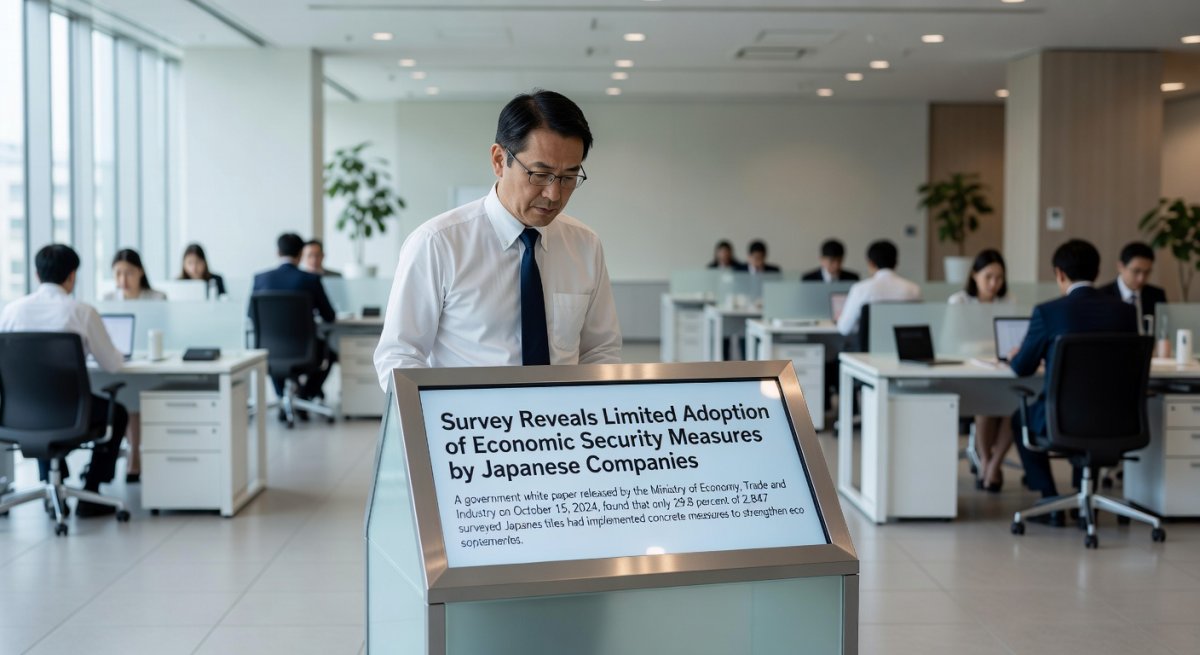
Only about 30 percent of Japanese companies have implemented substantive measures to strengthen economic security, according to a government white paper released by the Ministry of Economy, Trade and Industry (METI) on October 15, 2024. The survey of 2,847 firms found limited progress in diversifying procurement sources, reinforcing cybersecurity protocols, and mapping supply chain vulnerabilities despite the 2022 Economic Security Promotion Act.
The METI paper, titled “Economic Security Measures in Japanese Industry 2024,” showed that 29.8 percent of respondents had taken concrete actions such as dual-sourcing critical components or conducting third-party audits of information systems. The remaining 70.2 percent reported either no measures or only preliminary discussions. Larger firms with annual revenue above 100 billion yen recorded a 41 percent implementation rate, while small and medium-sized enterprises lagged at 22 percent.
**The Findings**
METI’s questionnaire covered 12 sectors, with electronics and automotive showing the widest gaps. In semiconductors and electronic components, 34 percent of firms had diversified suppliers beyond single-country dependence, primarily moving from China to Vietnam, Malaysia, and domestic alternatives. Cybersecurity investments remained low: only 27 percent of all respondents had adopted multi-factor authentication across supply-chain platforms or conducted annual penetration testing.
The paper cited specific data points. Among the 847 manufacturing firms surveyed, 62 percent still relied on a single overseas source for at least one rare-earth or specialty chemical input. Just 19 percent had established formal contracts with alternative suppliers that included force-majeure clauses covering geopolitical disruptions.
METI Vice Minister for Economic and Industrial Policy, Hiroshi Yoshida, stated during the release briefing: “The data indicate that awareness has risen since the Act took effect, yet translation into operational changes remains insufficient. Firms must treat economic security as a core management responsibility rather than a compliance checkbox.”
**Background on Japan’s Economic Security Framework**
Japan enacted the Economic Security Promotion Act in May 2022, the first comprehensive legislation of its kind in Asia. The law introduced four pillars: supply-chain resilience, critical technology protection, infrastructure security, and private-sector data governance. METI has since published annual implementation reports and provided subsidies totaling 152 billion yen through fiscal 2024 for companies that relocate production or develop domestic alternatives for 10 designated critical materials.
The current white paper builds on earlier METI surveys from 2021 and 2023. Implementation rates have risen from 18 percent in 2021 to the present 29.8 percent, yet the pace has slowed since 2023. Officials attribute the plateau to higher costs of dual-sourcing and difficulty identifying qualified alternative vendors that meet Japanese quality standards.
**Sector-Specific Data and Company Examples**
The automotive sector, which accounts for roughly 20 percent of Japan’s exports, recorded a 26 percent implementation rate. Toyota Motor Corporation reported in its June 2024 sustainability filing that it had qualified 47 secondary suppliers for battery-grade lithium and nickel; however, the METI survey showed most tier-two and tier-three suppliers had not replicated such mapping. In contrast, Sony Group Corporation disclosed in its 2024 integrated report that it had completed cybersecurity assessments for 92 percent of its semiconductor procurement partners, placing it among the higher-scoring respondents.
Electronics firms cited difficulty in replicating the precision required for photoresists and etching gases currently sourced predominantly from Japan and a limited number of European and U.S. producers. The paper noted that 41 percent of respondents in the information and communications technology sector had introduced supply-chain risk scoring systems, yet only 15 percent had integrated those scores into procurement decisions.
**Government and Industry Response**
METI has expanded its “Economic Security Support Center,” established in 2023, to offer free supply-chain mapping tools and cybersecurity self-assessment checklists. As of September 2024, 1,134 companies had registered for the service, though only 312 had completed full assessments. The ministry is also coordinating with the National Center of Incident Readiness and Strategy for Cybersecurity (NISC) to issue sector-specific guidelines by March 2025.
Keidanren, the Japan Business Federation, welcomed the findings while urging further public support. Chairman Masakazu Tokura said in an October 16 statement: “Companies recognize the risks, but the financial and technical burden of rapid diversification must be shared with government through tax incentives and technology transfer programs.”
**Implications and Next Steps**
The white paper concludes that sustained policy support and clearer cost-sharing mechanisms will determine whether implementation rates accelerate before the next review cycle in 2026. METI plans to incorporate the survey results into revisions of the subsidy framework and to publish anonymized benchmark data for peer comparison among firms. Further updates will be provided as the ministry completes its follow-up consultations with industry associations.
This is Kenji Tanaka for Global1 News, reporting from Tokyo. 🇯🇵
What's Your Reaction?
Like
0
Dislike
0
Love
0
Funny
0
Wow
0
Sad
0
Angry
0
Comments (0)