
Duterte's Day of Reckoning: Up to 70 Witnesses Set to Testify in Historic ICC Trial
Duterte's Day of Reckoning: Up to 70 Witnesses Set to Testify in Historic ICC Trial
The trial of former President Rodrigo Duterte is shaping up to be one of the most consequential war crimes proceedings in modern history, and the numbers tell the story: up to 70 witnesses are expected to testify against the former strongman when his case finally goes before the International Criminal Court in The Hague.
The staggering figure — confirmed by sources close to the ICC prosecution — underscores the scale of the alleged crimes committed under Duterte's brutal war on drugs, a campaign that human rights organizations estimate killed as many as 30,000 people between 2016 and 2022.
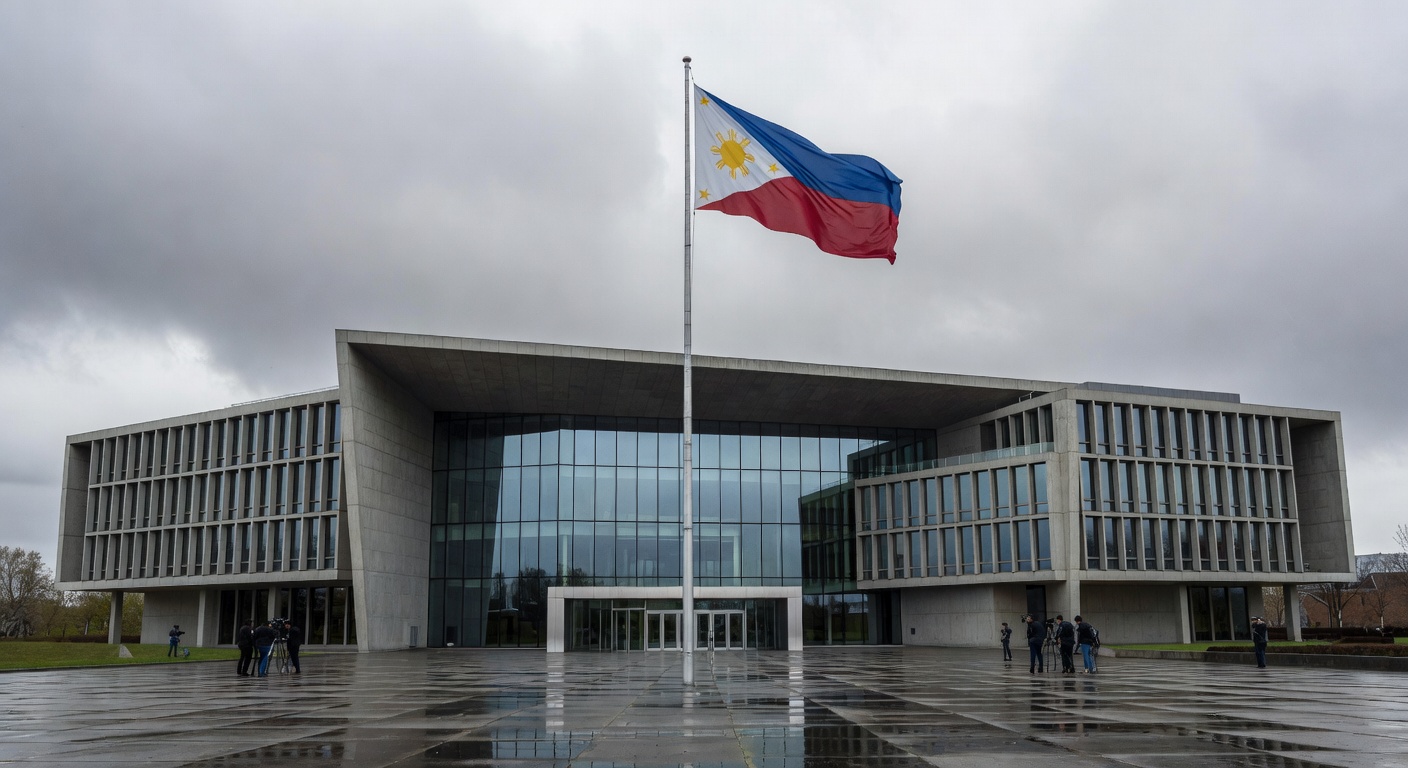
The International Criminal Court in The Hague prepares for one of its most significant trials. (Global 1 News)
The Witness List
The 70 witnesses represent a cross-section of Philippine society: former police officers who participated in drug war operations and have since had a change of heart; family members of victims who witnessed the killings firsthand; forensic experts who documented the pattern of extrajudicial executions; and even former government officials who were present when the policies were formulated.
The prosecution's strategy is clear: overwhelm the court with volume and consistency of testimony. By presenting dozens of witnesses who all describe the same pattern of state-sanctioned violence, the prosecution aims to establish beyond any reasonable doubt that Duterte's drug war was not a series of isolated incidents but a coordinated policy implemented at the highest levels of government.
"The sheer number of witnesses makes it impossible for the defense to argue that these were isolated rogue operations," said a legal analyst familiar with the case. "When you have 70 people telling the same story from different perspectives, the pattern becomes undeniable."
The Charges
Duterte faces charges of crimes against humanity — specifically, murder, torture, and persecution — for his role in directing the drug war. Under the Rome Statute, crimes against humanity are defined as widespread or systematic attacks directed against civilian populations. The prosecution will argue that Duterte's drug war meets both criteria: it was widespread (thousands of killings across the country) and systematic (implemented through police orders, public statements, and institutional pressure).
The defense will likely challenge the ICC's jurisdiction, arguing that the Philippines withdrew from the Rome Statute in 2019. However, the court has already ruled that it retains jurisdiction over crimes committed while the Philippines was still a signatory (2016-2019) — the period when the vast majority of drug war killings occurred.
The ICC's case relies on witness testimony, forensic evidence, and command responsibility doctrine. (Global 1 News)
Witness Protection Challenges
One of the most sensitive aspects of the trial is witness protection. Many of the 70 witnesses are testifying at great personal risk — threats from Duterte supporters, retaliation from former police colleagues, and the trauma of reliving horrific events. The ICC has implemented strict protective measures, including pseudonyms, voice distortion, and closed-circuit testimony.
But the risks extend beyond the courtroom. Witnesses in the Philippines have reported harassment, intimidation, and even physical attacks. Human rights organizations have called on the Philippine government to provide adequate protection, but critics say the government has been reluctant to cooperate with the ICC process.
"Every witness who steps forward is a hero," said a human rights advocate. "They know the risks, but they also know that this may be the only chance for justice. The world needs to hear their stories."
The Political Context
The trial unfolds against a deeply polarized Philippine political landscape. Duterte remains popular among a significant portion of the population, particularly those who believe his drug war made the streets safer. His supporters view the ICC proceedings as foreign interference in Philippine sovereignty — a colonialist imposition by Western powers.
Victims' families and human rights advocates see it very differently. For them, the ICC represents the only realistic path to justice after years of domestic impunity. The Philippine justice system has failed to hold anyone accountable for the drug war killings. The ICC is their last hope.
This trial will force the Philippines to confront a painful chapter in its history. Whether the nation emerges from that reckoning stronger or more divided remains to be seen.
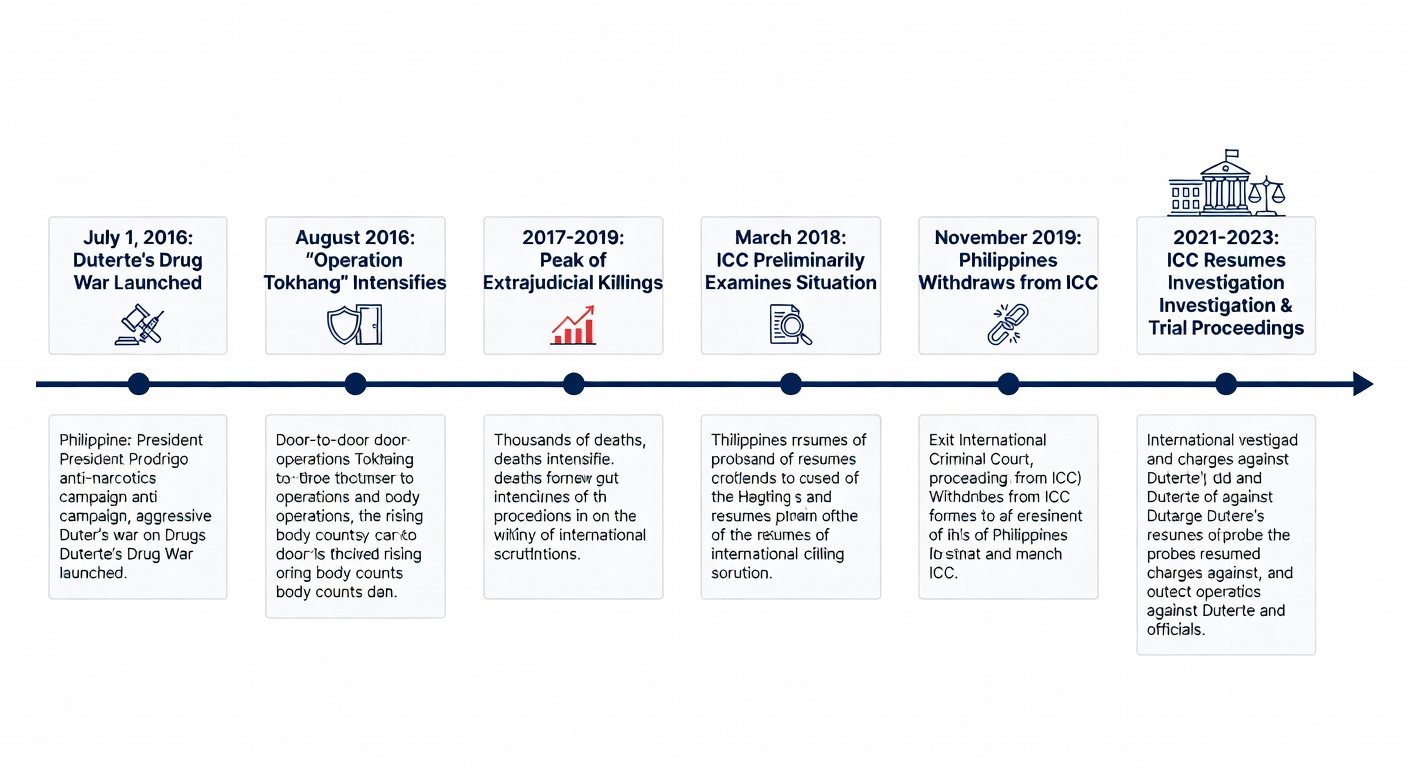
The timeline from Duterte's drug war launch to the historic ICC trial. (Global 1 News)
Key Takeaways
- Up to 70 witnesses are expected to testify against Duterte in the ICC trial for crimes against humanity.
- The prosecution will present evidence of a coordinated state policy of extrajudicial killings.
- Witness protection remains a critical concern, with many testifying at great personal risk.
- The trial is deeply polarizing in the Philippines, dividing Duterte supporters from victims' families.
- The case could set historic precedents for international criminal law and state accountability.
Conclusion
Seventy witnesses. Thousands of victims. One former president. The Duterte trial is not just a legal proceeding — it is a reckoning for a nation and a test of the international justice system's ability to hold powerful leaders accountable. The world will be watching. The families of the victims have waited years for this moment. Now, finally, justice may be within reach.
This is Bella Reyes for Global1 News, reporting from Manila. 🇵🇭
This article was produced with AI-assisted research and editorial support. Reporting is based on sources cited in the article.
What's Your Reaction?
 Like
0
Like
0
 Dislike
0
Dislike
0
 Love
0
Love
0
 Funny
0
Funny
0
 Wow
0
Wow
0
 Sad
0
Sad
0
 Angry
0
Angry
0

Philippines/Southeast Asia Correspondent at Global1.News. Manila-based journalist covering Philippine politics, environment, maritime security, and social issues. Passionate about marine conservation and the communities protecting the Philippines' natural heritage.









Comments (0)