
Busan’s Maritime Turn: Chun Jae-soo’s Blueprint and South Korea’s Oceanic Strategy
From National Assembly to Busan City Hall: Chun Jae-soo’s Political Formation Chun Jae-soo’s election as Busan mayor on 4 June 2026 marks a notable shift in the city’s leadership after years of conservative municipal governance. Raised in Busan, Chun studied history and politics at a Seoul university before entering the National Assembly staff and later aligning with the pro-la
From National Assembly to Busan City Hall: Chun Jae-soo’s Political Formation
Chun Jae-soo’s election as Busan mayor on 4 June 2026 marks a notable shift in the city’s leadership after years of conservative municipal governance. Raised in Busan, Chun studied history and politics at a Seoul university before entering the National Assembly staff and later aligning with the pro-labor liberal agenda of the Roh Moo-hyun administration. His parliamentary victories in the Busan constituency in 2016, 2020, and 2024 positioned him as the sole Democratic Party representative from the region in the most recent contest, underscoring both his personal resilience and the narrow base of liberal support in the southeast.
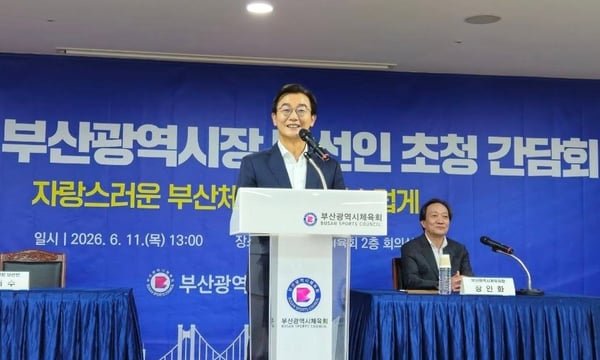
Chun Jae-soo attends a meeting of the Busan Sports Council, June 11, 2026. (The Diplomat)
These experiences shaped a consistent emphasis on institutional relocation and industrial policy rather than symbolic projects. As Minister of Ocean and Fisheries until his resignation in December 2025, Chun oversaw the physical transfer of the entire ministry to Busan and secured the headquarters move of HMM, South Korea’s largest container shipping line. Such moves established concrete precedents for the decentralization of maritime functions that now inform his mayoral program.
The Four-Point Blueprint and the “Youth New Deal” Label
Chun’s platform centers on four interlocking proposals designed to position Busan as South Korea’s primary maritime hub. The first calls for a Maritime Policy Committee placed under direct presidential authority yet headquartered in Busan. The second envisions Busan as the operational base for Northern Sea Route traffic, including the home-porting of ice-class vessels. The third proposes the establishment of a Maritime International and Commercial Court in the city by 2028. The fourth outlines a Southeast Investment Agency anchored in Busan and capitalized at 40 billion dollars. Chun has framed the package collectively as the “Youth New Deal,” linking maritime infrastructure to employment generation for younger cohorts in the region.
These elements build directly on administrative actions already taken at the ministerial level. The ministry relocation and HMM decision demonstrated that central-government functions and corporate headquarters can be shifted southward when political will aligns with local capacity. The new blueprint extends this logic from single-agency moves to a coordinated national maritime architecture.
Presidential Alignment and Institutional Centralization in Busan
President Lee Jae-myung’s administration has signaled support for the proposed Maritime Policy Committee. Placing such a body under presidential oversight while locating its secretariat in Busan represents an attempt to reconcile centralized strategic direction with regional execution. In Korean administrative practice, committees attached to the Blue House have historically carried greater convening power than line-ministry bodies; situating one in Busan could therefore alter the balance of influence between Seoul-based planners and port-city stakeholders.
This arrangement also carries implications for inter-ministerial coordination. Ocean and fisheries policy, trade logistics, and foreign affairs all intersect in Arctic-route planning and international commercial dispute resolution. A presidential committee based outside the capital may reduce the friction that often arises when multiple Seoul agencies manage overlapping maritime dossiers.
Arctic Shipping Ambitions and the Northern Sea Route
The Northern Sea Route component addresses long-standing Korean concerns over reliance on the Malacca Strait and Suez Canal. By designating Busan as the primary Korean terminus for ice-class vessel operations, the plan seeks to capture trans-Arctic cargo flows that are projected to increase as polar ice recedes. The proposal builds on earlier ministry-level studies but moves beyond feasibility reports toward operational infrastructure commitments, including dedicated berths and cold-weather logistics facilities.
Success will depend on coordination with shipbuilding chaebols and classification societies, as well as diplomatic arrangements with Russia and Nordic states. Busan’s existing container terminal capacity and its recent experience absorbing the HMM headquarters provide a practical foundation, yet the timeline for ice-class fleet expansion remains subject to global shipping cycles and domestic financing decisions.
Legal Infrastructure and Investment Mechanisms
The proposed Maritime International and Commercial Court by 2028 aims to attract dispute-resolution business currently handled in Singapore or London. Korea already possesses specialized maritime benches within the ordinary court system; elevating a dedicated international commercial court in Busan would require legislative changes to jurisdiction and judge selection. The 2028 target date allows roughly two years from Chun’s 1 July 2026 inauguration for drafting and passage of enabling statutes.
Parallel to the court, the Southeast Investment Agency with its 40-billion-dollar mandate is intended to channel public and private capital into port-adjacent industries. The scale of the fund exceeds typical regional development allocations and will require oversight mechanisms that satisfy both central fiscal authorities and local stakeholders. Past Korean regional investment vehicles have sometimes suffered from fragmented governance; the agency’s placement under the new mayoral administration offers one avenue for tighter accountability.
Electoral Context and Limits of Symbolic Projects
Chun defeated incumbent People Power Party mayor Park Heong-joon, whose administration was closely associated with the unsuccessful 2030 World Expo bid. More than 80 percent of Busan residents opposed the Pompidou Busan cultural project, reflecting fatigue with high-profile but low-employment signature initiatives. Chun’s emphasis on shipping, courts, and investment agencies therefore responds to voter preference for tangible economic functions over cultural branding.
Nevertheless, the allegations that prompted his ministerial resignation in December 2025—receipt of 40 million won in cash and designer watches from a religious group—remain part of the public record. Although investigators found only circumstantial evidence and the statute of limitations closed further action, staff members faced charges related to evidence handling. These episodes illustrate the political risks that accompany rapid institutional relocation when oversight mechanisms lag behind administrative ambition.
By Prof. David Park, Staff WriterThis article was produced with AI-assisted research and editorial support. Reporting is based on sources cited in the article.
What's Your Reaction?
 Like
0
Like
0
 Dislike
0
Dislike
0
 Love
0
Love
0
 Funny
0
Funny
0
 Wow
0
Wow
0
 Sad
0
Sad
0
 Angry
0
Angry
0

East Asia/Technology Correspondent at Global1.News. Seoul-based voice covering Korean politics, technology, business, and culture. Analyzes how technology and geopolitics intersect across East Asia.














Comments (0)