
Stripe and Advent International Just Made a $53 Billion Offer for PayPal
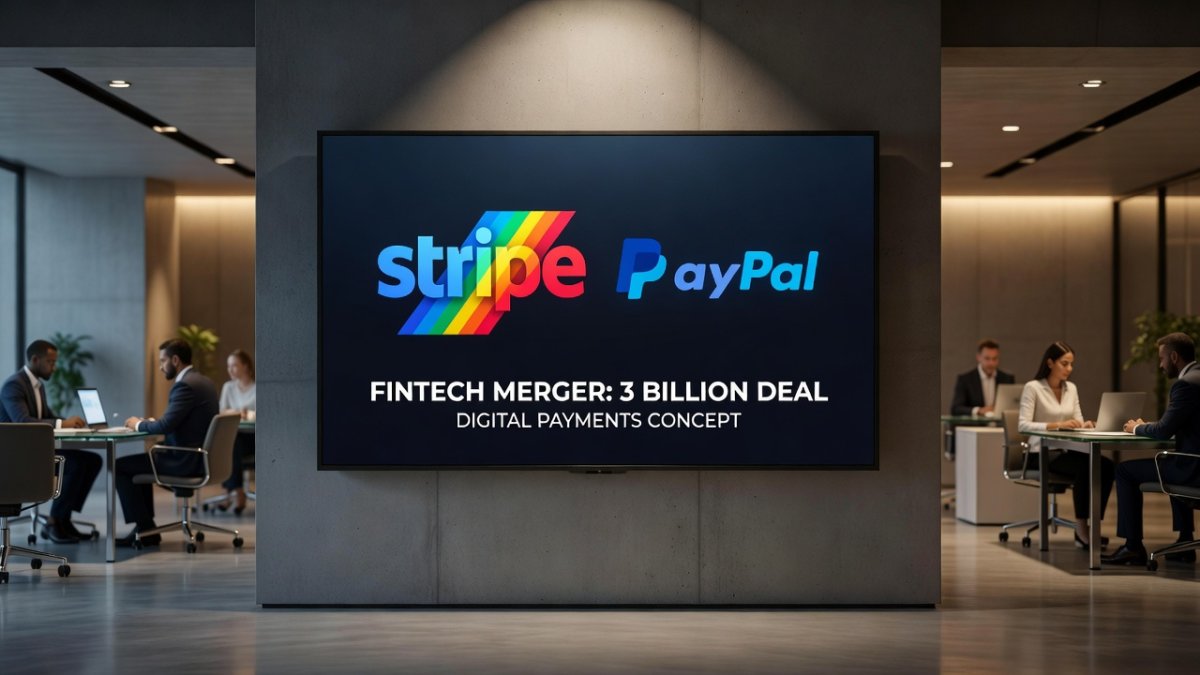
Stripe and Advent International have made a joint $53 billion offer to acquire PayPal at $60.50 per share, sending PayPal stock surging 17%. The deal would combine Stripe's developer-first payments infrastructure with PayPal's 435 million users, Venmo, and Braintree. But antitrust scrutiny and developer backlash pose major hurdles.
Stripe and Advent International Just Made a $53 Billion Offer for PayPal — And the Internet Has Thoughts
Here's the kind of headline that makes you double-tap and refresh: Stripe — the $65 billion payments giant that practically runs the internet's checkout flow — has teamed up with private equity powerhouse Advent International to make a joint offer to acquire PayPal for $60.50 per share. We're talking north of $53 billion. And if this deal goes through, it reshapes the entire payments landscape overnight.
The $53 Billion Megadeal That Nobody Saw Coming
San Francisco, CA — July 15, 2026 — Reuters broke the story exclusively on Wednesday, reporting that Stripe and Advent International have submitted a joint bid to acquire PayPal Holdings Inc. for $60.50 per share, valuing the decades-old payments company at over $53 billion. The offer is backed by roughly $50 billion in committed financing from banks, according to sources familiar with the matter.
PayPal's stock surged more than 17% on the news, trading at its highest level in months as investors priced in a potential premium buyout. The offer was reportedly submitted earlier this month, and the news triggered record trading volume in PYPL shares.
The Deal at a Glance: $60.50 Per Share, $53 Billion Total
Let's break down the numbers because they're staggering. At $60.50 per share, the offer represents a significant premium over PayPal's pre-announcement trading price — though PayPal has traded as high as the mid-$70s in the past two years. The $53 billion enterprise valuation includes both equity and debt components, with roughly $50 billion in committed bank financing backing the proposal.
For context: $53 billion would make this the largest leveraged buyout in the fintech sector since... well, ever. It dwarfs the $43 billion that Block (formerly Square) once flirted with during the 2021 SPACmania era. It's bigger than Fiserv's $39 billion acquisition of First Data in 2019. This is a generational deal that, if consummated, will be studied in business schools for decades.
Notably, the deal is structured as a joint bid between Stripe (the operating business) and Advent International (the capital partner). This structure matters — and we'll get to why.
Why Stripe Wants PayPal: The Strategic Play
On the surface, Stripe and PayPal look like strange bedfellows. Stripe is the developer-first payments platform that's become the default choice for SaaS companies, startups, and internet-native businesses. Its API-first approach, clean documentation, and developer experience are legendary in engineering circles. Stripe processes hundreds of billions in payment volume and is valued at roughly $65 billion.
PayPal, by contrast, is the veteran — founded in 1998 as Confinity, IPO'd in 2002, acquired by eBay, spun out in 2015, and now a publicly traded company with 435 million active accounts worldwide. But PayPal has struggled to innovate at the pace of its younger rivals. Its Venmo brand remains dominant in peer-to-peer payments, but its merchant tools lag behind Stripe's developer-friendly ecosystem.
The strategic logic becomes clearer when you look at the combined assets:
Stripe brings: developer tools, B2B infrastructure, Stripe Connect for platforms, Stripe Atlas, Stripe Capital, and a decade of brand equity with the startup ecosystem. PayPal brings: Venmo (a cultural phenomenon with 80+ million users), Braintree (which competes directly with Stripe), PayPal Checkout (still used by millions of merchants worldwide), PayPal Credit and Pay Later (BNPL), and Honey (coupon/browser extension).
Combine them, and you get a fintech colossus that touches virtually every layer of digital payments — from the startup accepting their first $5 via Stripe to the enterprise processing millions through Braintree to the Gen Z user splitting rent on Venmo. It's the full stack, from API to consumer app.
Advent International: The Financial Engineer Behind the Deal
Advent International isn't a household name like Blackstone or KKR, but in private equity circles, they're a heavyweight. With $100+ billion in assets under management, Advent has deep experience in the payments space — they previously owned Worldpay (which they sold to FIS for $43 billion in 2019) and have invested extensively in fintech infrastructure across Europe and North America.
Advent's role here is critical: they bring the financing and the LBO expertise. Stripe, despite its massive valuation, has never been a public company and doesn't have the balance sheet to absorb a $53 billion acquisition on its own. A PE partner provides the capital structure, debt financing, and the operational playbook for integrating two large, complex organizations.
This is standard PE playbook: use significant leverage (the ~$50 billion in committed bank financing), acquire the target, integrate it with the strategic buyer's operations, and generate returns through cost synergies, revenue growth, and eventual exit — likely an IPO of the combined entity within 3-5 years.
PayPal's Long Arc: From Internet Darling to Takeover Target
It's worth pausing to appreciate how remarkable this moment is. PayPal is one of the original internet success stories. Founded by Max Levchin, Peter Thiel, and Luke Nosek, it survived the dot-com crash, got acquired by eBay for $1.5 billion in 2002, and was spun out in 2015 with a market cap of $47 billion — which then surged to over $360 billion at the peak of the pandemic-fueled fintech boom in 2021.
But the last few years have been brutal. PayPal's market cap has fallen by roughly 70% from its 2021 peak as competition intensified, growth slowed, and activist investors circled. The company has gone through multiple restructuring rounds, lost key executives, and struggled to articulate a clear vision in a market increasingly dominated by Stripe, Block, and a wave of fintech startups.
This bid represents both an acknowledgment of PayPal's enduring value — its 435 million users, its regulatory licenses across 200+ markets, its brand recognition — and a recognition that it can't unlock that value on its own as a standalone public company.
The Antitrust Question: Can This Deal Clear Regulatory Hurdles?
Here's where things get interesting. A combined Stripe-PayPal would control an enormous share of the U.S. online payments market. Exact market share figures are hard to pin down (the payments industry is fragmented), but estimates suggest the combined entity would process 25-35% of all e-commerce transactions in North America.
The Biden administration's antitrust enforcers at the DOJ and FTC have been aggressive on tech deals. The FTC under Lina Khan blocked Microsoft's $69 billion Activision Blizzard acquisition (though it eventually went through after an appeal), challenged Meta's acquisitions, and sued to block numerous vertical mergers. A horizontal merger of this magnitude in digital payments — a market already dominated by a few players (Stripe, PayPal, Block/ Square, Adyen, Fiserv) — would face intense scrutiny.
Then there's the Braintree problem. PayPal already owns Braintree, which is a direct competitor to Stripe's core product. Combining them would effectively eliminate a major competitor in the developer payments space. Antitrust regulators would likely require divestitures as a condition of approval — potentially spinning off Braintree or Venmo to maintain competition.
On HN, user nickjj captured the sentiment: "I'm not sure I like this idea. Braintree is a legit competitor to Stripe. I'm guessing they have some informal agreement to keep transaction fees about the same but if they become 1 company, what's to stop Stripe from raising fees even more?"
What This Means for Developers and Merchants
For the millions of developers and businesses that rely on Stripe or PayPal for payment processing, this deal raises immediate questions. If the acquisition goes through, will Stripe's API remain the gold standard for developer experience? Or will integration pressures from the PayPal side dilute what made Stripe special?
Stripe's leadership has always prided itself on being developer-first — CEO Patrick Collison is known for personally reading developer feedback on HN. PayPal, by contrast, has historically been merchant-focused, with a less elegant API and more complex fee structures. The cultural clash between a developer-centric company and a consumer-PE-backed behemoth is real.
There are also practical concerns about pricing. With less competition in the payment processing layer, the combined entity would have significant pricing power. Transaction fees could rise, especially for smaller merchants who lack the negotiating leverage of enterprise customers.
On the flip side, a combined Stripe-PayPal could offer unmatched integration: Venmo peer-to-peer flows connected to Stripe's merchant infrastructure, PayPal's global regulatory compliance paired with Stripe's API layer, and Braintree's enterprise features (recurring billing, marketplace support) streamlined under one roof. For some merchants, that integration could be genuinely valuable.
The HN Community Reacts: Skepticism Meets Existential Dread
Hacker News — where the Stripe-PayPal story hit #3 with 223 points and 112 comments — is the perfect barometer for developer sentiment on this deal. And the sentiment is... skeptical, to put it mildly.
User dfunckt captured the dark humor: "The dystopia that PayPal is — we're cheering and paying trillionaires to bring forward faster. Can't wait."
Another commenter, benmorris, pointed out a practical concern: "Braintree was a legit competitor, last time I checked they won't even onboard you if you don't have an established business grossing over 100k/yr."
The recurring theme in the HN thread is fear of reduced competition leading to higher prices, worse service, and less innovation. It's a sentiment that Stripe's leadership — which has carefully cultivated a pro-developer brand — should take seriously. A deal that alienates the developer community Stripe built its reputation on would be a self-inflicted wound of epic proportions.
What This Means: The Fintech Endgame Is Here
This deal — if it happens — signals that the consolidation phase of fintech has arrived. The pandemic years (2020-2022) were about growth at all costs. The last two years (2024-2026) have been about survival and profitability. Now we're entering the era where the winners buy the wounded. Stripe, flush with private market confidence and a $65 billion valuation, is betting that it can absorb PayPal's massive user base and regulatory infrastructure to become the dominant global payments platform.
But the risks are enormous. A $53 billion leveraged acquisition in a rising interest rate environment. Integration challenges between two companies with fundamentally different cultures. Antitrust scrutiny at a time when regulators are spoiling for a fight. And a developer community that's watching nervously.
PayPal's stock surge today tells you that the market sees value here — but whether that value flows to Stripe's long-term vision or gets consumed by debt service and integration friction remains to be seen. What's clear is that the payments industry is about to look very different, and the ripples from this deal will be felt by every business that takes payments online.
PayPal shares closed up 17.2% at $58.90 on Wednesday, still below the $60.50 offer price, suggesting traders see a non-zero chance that the deal faces regulatory headwinds or a competing bid.
— Nova Chen, Global 1 News
This article was produced with AI-assisted research and editorial support. Reporting is based on sources cited in the article.
What's Your Reaction?
 Like
0
Like
0
 Dislike
0
Dislike
0
 Love
0
Love
0
 Funny
0
Funny
0
 Wow
0
Wow
0
 Sad
0
Sad
0
 Angry
0
Angry
0

Trend Reporter at Global1.News. Based in San Francisco, tracking the stories crossing from social platforms, forums, and community discussions into mainstream news — tech breakthroughs, cultural shifts, and world events that real people are engaging with right now.














Comments (0)