
Chile Humboldt Penguins Crash 60% as Climate Crisis Deepens
**Keywords:** Humboldt penguin Chile, climate change penguins, El Niño Humboldt Current, endangered Humboldt penguin, marine heatwaves Chile, overfishing anchovy sardine, H5N1 avian flu penguins, Oceana Chile protected areas, Dominga mining project, Peru Chile penguin monitoring In the windswept outpost of Punta de Choros, veteran biologist Dr. Mateo Rivera stands on a once-cro
In the windswept outpost of Punta de Choros, veteran biologist Dr. Mateo Rivera stands on a once-crowded rocky outcrop where Humboldt penguins once nested by the thousands. Today only scattered pairs remain, their calls replaced by silence. Rivera, who has monitored these colonies for three decades, now documents empty burrows as Chile confronts its accelerating climate emergency that is reshaping the entire northern coastline.
Chile's Humboldt Penguin Colonies Collapse as Climate Change Intensifies El Niño and Marine Heatwaves
La Serena, Coquimbo Region – Chile, June 2026 — Chile’s Humboldt penguin population has plummeted more than 60 percent between 2021 and 2025, prompting the Environment Ministry to list the species as “En Peligro” domestically in late 2025. Global numbers now sit below 20,000 individuals, a steep drop from roughly 45,000 in the 1990s. The collapse centers on the Humboldt Archipelago off the Atacama and Coquimbo regions, where breeding sites on Isla Chañaral and Isla Pan de Azúcar inside Pan de Azúcar National Park have lost entire cohorts. Local biologists quoted in The Clinic report describe once-vibrant colonies reduced to scattered survivors, warning that without immediate intervention the species faces functional extinction in its core Chilean range within a decade.
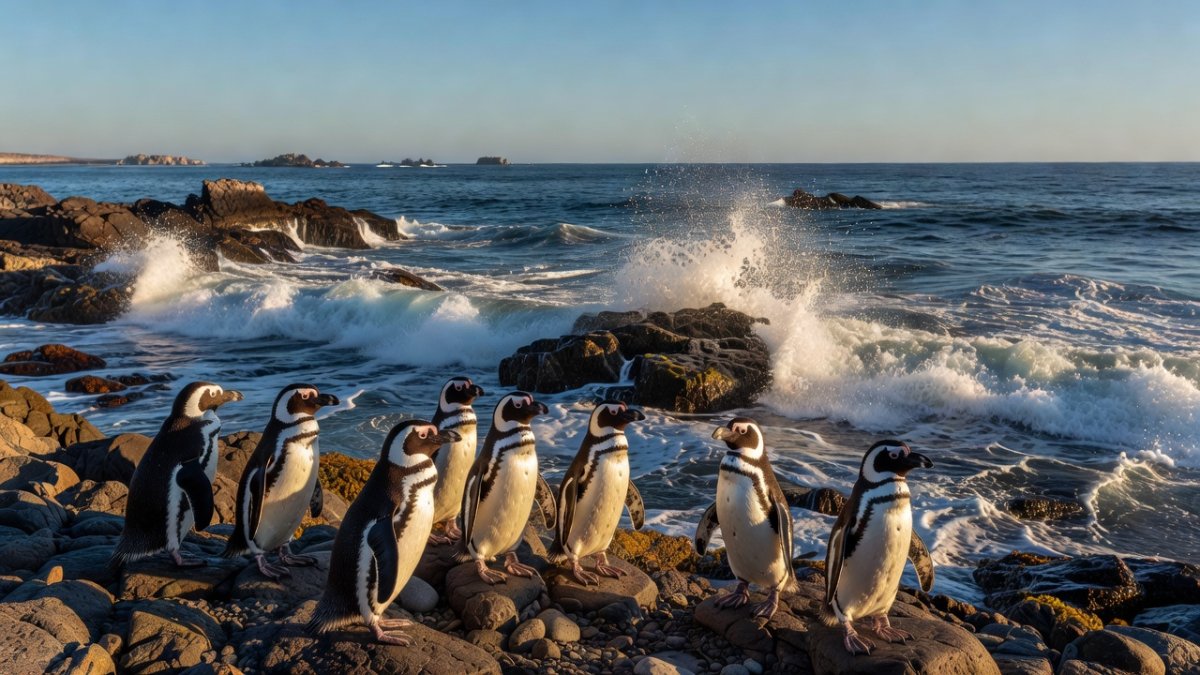
Vanishing Colonies: The 60% Crash
The scale of the loss is staggering. Between 2021 and 2025 the Humboldt penguin population in Chile fell more than 60 percent, driving the global total below 20,000 birds from an estimated 45,000 in the 1990s. Chile’s Environment Ministry responded by classifying the species “En Peligro” in late 2025, acknowledging that the primary breeding grounds in the Humboldt Archipelago face existential pressure. Isla Chañaral and Isla Pan de Azúcar inside Pan de Azúcar National Park, long considered strongholds, now host only remnant pairs. Biologists cited in The Clinic describe entire stretches of coastline where burrows remain empty year after year. The epicenter of the decline lies along the Atacama and Coquimbo coasts, where once-dense colonies have fragmented into isolated pockets. Without rapid expansion of protected marine zones, the remaining birds risk losing the last viable nesting habitat that has sustained the species for centuries. The speed of this collapse has shocked even longtime observers who expected gradual erosion rather than sudden disappearance of whole breeding groups.
Climate Change and the Humboldt Current
The Humboldt Current normally delivers cold, nutrient-rich waters that fuel massive anchovy and sardine populations, the foundation of the penguin diet. Climate change is now intensifying El Niño events, suppressing the cold-water upwelling that sustains these fish stocks. Marine heatwaves and steadily rising sea surface temperatures further reduce prey availability across the northern Chilean shelf. When upwelling fails, anchovy and sardine schools collapse, leaving adult penguins unable to feed chicks. The same pattern devastated Galápagos penguins, which suffered 77 percent mortality during the 1982-83 El Niño. Emperor penguins in Antarctica face parallel threats from sea-ice loss. In Chile the combination of warmer waters and more frequent heatwaves is pushing the Humboldt penguin toward the same tipping point. Ocean temperatures along the Atacama coast have risen measurably since the 1990s, shortening the window when prey remains abundant enough for successful breeding. Each missed season compounds the population crash already documented between 2021 and 2025.
Disease, Fishing, and Industrial Pressure
Additional stressors compound the climate-driven prey shortage. The H5N1 avian flu outbreak killed an estimated 8.5 percent of Chile’s Humboldt penguins during 2022-2023. Overfishing of anchovy and sardine removes the remaining food supply, while bycatch in gillnets continues to drown birds at sea. The proposed Dominga mining and port project near La Higuera was rejected for the third time in 2025 by the Committee of Ministers, a major victory for Oceana Chile and allied conservation groups. Oceana has led multiple expeditions through the Humboldt Archipelago and helped secure protection for more than 738,000 square kilometers of Chilean ocean. Still, industrial fishing pressure and the legacy of proposed ports threaten to undo these gains. Without stricter fisheries regulation and permanent no-take zones, the cumulative toll from disease, entanglement, and habitat disturbance will accelerate the 60 percent decline already recorded. The 2025 Dominga rejection demonstrates that sustained advocacy can block destructive projects, yet enforcement remains uneven along remote stretches of the northern coast.
What This Means for Latin America
Nine of the world’s 18 penguin species occur in Chilean waters, making the country a global penguin stronghold whose fate affects the entire Pacific seaboard. The Humboldt Current ecosystem supports artisanal fishing communities from Peru to central Chile that depend on the same anchovy and sardine stocks. Tourism at Isla Magdalena’s Monumento Natural Los Pingüinos and Pan de Azúcar National Park generates local revenue that could vanish if colonies disappear. Peru-Chile binational scientific collaboration is now monitoring shared populations, recognizing that the species does not respect maritime borders. Marine heatwaves and intensified El Niño events ripple through the entire Humboldt ecosystem, reducing biodiversity and undermining food security for coastal communities. The interconnectedness of these pressures means that protecting Humboldt penguins also safeguards the broader marine economy of Latin America’s western coast. Failure to act risks cascading losses that extend far beyond the birds themselves.
Voices from the Ground
Dr. Mateo Rivera and colleagues from WWF Chile and Oceana Chile have spent years documenting the silent beaches where Humboldt penguins once bred. Oceana expeditions have mapped critical foraging areas and pushed for expanded marine protected areas around the Humboldt Archipelago. Local fishing families in Punta de Choros describe empty nets and fewer penguins returning each season, linking their livelihood directly to the health of the Current. The “En Peligro” listing provides legal tools for stronger enforcement, yet Natural Monument designations have faced repeated setbacks from industrial interests. Biologists warn that the window for reversing the 60 percent decline is closing rapidly. Community-led monitoring programs now complement government surveys, creating a network of observers who track both penguin numbers and illegal fishing activity. These ground-level efforts underscore the urgency felt across northern Chile as the species that defines the region’s identity slips toward disappearance.
The Bottom Line — What Comes Next
The next decade will decide whether Humboldt penguins retain a viable population in Chile. Expanded fisheries regulation, new marine protected areas, and aggressive climate mitigation are essential to restore prey abundance and reduce bycatch. Sustained funding for Peru-Chile monitoring and H5N1 vaccination research must accompany habitat protection. Chile holds responsibility for the majority of the world’s remaining Humboldt breeding stocks and therefore carries an outsized obligation to act. Readers can support Oceana Chile and WWF campaigns, demand enforcement of the 2025 Dominga rejection, and advocate for stronger international cooperation on El Niño preparedness. Without decisive steps the 60 percent crash recorded between 2021 and 2025 will become a permanent loss, erasing one of Latin America’s most iconic marine species from its native waters.
By Elena Vasquez, Staff Writer
This article was produced with AI-assisted research and editorial support. Reporting is based on sources cited in the article.
What's Your Reaction?
 Like
0
Like
0
 Dislike
0
Dislike
0
 Love
0
Love
0
 Funny
0
Funny
0
 Wow
0
Wow
0
 Sad
0
Sad
0
 Angry
0
Angry
0

Latin America Correspondent at Global1.News. Based in Mexico City, covering politics, economics, energy, and culture across the region. Brings an on-the-ground perspective to stories spanning from the Rio Grande to Patagonia.















Comments (0)