
Canada's National Food Strategy: Carney's $750M Greenhouse Plan
Carney Unveils National Food Strategy Prime Minister Mark Carney launched Canada’s National Food Strategy on June 11, 2026, marking a significant federal commitment to strengthening domestic food security through expanded year-round produce production. The strategy includes a $750 million federal investment aimed at scaling up greenhouses, vertical farms, and other forms of con
Carney Unveils National Food Strategy
Prime Minister Mark Carney launched Canada’s National Food Strategy on June 11, 2026, marking a significant federal commitment to strengthening domestic food security through expanded year-round produce production. The strategy includes a $750 million federal investment aimed at scaling up greenhouses, vertical farms, and other forms of controlled environment agriculture across the country. This announcement comes at a time when Canada continues to rely heavily on imports, bringing in approximately 90 percent of its fruits and 70 percent of its vegetables from abroad, with roughly 40 percent of fresh produce originating from the United States. Federal officials have framed the initiative as a response to supply chain vulnerabilities exposed in recent years, while also seeking to create new economic opportunities in the agricultural sector.
The federal-provincial dynamics surrounding the strategy are particularly noteworthy. While the funding flows from Ottawa, implementation will depend heavily on cooperation with provinces that already host the bulk of greenhouse operations. Ontario, British Columbia, and Quebec together account for the vast majority of existing capacity, and their governments will play key roles in permitting, infrastructure support, and workforce development. This interplay between federal dollars and provincial regulatory frameworks will determine how quickly new facilities can come online and whether smaller regions can attract investment.
The State of Canadian Greenhouse Production
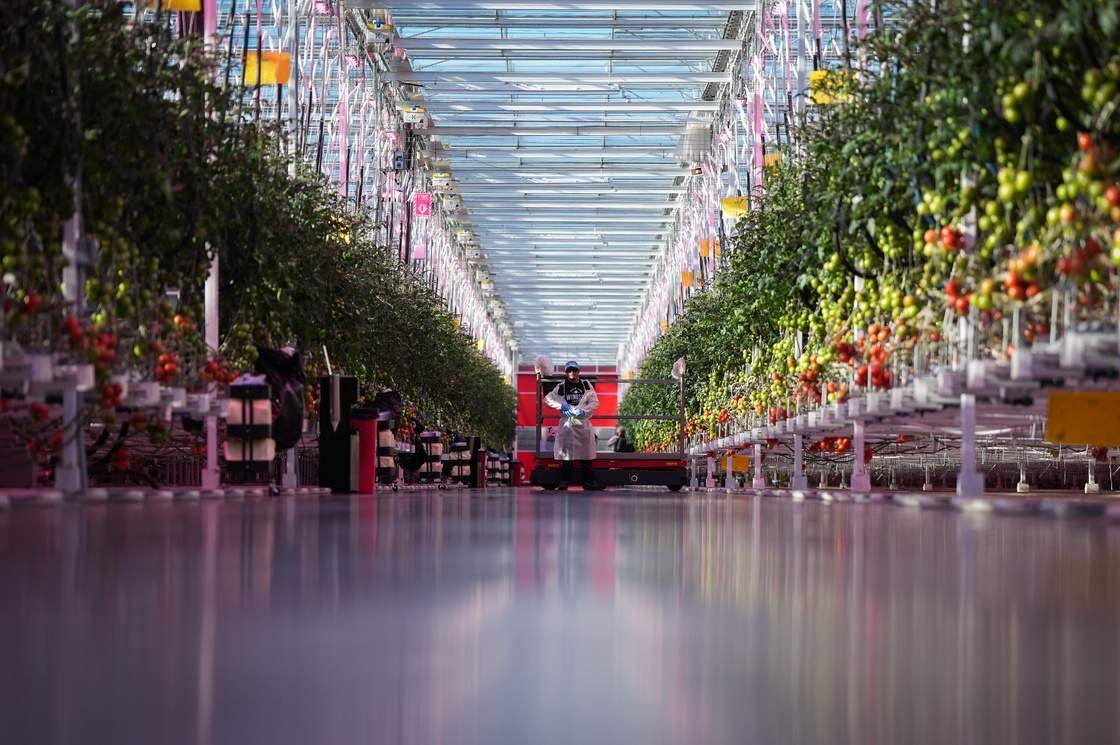
Current greenhouse production in Canada provides a solid foundation for the ambitions outlined in the National Food Strategy. In 2025, the total greenhouse area reached 35.9 million square metres, generating sales of $6.5 billion. Ontario leads with 64.9 percent of this area, followed by British Columbia at 17.4 percent and Quebec at 10.4 percent. These three provinces dominate because of favourable microclimates, established supply chains, and access to markets in major urban centres. The top crops grown under glass or in vertical systems include tomatoes, cucumbers, strawberries, lettuce, and herbs, all of which benefit from the consistent conditions that controlled environment agriculture provides.
Controlled environment agriculture involves precise management of temperature, humidity, lighting, and nutrient delivery, allowing producers to extend growing seasons dramatically. For Canadian farmers, this means shifting from seasonal outdoor production to year-round operations that can supply retailers even during harsh winter months. Small to medium commercial greenhouses typically range from 1,000 to 10,000 square feet, while large-scale facilities can span 10,000 square feet to several acres. Quebec’s Harnois stands out as a major domestic manufacturer of greenhouse structures, supplying equipment that supports both new entrants and expansions by existing operators.
Regional differences are pronounced. Ontario’s concentration around Leamington has created a dense cluster of expertise and infrastructure, while British Columbia’s operations benefit from milder coastal conditions and proximity to Asian export markets. Quebec’s share, though smaller, supports local demand in the Montreal area and benefits from provincial incentives that complement federal funding. These variations illustrate how the National Food Strategy must accommodate distinct provincial realities rather than applying a uniform national template.
Challenges to Scaling Up Domestic Production
Expanding controlled environment agriculture faces several structural hurdles that the $750 million commitment alone cannot immediately resolve. Greenhouse construction costs range from US$5 to US$35 per square foot according to CraftCamp data, representing a substantial capital outlay for operators considering expansion or new builds. Energy requirements for heating and lighting during Canadian winters add ongoing operational expenses that can erode profitability, particularly in provinces where electricity or natural gas prices remain elevated.
Federal-provincial coordination will be essential to address these barriers. Provinces must align building codes, environmental approvals, and agricultural zoning rules with federal investment timelines, yet each jurisdiction maintains its own priorities and bureaucratic processes. Ontario’s established greenhouse belt may absorb new capital more rapidly than Atlantic Canada or the Prairies, where colder climates and limited existing infrastructure could slow adoption. This uneven geography risks concentrating benefits in already dominant regions unless targeted measures encourage broader distribution.
Comparisons with greenhouse strategies in the Netherlands and Israel highlight both opportunities and constraints. Those countries have achieved high productivity through decades of research investment and energy-efficient technologies, yet Canada’s northern latitude imposes greater heating demands that those models do not fully address. The strategy’s emphasis on controlled environment agriculture therefore requires tailored Canadian solutions rather than direct importation of foreign blueprints.
Expert Perspectives on Feasibility
Industry leaders have welcomed the announcement. Canadian Produce Marketing Association president Ron Lemaire described the commitment as the highest investment in the fresh produce sector in recent history, while the Canadian Federation of Agriculture also praised the strategy for recognising the role of domestic production in national food security. These endorsements reflect broad sectoral support for reducing import dependence.
Academic voices offer more cautious assessments. Professor Michael Widener of the University of Toronto notes that scaling up remains difficult because the approach is energy-intensive and essentially involves shining fake sunlight on crops during long winter months. He points out that attempting to grow oranges in December would not be reasonable for Canada and instead recommends diversifying trade partners. Professor Barry Prentice of the University of Manitoba observes that greenhouses remain centred in Leamington, British Columbia, and Quebec, with limited capacity to expand rapidly into new regions without major infrastructure upgrades.
Canada’s recent agricultural agreements with Asian countries, signed last year, provide an additional avenue for supply stability while domestic capacity grows. These trade deals complement the National Food Strategy by ensuring continued access to imports during the transition period, rather than creating an abrupt shift toward complete self-sufficiency.
Impact on Canadian Households and Grocery Prices
For Canadian households, the strategy’s long-term promise lies in greater price stability and fresher local options, though immediate effects on grocery bills are likely to be modest. Increased domestic production of tomatoes, cucumbers, strawberries, lettuce, and herbs could gradually reduce reliance on imports that are subject to currency fluctuations and cross-border logistics disruptions. However, the high capital costs of new greenhouse facilities mean that any price benefits will materialise only after several growing seasons.
Regional impacts will vary. Households in Ontario and British Columbia may see earlier availability of locally grown produce, while consumers in the Prairies and Atlantic provinces could continue depending more heavily on imports or interprovincial shipments. The strategy’s success in lowering prices will hinge on whether new facilities achieve sufficient scale to compete with established supply chains from the United States and other trading partners.
Over time, the combination of federal investment and provincial implementation could foster a more resilient food system, particularly if energy-efficient technologies reduce operating costs. Yet experts caution against expecting dramatic short-term changes in the produce aisle, given the physical and economic realities of expanding controlled environment agriculture in a northern climate.
What Happens Next
Implementation of the National Food Strategy will unfold over multiple years, with the federal government working alongside provincial partners to allocate the $750 million across projects that meet defined criteria for expansion and innovation. Early focus is expected on regions already possessing greenhouse expertise, while efforts to broaden geographic reach will require additional planning and infrastructure support.
Monitoring progress will involve tracking new greenhouse area added, sales growth beyond the 2025 baseline of $6.5 billion, and shifts in import volumes for key crops. The federal commitment signals a sustained policy direction, yet actual outcomes will depend on continued collaboration between Ottawa and the provinces, as well as the willingness of farmers and investors to commit capital in an energy-intensive sector.
As Canada navigates this transition, the strategy represents a measured attempt to balance food security goals with economic and environmental realities. Its effectiveness will be judged not by immediate headlines but by measurable increases in domestic production capacity over the coming decade.
Tags: National Food Strategy, Mark Carney, greenhouse production, grocery costs, controlled environment agriculture, Canadian food security, indoor farming
By Alex Thompson, Staff Writer
This article was produced with AI-assisted research and editorial support. Reporting is based on sources cited in the article.
What's Your Reaction?
 Like
0
Like
0
 Dislike
0
Dislike
0
 Love
0
Love
0
 Funny
0
Funny
0
 Wow
0
Wow
0
 Sad
0
Sad
0
 Angry
0
Angry
0

Canada Correspondent at Global1.News. Based in Toronto, covering Canadian politics, energy, trade, and US-Canada relations. Provides the Canadian perspective on North American and global affairs.














Comments (0)