
Twelfth Night of Hell: Trump Threatens Nuclear Infrastructure as US-Iran War Hits $37.5 Billion
US forces hit Iran for a 12th night as Trump threatens bridges, power plants and sites near Natanz. War costs hit 7.5 billion with a 5 billion request pending. Hormuz shipping stalls, Brent reaches 2, Houthis strike Saudi tankers, and diplomacy freezes amid Gulf spillover.
CENTCOM Details Twelfth Night of Precision Strikes on Iranian Sites
The U.S. military has pressed ahead with its eleventh and twelfth consecutive nights of airstrikes against Iran, according to a CENTCOM announcement covering operations that began at 5:30 pm ET on July 22. Officials described the targets as Iranian command centers, air defenses, missile and drone sites, coastal facilities and communications networks concentrated in western regions of the country. Strikes were reported near the cities of Ahvaz, Ramshir and Andimeshk, underscoring the sustained tempo of the campaign now stretching deep into a second week of open hostilities.
Iranian state media confirmed impacts in those same western areas, while local reports documented two people killed in a U.S. missile strike on the village of Talkhab-e Seyyed Fattah in Khuzestan province. The limited casualty figure stands in contrast to the breadth of the target list, yet it highlights the human cost accumulating on the ground even as both sides trade claims of precision. CENTCOM has framed the raids as necessary to degrade Iran’s ability to threaten shipping and project power across the Gulf.
This latest wave arrives against a backdrop of already elevated regional tensions, with commercial traffic through critical waterways under severe strain. Military planners appear focused on systematically dismantling the networks that enable Iranian missile and drone operations, a strategy that has now entered its twelfth night without any public indication of an imminent pause. The persistence of the strikes signals Washington’s determination to maintain pressure even as costs mount and diplomatic channels remain frozen.
Observers note that the choice of western Iranian locations places the operations closer to Iraq and the Gulf littoral, raising the risk of further spillover. With each successive night, the operational pattern has become clearer: repeated, multi-site attacks designed to keep Iranian air defenses and command nodes off balance. Whether this approach can force a strategic shift in Tehran remains the central unanswered question hanging over the conflict.
Trump Warns of Bridge and Power Plant Retaliation for Hormuz Attacks
President Trump escalated the rhetoric dramatically by declaring that the United States will destroy “one bridge or power plant” in Iran each time Tehran fires on a ship in the Strait of Hormuz. “From this point forward, any time the Islamic Republic of Iran shoots at a ship in the Strait of Hormuz, whether it be by Missile, Rocket, Drone, or any other device or weapon, the United States will destroy one bridge or power plant in Iran,” Trump stated, laying down a stark new red line that directly links maritime incidents to inland infrastructure targets.
In a speech delivered in Georgia, the president added that Washington does not need the Strait of Hormuz but is acting “because we have to, because we cannot allow them.” The formulation leaves little room for ambiguity: any Iranian attempt to interfere with shipping will now trigger deliberate strikes on civilian-linked infrastructure. Trump further indicated that U.S. forces will soon strike near “Pickaxe Mountain,” known as Kuh-e Kolang Gaz La, an underground site in the vicinity of Iran’s Natanz nuclear enrichment facility.
Speaking to reporters in the Oval Office, Trump shut the door on immediate diplomacy, asserting that Iran wants “to desperately meet” but that the United States has “no interest” until Tehran is ready to engage “in a meaningful way.” The combination of infrastructure threats and the explicit mention of a site near Natanz marks a significant broadening of the target set beyond purely military installations. Critics already warn that such moves risk crossing into territory governed by strict international legal constraints on civilian objects.
The president’s language leaves Iranian decision-makers with a binary choice: cease all attacks on shipping or watch bridges and power plants disappear one by one. That clarity may appeal to domestic audiences seeking resolve, yet it also compresses the space for de-escalation at a moment when regional actors are already absorbing secondary blows. The coming days will test whether the threat alone alters Iranian behavior or simply accelerates the cycle of retaliation.
Pentagon Chief Reveals $37.5 Billion Price Tag and Seeks Fresh Funds
Pentagon Chief Pete Hegseth disclosed that the war with Iran has already cost $37.5 billion, a figure that landed with force on Capitol Hill as he requested fresh funding from senators. The scale of expenditure after less than a month of high-intensity operations illustrates the enormous resource demands of sustained air and naval campaigns in the region. Hegseth’s testimony framed the outlay as the necessary price of degrading Iranian capabilities and keeping critical waterways open.
Beyond the $37.5 billion already spent, the Pentagon has requested an additional $95 billion package specifically for the Iran war effort. That request, if approved, would push total authorized spending well above $130 billion and signal that military planners anticipate a protracted confrontation rather than a short punitive campaign. Lawmakers now face the politically charged task of weighing these sums against competing domestic priorities while images of burning infrastructure dominate news cycles.
The cost trajectory also raises questions about long-term sustainability and opportunity costs for other U.S. global commitments. Each night of strikes consumes precision munitions, fuel, and maintenance resources at rates that quickly compound. Hegseth’s decision to publicize the $37.5 billion tally appears calculated to build urgency behind the larger $95 billion ask, yet it simultaneously hands critics a concrete number with which to challenge the administration’s strategy.
For taxpayers and markets alike, the financial dimension has become impossible to ignore. Oil prices have already reacted, and further infrastructure damage on either side will only amplify economic ripple effects. The Pentagon’s dual message—here is what we have spent, and here is what we still need—sets the stage for a high-stakes funding battle even as bombs continue to fall.
Iranian Foreign Minister Promises Eye-for-Eye Response
Iran’s Foreign Minister Seyed Abbas Araghchi answered the latest U.S. strikes and Trump’s infrastructure threats with a blunt restatement of Tehran’s doctrine: “Our defense doctrine is clear: eye for an eye. Any aggression against Iran, including our infrastructure, will compel a powerful and decisive response.” Araghchi went further, warning that “those who contribute to such aggression, whatever the kind of support, will also be considered as legitimate targets,” language that appears aimed at both the United States and any regional partners assisting Washington.
In practical terms, Iran has already expanded its retaliation beyond U.S. forces by targeting energy infrastructure and desalination plants that supply drinking water in neighboring Gulf countries. These attacks on dual-use and civilian-linked facilities mirror the very infrastructure threats now emanating from the White House, creating a dangerous symmetry. Each side can now claim the other struck first at the civilian backbone of modern life.
The foreign minister’s comments leave little doubt that Tehran intends to match any escalation rung for rung. By explicitly including infrastructure in the category of actions that will trigger “powerful and decisive” replies, Araghchi has drawn his own red line. The risk is that both capitals are now locked into a logic of automatic reciprocity that leaves scant room for off-ramps.
International law generally prohibits attacks on civilian infrastructure unless it is being used for military purposes, a standard both parties have increasingly strained. As desalination plants and power grids enter the crosshairs, the humanitarian consequences for ordinary civilians across the Gulf could escalate far faster than the diplomatic machinery can respond. Araghchi’s words suggest Iran is prepared for that contest.
Kuwait Intercepts Hostile Drones as Conflict Spills Over
Kuwait’s military announced that its air defense systems had intercepted hostile drones, with the General Staff of the Kuwaiti Army stating that forces were “confronting attacks by hostile drones” and that explosions heard in the area were the result of interception operations. The incident marks a clear geographic expansion of the fighting beyond Iranian and Iraqi airspace into the territory of a key U.S. partner.
For Kuwait, a nation that has long sought to balance relations in a volatile neighborhood, the drone incursions represent an unwelcome reminder that neutrality offers limited protection once major powers begin trading blows. Air defense crews were forced to engage incoming threats in real time, turning what might have been a distant war into an immediate national security event. The successful interceptions prevented greater damage, yet the psychological impact on a small Gulf state is considerable.
The timing of the drone activity—coinciding with the twelfth night of U.S. strikes—suggests either Iranian retaliation, proxy action, or a deliberate test of Kuwaiti and American air defense coordination. Regardless of provenance, the episode demonstrates how quickly the conflict can generate secondary fronts. Shipping, energy facilities, and now the airspace of non-belligerent states are all being drawn into the same vortex.
Regional capitals will be watching closely to see whether Kuwait requests additional U.S. defensive support or seeks to de-escalate through its own diplomatic channels. Either path carries risks. What is already certain is that the war’s blast radius has grown large enough to rattle windows in Kuwait City.
Houthis Declare Maritime Embargo and Strike Saudi Tankers
Yemen’s Houthi rebels announced they had carried out missile and drone strikes on two Saudi oil tankers in the Red Sea, identifying the vessels as the Encelia and the Layla. The group simultaneously declared a maritime embargo on Saudi Arabia in solidarity with Iran against the United States. These actions open a southern front that threatens another of the world’s vital energy corridors at the precise moment the Strait of Hormuz is already under severe pressure.
By targeting Saudi tankers, the Houthis are both supporting their Iranian alignment and punishing Riyadh for its perceived proximity to Washington. The Red Sea attacks complicate Saudi efforts to keep oil flowing via its East-West pipeline to Red Sea terminals, a workaround that has become more important as Hormuz traffic seizes up. Each successful Houthi strike raises insurance rates and deters commercial operators from the southern route as well.
The embargo declaration, while difficult to enforce comprehensively, adds a layer of political and psychological pressure. Ship owners must now calculate risks on two separate waterways rather than one. For global energy markets already digesting $92-per-barrel Brent crude, the multiplication of threats produces a compounding effect that no single naval task force can fully neutralize.
The Houthi move illustrates the networked nature of the current confrontation: Iranian allies are activating in theaters far from the primary U.S.-Iran strike zones. Containing the conflict therefore requires simultaneous attention to the Gulf, the Red Sea, and the political calculations of non-state actors who see opportunity in the chaos.
Strait of Hormuz Traffic Crippled as Oil Markets React
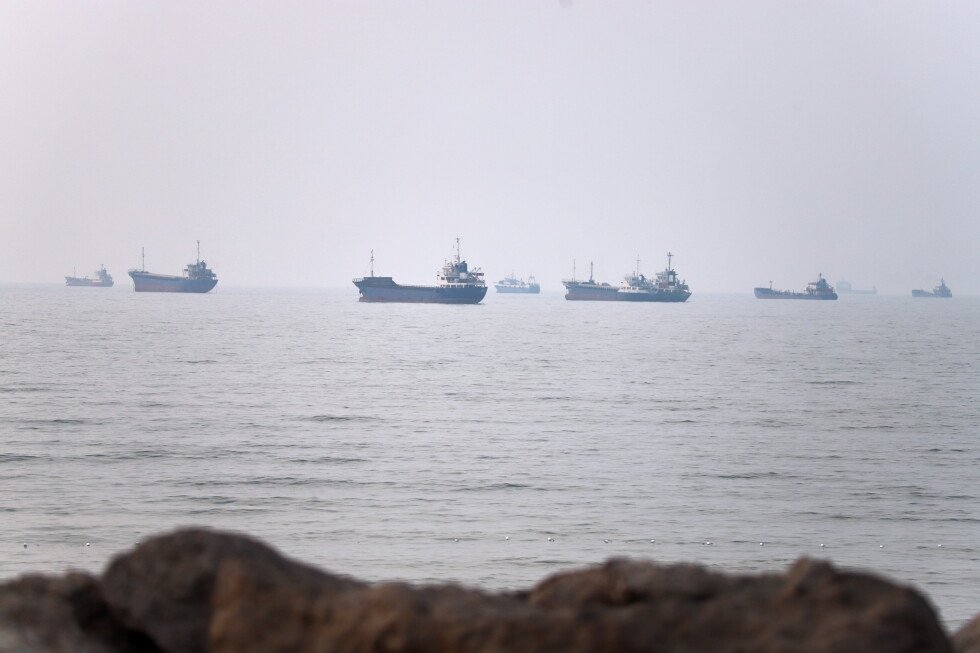
The Strait of Hormuz, which carried roughly one-fifth of the world’s crude oil and natural gas before the conflict, is now effectively blocked for normal commercial purposes. Iran’s IRGC Navy has claimed control over entry to and exit from the waterway, a assertion CENTCOM dismissed as “false.” According to the U.S. command, American forces have assisted more than 900 commercial ships through the strait since early May and have redirected nine commercial vessels while disabling one during enforcement operations.
Despite the U.S. escort effort, shipping has slowed to a crawl and markets have taken notice. Brent crude climbed to $92 per barrel as traders priced in the near-halting of one of the planet’s most important energy chokepoints. Saudi Arabia has shifted volumes onto its pipeline to the Red Sea in an attempt to bypass the worst of the disruption, yet that route now faces its own Houthi threats.
CENTCOM’s figures—more than 900 ships assisted, nine redirected, one disabled—paint a picture of continuous, low-level naval skirmishing rather than a clean blockade. Still, the practical result for oil traders and importing nations is the same: elevated prices, delayed cargoes, and the constant risk of a single miscalculation turning into a larger clash. Trump’s new bridge-and-power-plant doctrine is explicitly tied to any further Iranian shooting in these waters, raising the stakes for every subsequent incident.
Energy economists warn that prolonged disruption at this scale will feed through into global inflation and supply-chain costs far beyond the Middle East. The $92 barrel is only the first visible symptom. If the strait remains contested and the Red Sea grows more dangerous, the economic pain will spread to households and industries worldwide that have no direct stake in the political quarrel.
Diplomatic Channels Freeze While Rubio Sounds Alarm at ASEAN
Diplomatic prospects appear bleak after President Trump’s Oval Office declaration that Washington has “no interest” in meeting Iranian officials until they are ready to talk “in a meaningful way.” Pakistan’s Prime Minister Shehbaz Sharif expressed “deep concern” and held talks with Iran’s Interior Minister, while Pakistan’s army chief Field Marshal Asim Munir—who played a key role in brokering last month’s interim deal—has been engaged behind the scenes. Those efforts have yet to produce a visible breakthrough.
Secretary of State Marco Rubio, speaking at the ASEAN Foreign Ministers’ Meeting in Pasay, Metro Manila, Philippines, warned that Iranian control of the Strait of Hormuz would set a “dangerous precedent” with repercussions far beyond the Middle East. Rubio’s decision to elevate the issue before Southeast Asian counterparts underscores how the conflict is already reshaping conversations in distant capitals that depend on stable energy flows and open sea lanes.
Meanwhile, President Trump has approved a landmark 30-year civilian nuclear cooperation agreement with Saudi Arabia that would allow U.S. companies to supply nuclear technology, equipment and expertise. The timing of the announcement, in the midst of strikes near Iranian nuclear-related sites, sends a pointed signal about which regional partners Washington intends to bolster. It also adds another layer of complexity to non-proliferation discussions at a moment when military action near Natanz is being openly discussed.
With both sides hardening their positions, the diplomatic vacuum is being filled by military facts on the ground and by secondary actors pursuing their own agendas. International law’s restrictions on civilian infrastructure attacks are being tested daily, and the longer the talking stops, the harder it becomes to restore any off-ramp. The twelfth night of strikes may be remembered less for the munitions expended than for the opportunities at dialogue that were allowed to slip away.
By Jessica Ali, Staff WriterThis article was produced with AI-assisted research and editorial support. Reporting is based on sources cited in the article.
What's Your Reaction?
 Like
0
Like
0
 Dislike
0
Dislike
0
 Love
0
Love
0
 Funny
0
Funny
0
 Wow
0
Wow
0
 Sad
0
Sad
0
 Angry
0
Angry
0

Editor-in-Chief at Global1.News. Atlanta-based journalist who cuts through the BS and tells it like it is. Lead anchor, host, and the voice you hear when the spin stops and the truth starts.













Comments (0)