
Venezuela Twin Earthquakes: 1,700 Dead as Communities Forced to Self-Rescue
Death Toll Passes 2,200 as Rescue Operations Continue Across Venezuela's Devastated Coast The ground still trembles in memory along Venezuela's northern coast, where two ferocious quakes of 7.2 and 7.5 magnitude struck near La Guaira, leaving at least 2,295 dead and more than 1,400 buildings reduced to dust in La Guaira state alone. Families wander the ruins of Catia La Mar and
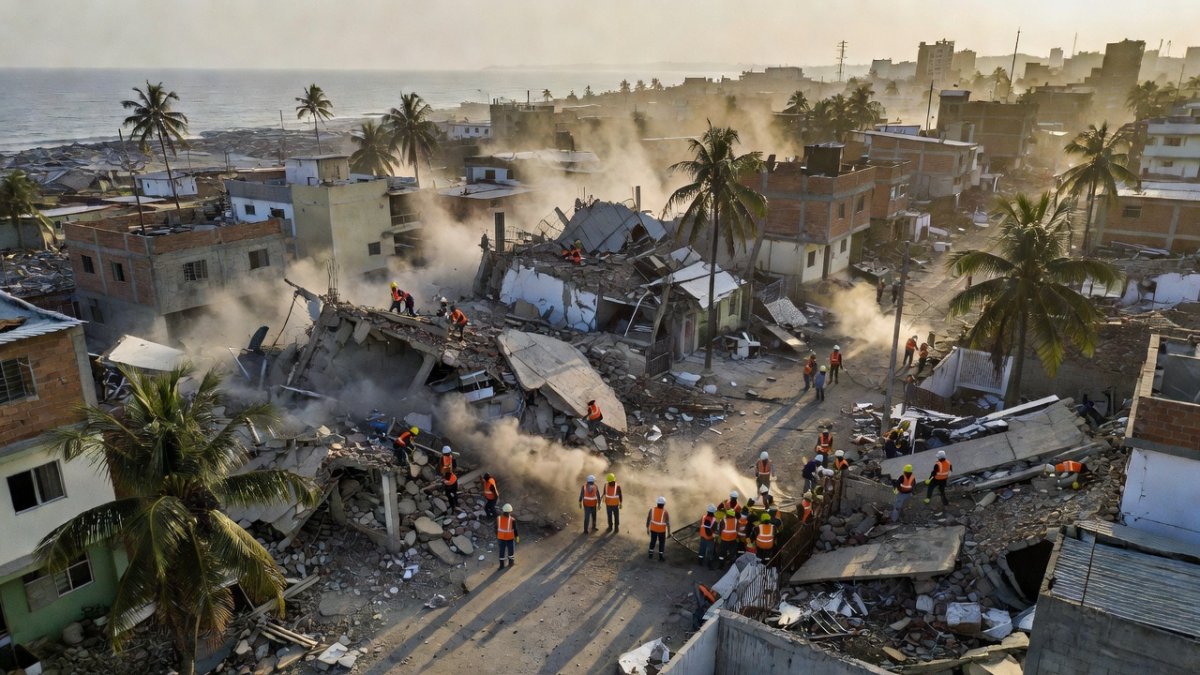
Death Toll Passes 2,200 as Rescue Operations Continue Across Venezuela's Devastated Coast
The ground still trembles in memory along Venezuela's northern coast, where two ferocious quakes of 7.2 and 7.5 magnitude struck near La Guaira, leaving at least 2,295 dead and more than 1,400 buildings reduced to dust in La Guaira state alone. Families wander the ruins of Catia La Mar and Caraballeda calling names into the night, while the stench of death rises from Bello Horizonte complex in Caracas. Today the scale of loss feels almost biblical, yet the living refuse to surrender their hope.
Interim President Delcy Rodriguez hailed the rescue of two-year-old Kleiber Moran as a "source of hope for our people," after Jordanian teams pulled the child from rubble in La Guaira after six days. Jorge Rodriguez, president of the National Assembly, described the earthquakes as "the most disastrous event this republic has suffered in the last 123 years" and insisted that "every person saved is a miracle." UN teams are already procuring 10,000 body bags as 14,000 Venezuelan soldiers fan out across the destruction.
Yet the human cost keeps mounting. Grandfather Jose Rincon searched through more than 200 bodies for his grandson Abelardo Rincon, 23, one of the Flight 164 deportees listed among the missing. A DHS statement noted that "When an individual is no longer in ICE custody, ICE is no longer responsible for them," leaving families to confront the rubble alone.
Survivors Describe Government Response as Dangerous and Too Slow
Kevin Montilla stood outside the pancaked remains of his building in Los Palos Grandes, his voice cracking as he described the agonizing wait. "The rescue operation started very late and it's been slow. Initially it was only people who live in the community who came in to help. The police just came to check, but they didn't help. The government's response has been frustrating and impotent." His wife Luzmary and daughter Jhoerliyzmar remain unaccounted for beneath the concrete.
One resident screamed directly at Delcy Rodriguez during a visit to the ruins: "You're campaigning in the middle of a tragedy! The government isn't doing anything for the people!" The outburst captured the fury spreading through Chacao and Catia La Mar, where official presence has been limited to photo opportunities rather than heavy equipment.
Ex-policeman Jan Carlos Roa Garcia, 50, now sleeps rough because his building was declared unsafe. "If I was 30 and not 50, then maybe. But I don't know where to begin. And so far, no-one in authority has contacted us." His words echo the broader abandonment felt across Caracas neighborhoods still waiting for coordinated aid.
With No Machinery, Families Dig Through Rubble With Bare Hands
Miguel Oscar Nunez refuses to leave the pile of twisted rebar that swallowed his son Angel. "My son, like hundreds of others is trapped under the rubble. But we need more support from authorities urgently to dig them out. It's possible that the earthquake has not killed him, but can you imagine if he is killed because of the negligence of the authorities." Around him, neighbors claw at concrete with bleeding fingers.
Juan Avendo, 60, who lives across from the collapsed Bello Horizonte complex, remembers the first hours vividly. "We could hear the screams and shouts of people trapped under the rubble. So we tried to help them ourselves, using our bare hands, clawing through the debris with our nails." No cranes arrived for days.
William Rodrigues keeps searching for his uncle despite the overwhelming odor. "The stench is horrible here. But I'm still trying because I'm looking for my uncle. We cannot just stand by idly when there's the possibility that there might be people alive under the rubble. Help arrived very late in most places, and in some, it has still not arrived." Deilisbeth Herreira, searching for daughters Greydelys, 12, and Graybelys, 13, adds: "I have help from no one. No machines or rescuers have been sent to dig through the rubble. It's like you've been left on your own to find your loved ones. My daughters were quiet, studious girls. I just want them back at any cost."
Hospitals Overwhelmed as Decade of Underfunding Compounds the Crisis
Glendys Delgado watches flies swarm over the debris in Caraballeda and fears the next wave of suffering. "There's a smell… the dead are already being felt. That's going to make us and the children sick. No one from the government has come here." Venezuela's chronically underfunded healthcare system, starved for decades, now faces an impossible influx of crush injuries and infections.
Jesus Suarez traveled 200 kilometers from his home to search for his son Jean Suarez, only to confront the same void. "There's no information at all. People who know him say they didn't see him come out or anything. It's impossible to rescue him... There is no sophisticated equipment here. A human being alone cannot do it - it's too dangerous." Makeshift triage points lack even basic antibiotics.
Local doctors report that many survivors are succumbing not to the initial trauma but to secondary complications that Brazil's Defesa Civil protocols would normally prevent through rapid field hospitals. The absence of such systems has turned treatable wounds into fatal ones across La Guaira state.
International Rescue Teams Face a Race Against Time
Rescue teams from more than ten nations have converged on the coast, yet the window for finding survivors narrows with every passing hour. Jordanian specialists who saved Kleiber Moran continue working alongside Colombian and Chilean units familiar with the Andes seismic belt that runs through Ecuador, Peru, and Chile. Their expertise highlights how Venezuela's isolation has left it unprepared for events that neighboring countries have learned to anticipate.
Musician Zaira Castro watched the international crews arrive in Chacao and noted the contrast with official inaction. "We're all pretty frustrated because the government is not showing what it should — a serious display of help. It's actually us, the Venezuelans, who are helping each other. We live in a society that has grown into helping each other. We don't depend on the government — that doesn't exist for us anymore."
Brazil's CEMADEN early-warning network and Defesa Civil rapid-deployment model offer a template that could have shortened response times here, yet political barriers have kept such cooperation minimal. The result is a race against both time and institutional failure.
Stories of Survival: The Two-Year-Old and the Newborn Who Beat the Odds
Kleiber Moran, two, emerged after six days beneath the rubble of La Guaira, his small body lifted by Jordanian rescuers into the arms of aunt Andreina Sarmiento, 23. "I will take care of Kleiber with a mother's warmth until my sister appears," she said, cradling the child who had become a symbol of fragile hope.
Dayana Patino survived alongside her 18-day-old son Juan David, refusing to let either of them slip away. "As long as he was alive, I was going to be alive. Every now and then I was touching his nose for proof that he was still breathing." Her husband Gerson, who had feared the worst, described the moment he saw them: "I thought they were dead. And when I saw my son I felt like I was born again. I couldn't believe it… I felt the life come back to me."
These miracles stand against the daily discoveries of bodies that no longer breathe. Each rescue underscores what coordinated machinery and earlier international access might have multiplied across the shattered coast.
What Venezuela's Earthquake Response Reveals About Latin America's Preparedness Gap
The earthquakes have laid bare a regional vulnerability along the Andes seismic belt, where Colombia, Ecuador, Peru, and Chile have invested in early-warning systems and cross-border protocols that Venezuela conspicuously lacks. Brazil's CEMADEN monitoring stations and Defesa Civil's standardized deployment of heavy equipment and medical teams represent the kind of integrated response that could have saved hundreds here.
Instead, the pattern of late arrivals, absent machinery, and families reduced to digging with their nails repeats across La Guaira, Caracas, and Catia La Mar. The 14,000 soldiers deployed cannot compensate for decades of eroded institutions and the refusal to accept outside expertise until the death toll had already soared past 2,200.
As aftershocks continue and the smell of death spreads, the lesson for Latin America is stark: seismic risk does not respect borders or politics. Without the coordinated preparedness Brazil and its Andean neighbors have built, the next rupture will again turn neighbors into rescuers and governments into spectators. The people of Venezuela have already paid that price in blood and silence.
By Elena Vasquez, Staff WriterThis article was produced with AI-assisted research and editorial support. Reporting is based on sources cited in the article.
What's Your Reaction?
 Like
0
Like
0
 Dislike
0
Dislike
0
 Love
0
Love
0
 Funny
0
Funny
0
 Wow
0
Wow
0
 Sad
0
Sad
0
 Angry
0
Angry
0

Latin America Correspondent at Global1.News. Based in Mexico City, covering politics, economics, energy, and culture across the region. Brings an on-the-ground perspective to stories spanning from the Rio Grande to Patagonia.









Comments (0)