
Venezuela Rocked by Twin Earthquakes: 7.5 Magnitude Devastates Caracas Region
On the evening of June 24, 2026, Venezuela endured a rare and destructive sequence of twin earthquakes that struck with almost no warning, leaving a trail of collapsed buildings, disrupted infrastructure, and a deepening humanitarian emergency in one of the world's most fragile nations. The events unfolded rapidly near the coastal city of Moron in Carabobo state, amplifying lon
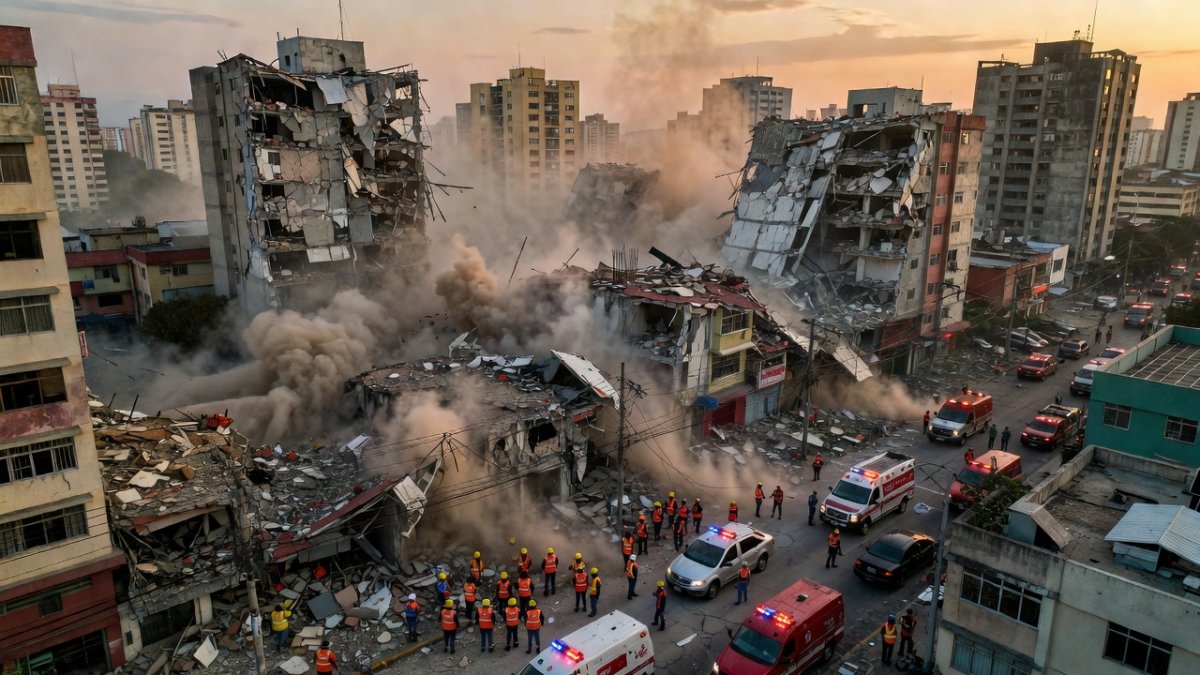
On the evening of June 24, 2026, Venezuela endured a rare and destructive sequence of twin earthquakes that struck with almost no warning, leaving a trail of collapsed buildings, disrupted infrastructure, and a deepening humanitarian emergency in one of the world's most fragile nations. The events unfolded rapidly near the coastal city of Moron in Carabobo state, amplifying long-standing vulnerabilities in a country already strained by economic collapse and political isolation.
THE TWIN STRIKES
The sequence began at approximately 8:15 p.m. local time when a 7.2 magnitude foreshock rattled the region for several seconds. Just 40 seconds later, the mainshock registered 7.5 on the Richter scale, according to preliminary data released by the United States Geological Survey. The epicenter was located near Moron in Carabobo state, roughly 168 kilometers west of Caracas, at a shallow depth that intensified ground acceleration across a wide area. USGS officials immediately issued a red alert, stating that high casualties and extensive damage were probable given the population density and construction quality in the affected zones.
More than 7.2 million people experienced strong to violent shaking, with the tremors propagating as far as 1,700 kilometers to Manaus in Brazil. Reuters correspondents on the ground reported that residents in Caracas felt the ground lurch violently for nearly a minute during the mainshock, sending crowds into the streets amid falling debris and power outages. AP photographers captured images of cracked facades and overturned vehicles along major thoroughfares, underscoring how the shallow focal depth converted what might have been survivable motion into catastrophic destruction in poorly engineered structures.
Seismologists noted the unusually brief interval between the two events left virtually no time for organized evacuation or protective measures. The combined energy release exceeded that of many single large quakes in the region, with aftershocks continuing into the night. International monitoring agencies, including those cited by Reuters, emphasized that the red alert level reflected both the magnitude and the socioeconomic context, where even moderate shaking can overwhelm response capacities already stretched thin by years of crisis.
Early estimates from the USGS placed the event among the most significant in northern South America in over two centuries, with peak ground accelerations recorded at levels capable of toppling unreinforced masonry. The rapid succession of shocks compounded panic, as many residents initially believed the foreshock signaled the end of the danger only to be caught in the stronger follow-up. This pattern, documented in real time by AP stringers, highlighted the lethal efficiency of the 40-second gap in preventing any meaningful public response.
SEISMIC CONTEXT
The earthquakes occurred along the boundary between the Caribbean and South American tectonic plates, where convergence proceeds at approximately 20 millimeters per year. This slow but persistent motion has built up significant strain over centuries, releasing periodically in large events. Seismologists cited by Al Jazeera explained that the June 24 sequence fits a classic foreshock-mainshock pattern, though the 40-second separation proved far too brief for any practical warning dissemination or public action.
Historical records show the last major quake in the immediate vicinity was the 1812 Caracas earthquake, which measured approximately 7.7 and leveled much of the capital. That event killed thousands and reshaped the city's development, yet modern building practices have not fully incorporated lessons from that disaster. USGS seismic history archives reveal multiple moderate events in the intervening years, but none approached the combined intensity of the 2026 twin strikes, leaving populations unprepared for the scale of destruction.
The shallow depth of both shocks transformed what could have been moderate damage into widespread collapse. Energy from the quakes dissipated close to the surface rather than being absorbed deeper in the crust, producing intense horizontal accelerations that older and informally constructed buildings could not withstand. Al Jazeera analysts noted that this geological reality, combined with the plate-boundary setting, makes the northern Venezuelan coast one of the highest-risk zones in the Caribbean basin despite relatively infrequent large events.
Experts emphasized that the foreshock-mainshock dynamic observed here serves as a stark reminder of the limitations of current early-warning systems in developing nations. With only seconds between events, even sophisticated networks would struggle to issue actionable alerts. The 20-millimeter annual slip rate continues to load the fault, suggesting that additional seismic activity remains possible in the coming years or decades.
CARACAS COLLAPSES
In Caracas, the neighborhoods of Altamira, Chacao, and La Candelaria suffered the most severe damage, with multiple mid-rise apartment buildings pancaking due to inadequate reinforcement. Poor enforcement of building codes over decades left thousands of structures vulnerable to even moderate ground motion, a problem documented extensively by AP reporters surveying the rubble. Entire blocks in these upscale and middle-class districts were reduced to twisted rebar and concrete dust within minutes of the mainshock.
The coastal city of La Guaira, a key port facility north of the capital, saw entire blocks flattened, with historic warehouses and residential zones suffering near-total destruction. CNN teams on site described scenes of residents digging through debris with bare hands in search of family members, while The Guardian highlighted how years of neglected maintenance on older infrastructure accelerated the collapses. Simon Bolivar International Airport sustained critical runway damage and terminal cracks, forcing the immediate suspension of all commercial operations and stranding hundreds of travelers.
Widespread blackouts plunged Caracas and surrounding northern states into darkness, knocking out traffic signals, water pumps, and communication networks. The Guardian reported that the power grid failure persisted for days in some areas, complicating rescue efforts and leaving hospitals operating under emergency lighting where available. This infrastructure breakdown revealed the fragility of a system already prone to frequent outages even before the seismic events.
Local authorities confirmed that the combination of substandard construction and intense shaking produced damage patterns reminiscent of far larger quakes elsewhere in the world. AP photographers documented collapsed overpasses and fractured water mains, underscoring how the 7.5 mainshock exploited every weakness in the urban fabric. Recovery in these hardest-hit zones is expected to take years given the extent of the destruction.
TSUNAMI SCARE AND INFRASTRUCTURE
The Pacific Tsunami Warning Center issued an immediate advisory for all coasts within 300 kilometers of the epicenter, placing Puerto Rico, the U.S. Virgin Islands, and the ABC islands of Aruba, Bonaire, and Curacao on heightened alert. Although the advisory was later withdrawn after sea-level gauges showed no significant wave activity, the initial warning exposed the potential reach of secondary effects from shallow offshore quakes. NWS officials noted that even a modest tsunami could have overwhelmed low-lying coastal communities already reeling from the shaking.
Power grid failures compounded the crisis dramatically, leaving large portions of northern Venezuela without electricity for rescue operations. Bloomberg energy analysts reported that the blackout affected hospitals, water treatment plants, and emergency coordination centers simultaneously, creating cascading failures that hindered medical evacuations and search-and-rescue teams. Without backup generators functioning at scale, many facilities were forced to operate in near-total darkness during the critical first hours.
Water systems across the affected region began failing within hours as pumps lost power and pipelines ruptured under the intense ground motion. The NWS Pacific Tsunami Warning Center emphasized that the combination of seismic damage and infrastructure collapse created conditions ripe for secondary disasters, including potential contamination of remaining water supplies. Bloomberg sources inside Venezuela described how the lack of lighting turned nighttime rescue efforts into perilous endeavors, with responders relying on flashlights and mobile phone torches.
The tsunami scare, though ultimately benign, served as a wake-up call regarding the interconnected nature of regional hazards. Even distant islands prepared evacuation routes and stockpiled supplies, revealing how a single seismic sequence can trigger multi-hazard responses across international boundaries. The infrastructure failures that followed the shaking proved far more immediately lethal than any wave threat.
COMPOUNDING HUMANITARIAN CRISIS
Venezuela entered the earthquake sequence already mired in hyperinflation, chronic fuel shortages, and a near-total collapse of its healthcare system. Hospitals that were undersupplied before June 24 faced immediate shortages of medicines, surgical equipment, and even basic sanitation supplies once the shaking began. Al Jazeera correspondents documented patients being treated in parking lots under makeshift tarps because interior wards had become unsafe.
Since 2014, more than 7.7 million Venezuelans have fled the country according to UN data, leaving behind a population disproportionately composed of the elderly, the poor, and those with chronic health conditions. NBC News reported that these remaining residents proved especially vulnerable to the earthquakes, lacking the resources to evacuate or rebuild independently. The pre-existing humanitarian crisis meant that even moderate injuries quickly escalated into life-threatening conditions without access to functioning medical facilities.
Vice President Delcy Rodriguez announced the deployment of Civil Protection units and military personnel to coordinate rescue and relief, yet the armed forces' capacity remained severely constrained by the broader economic crisis. Al Jazeera analysts noted that fuel shortages limited vehicle movements, while unpaid salaries and equipment deficits reduced operational effectiveness. The military response, though symbolically important, could not compensate for years of underinvestment in disaster preparedness.
UN data further illustrated how the earthquakes struck a society already experiencing widespread malnutrition and disease. The loss of clean water and electricity accelerated the spread of preventable illnesses, turning what might have been a manageable seismic event into a generational public health emergency. International observers warned that without rapid external support, secondary deaths from infrastructure failure could eventually surpass those caused directly by the shaking.
AID AND GEOPOLITICS
Brazil, Colombia, and Mexico quickly offered humanitarian assistance, while the United Nations stood ready to coordinate larger-scale relief through established channels. The Red Cross began positioning supplies in neighboring countries, anticipating the need for cross-border deliveries. Reuters reported that these offers reflected both regional solidarity and recognition of Venezuela's limited domestic capacity to respond alone.
However, longstanding U.S. sanctions created immediate complications for banking transactions, shipping logistics, and customs clearance of relief supplies. Bloomberg sources explained that even donated goods required special licenses that could take weeks to obtain, delaying critical medicines and equipment. Humanitarian corridors were proposed but quickly became entangled in political negotiations, slowing the flow of aid to affected populations.
Neighboring countries themselves faced resource constraints that limited the scale of assistance they could provide. AP correspondents noted that Colombia and Brazil, while willing, had their own domestic priorities and could not sustain large-scale operations indefinitely. The geopolitical friction surrounding sanctions thus transformed a natural disaster into a test of international cooperation under strained diplomatic conditions.
Analysts emphasized that creative solutions, such as third-party facilitation through neutral organizations, would be necessary to bypass bureaucratic hurdles. Without such mechanisms, the window for effective life-saving intervention risked closing before meaningful quantities of aid could reach Caracas and surrounding regions.
WHAT COMES NEXT
Seismic retrofitting of Venezuela's aging building stock represents an urgent long-term necessity, yet the country's ruined economy makes large-scale investment nearly impossible without external financing. Experts warned that without systematic upgrades, future earthquakes will produce similarly devastating outcomes. The current crisis has exposed how decades of deferred maintenance have left the nation structurally unprepared for its tectonic setting.
Disease outbreaks and secondary deaths from failing infrastructure now pose the greatest immediate threat. Collapsed sanitation systems and contaminated water supplies could trigger epidemics that overwhelm remaining medical capacity. International health organizations have already begun modeling worst-case scenarios in which preventable illnesses claim more lives than the initial shaking.
The international community must treat this disaster as a generational emergency requiring sustained commitment rather than short-term relief. Pressure on governments to ease sanctions for humanitarian purposes and to fund reconstruction will be essential. Individuals can contribute by donating to reputable organizations with established logistics networks inside Venezuela and by urging elected representatives to support targeted humanitarian exemptions.
By Jessica Ali, Global 1 News
This article was produced with AI-assisted research and editorial support. Reporting is based on sources cited in the article.
What's Your Reaction?
 Like
0
Like
0
 Dislike
0
Dislike
0
 Love
0
Love
0
 Funny
0
Funny
0
 Wow
0
Wow
0
 Sad
0
Sad
0
 Angry
0
Angry
0

Editor-in-Chief at Global1.News. Atlanta-based journalist who cuts through the BS and tells it like it is. Lead anchor, host, and the voice you hear when the spin stops and the truth starts.










Comments (0)