
End of an Era: South Korea Prepares to Dissolve Its Prosecutors’ Office
South Korea will dissolve its 78-year-old Prosecutors’ Office on October 2, 2026, replacing it with the Public Prosecution Service (PPS) under the Ministry of Justice and the Serious Crimes Investigation Agency (SCIA) under the Ministry of Interior and Safety.
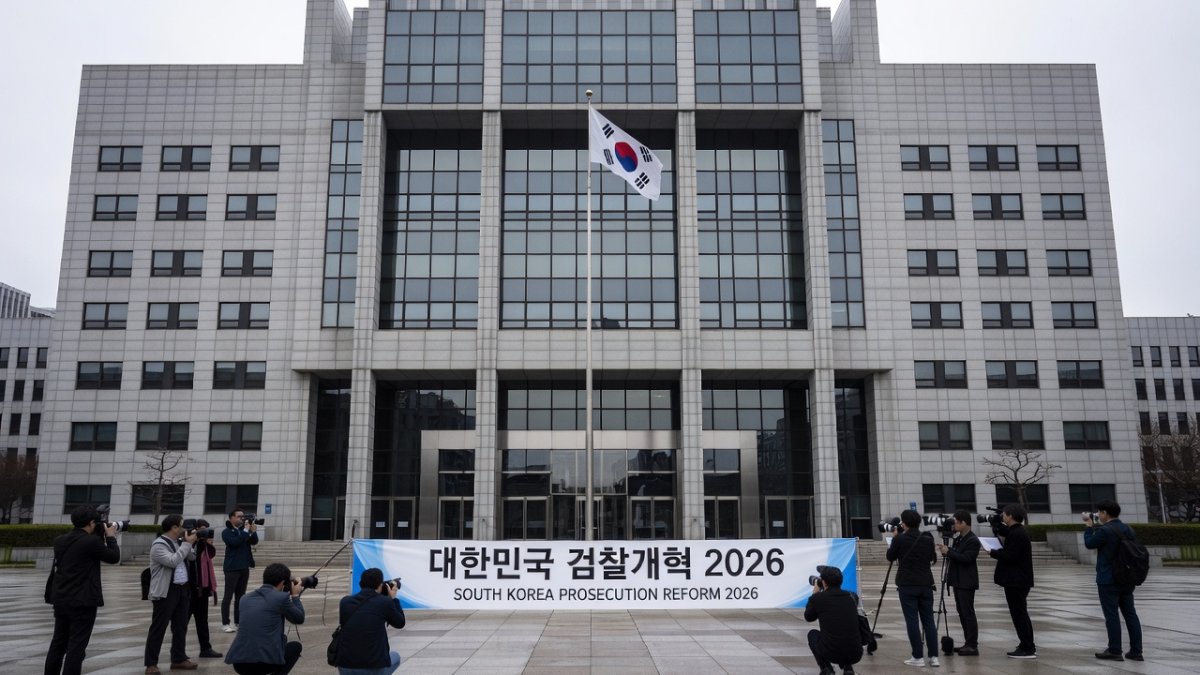
End of an Era: South Korea Prepares to Dissolve Its Prosecutors’ Office
The Republic of Korea is on the verge of the most significant restructuring of its criminal justice system since the founding of the modern state. On October 2, 2026, the 78-year-old Prosecutors’ Office — an institution inherited from the Japanese colonial legal framework and long regarded as one of the most powerful prosecutorial bodies in any democracy — will be dissolved. In its place will emerge two separate entities: the Public Prosecution Service (PPS) under the Ministry of Justice (MOJ), responsible solely for indictments, and the Serious Crimes Investigation Agency (SCIA) under the Ministry of Interior and Safety (MOIS), tasked with conducting investigations.
This reform, passed by the National Assembly in March 2026 with a 166-1 vote following a 24-hour filibuster by the opposition, represents the culmination of prosecutorial reform discussions accumulated over more than two decades. Driven by President Lee Jae-myung, who assumed office in June 2025 following the impeachment of President Yoon Suk-yeol, the changes aim to fundamentally recalibrate the balance of power within South Korea’s democratic institutions.
Historical Roots: From Colonial Inheritance to Democratic Deepening
Established in 1948, the Prosecutors’ Office was one of the first institutions created after Korea’s liberation from Japanese colonial rule. Rather than breaking cleanly with the colonial past, the new Republic adopted much of the Japanese procuracy model, granting prosecutors extraordinary powers that combined investigative, indictment, and even quasi-judicial functions. This concentration of authority stood in tension with the democratic ideals enshrined in the 1948 Constitution and became increasingly problematic as South Korea transitioned from authoritarian rule to consolidated democracy in the late 1980s and 1990s.
Throughout the democratic era, the prosecution maintained outsized influence over political and economic life. In a society where chaebol conglomerates dominate the economy and where political rivalries have often been intensely personal, the power to investigate, indict, and shape public perception has carried enormous strategic weight. Prosecutors have frequently functioned as political arbiters, sometimes advancing democratic accountability and at other times appearing to serve partisan interests. The current reform must therefore be understood not merely as bureaucratic reorganization but as a critical chapter in South Korea’s ongoing struggle to align its institutions with the demands of mature democratic governance.
Failed Reform Attempts: Roh Moo-hyun and Moon Jae-in
The drive to curb prosecutorial power is not new. President Roh Moo-hyun (2003-2008), himself a former human rights lawyer, made prosecutorial reform a signature agenda item. Roh’s administration sought to separate investigative and indictment functions and to strengthen the role of police and special investigative bodies. These efforts were largely thwarted by fierce internal resistance from within the Prosecutors’ Office and by conservative political forces that benefited from the status quo.
A similar pattern emerged under President Moon Jae-in (2017-2022). Moon, who came to power amid the Candlelight Revolution that toppled Park Geun-hye, promised sweeping “prosecutorial reform” (검찰개혁). His government passed legislation to limit the prosecution’s direct investigative powers over certain crimes and attempted to empower the police. Yet again, entrenched interests within the prosecution, combined with effective lobbying and strategic leaks, blunted the impact of these measures. The repeated failure of reform under two progressive presidents underscored a central reality of Korean politics: the Prosecutors’ Office had become a veto player capable of resisting even a determined executive and legislative majority.
The Yoon Suk-yeol Presidency: Politicization and Backlash
The immediate catalyst for the current radical reform was the presidency of Yoon Suk-yeol (2022-2025). A former prosecutor general himself, Yoon represented the apex of prosecutorial influence in Korean politics. His administration was widely accused of weaponizing the prosecution against political opponents while shielding those close to power. In particular, the office under Yoon was criticized for aggressively pursuing investigations against then-opposition leader Lee Jae-myung while showing conspicuous reluctance to thoroughly investigate allegations surrounding First Lady Kim Keon-hee.
These perceived double standards eroded public confidence in the institution. The controversial Yu Woo-sung case, in which an individual was wrongfully charged with espionage only to be acquitted years later, further damaged the prosecution’s reputation. In that case, the Supreme Court ultimately ruled that the prosecution had abused its indictment authority, highlighting systemic problems of overreach, insufficient oversight, and a culture of careerist ambition within the organization. The impeachment of President Yoon in late 2024 following his short-lived declaration of martial law in December 2024 crystallized public and legislative demand for structural change rather than incremental adjustment.
Lee Jae-myung’s Reform: From Campaign Promise to Legislative Reality
President Lee Jae-myung, who assumed office in June 2025 after Yoon’s removal, made the complete dismantling of the existing Prosecutors’ Office a central pillar of his justice agenda. Working closely with Democratic Party of Korea (DPK) floor leader Jung Chung-rae and other reformist lawmakers, Lee’s administration crafted legislation that went further than any previous attempt. The bills, debated amid intense partisan tension, passed the National Assembly in March 2026 after opposition lawmakers staged a 24-hour filibuster. The final vote of 166-1 reflected both the strength of the ruling coalition and the depth of public frustration with the old system.
The reform establishes a clear division of labor. The Public Prosecution Service (PPS), placed under the Ministry of Justice, will focus exclusively on reviewing evidence and deciding whether to seek indictments. The Serious Crimes Investigation Agency (SCIA), under the Ministry of Interior and Safety, will assume primary responsibility for investigating serious crimes, including corruption, economic crimes, and offenses involving high-level officials. A Central Investigation Office (CIO) structure is also being reconfigured within this new framework to handle particularly sensitive cases.
Implementation is being carefully phased. The Prosecutors’ Office is scheduled for formal dissolution on October 2, 2026, with the new institutions coming into force and being phased in during the following months. This cautious timeline reflects both technical complexity and political prudence.
Remaining Controversies: Supplementary Investigation Powers
Despite broad support for the reform, significant controversy persists regarding “supplementary investigation powers.” Under the new system, the PPS will retain limited authority to request additional investigations from the SCIA when prosecutors determine that evidence is insufficient. DPK hardliners have opposed even this residual power, arguing that any retained authority risks recreating the very problems the reform seeks to eliminate. Legal experts, by contrast, maintain that some mechanism for supplementary investigation is essential to prevent miscarriages of justice and to maintain professional standards in charging decisions.
The Supreme Court has urged the introduction of robust safeguards to accompany the reform. These include strengthened judicial oversight of investigative practices, clearer statutory guidelines on the respective roles of the PPS and SCIA, and mechanisms to prevent bureaucratic turf wars between the Ministry of Justice and the Ministry of Interior and Safety. How these safeguards are designed and implemented will largely determine whether the reform succeeds in enhancing both accountability and effectiveness.
What This Means: Strategic and Historical Significance
The abolition of the Prosecutors’ Office carries profound implications across multiple dimensions of South Korean society, politics, and governance.
First, it represents a decisive shift in the institutional balance of power. For seven decades, the prosecution functioned as a quasi-autonomous power center capable of checking — and sometimes intimidating — presidents, legislators, judges, and business leaders. By separating investigation from indictment and placing the two functions under different ministries, the reform seeks to introduce meaningful checks and balances. This aligns South Korea more closely with prosecutorial models in other advanced democracies while addressing the specific pathologies that developed in the Korean context.
Second, the reform has important implications for chaebol governance and economic accountability. South Korea’s family-controlled conglomerates have long existed in a complex relationship with state power. Prosecutorial authority has been used both to discipline chaebol misconduct and, at times, to engage in selective enforcement that served political purposes. A more professionalized and functionally divided system may reduce the potential for politically motivated investigations while maintaining credible deterrence against corporate crime. This could contribute to healthier corporate governance and greater predictability in the business environment.
Third, the changes carry democratic significance. South Korea’s democracy has matured considerably since the 1987 transition, yet institutional reforms have often lagged behind societal expectations. The current overhaul demonstrates that democratic institutions can eventually overcome even deeply entrenched bureaucratic interests when public demand is sufficiently strong and political leadership is determined. In this sense, the reform constitutes an important act of democratic deepening.
Fourth, there are subtle but real inter-Korean implications. North Korea’s state media has long portrayed South Korea as a “puppet regime” controlled by prosecutors, chaebol, and American interests. While Pyongyang’s propaganda holds little factual value, the successful implementation of this reform may strengthen South Korea’s soft power and normative appeal as a mature Asian democracy. It offers a narrative of institutional self-correction that contrasts sharply with the rigid authoritarianism north of the DMZ.
Finally, the reform raises important questions about bureaucratic capacity and institutional memory. The Prosecutors’ Office, despite its flaws, accumulated significant expertise in complex financial crimes, corruption cases, and national security-related investigations. The new SCIA and PPS will need to rapidly develop comparable competence while avoiding the insularity and elitism that characterized the old system. Training programs, recruitment strategies, and inter-agency coordination mechanisms will be crucial during the transition period that begins in October 2026.
Policy Implications and Future Challenges
As the reform moves toward implementation, several policy challenges loom. The relationship between the PPS and SCIA requires carefully calibrated protocols to prevent either paralysis or excessive friction. Clear guidelines must be established regarding which agency takes the lead in different categories of cases. Budgetary arrangements between the Ministry of Justice and the Ministry of Interior and Safety will need to be negotiated to ensure both institutions have adequate resources.
Personnel transitions present another delicate issue. Many current prosecutors will be reassigned to either the PPS or SCIA. Maintaining morale and preserving institutional knowledge during this reshuffling will test the administrative skill of both ministries. The Supreme Court’s call for safeguards suggests that judicial oversight mechanisms, possibly including a new independent review board for charging decisions in politically sensitive cases, may need to be established.
Longer-term, the success of the reform will be measured not by the dissolution ceremony in 2026 but by the quality of justice delivered in the years that follow. Will serious crimes be investigated more impartially? Will indictment decisions be more objective and less susceptible to political pressure? Will public confidence in the criminal justice system increase? These are the metrics that ultimately matter.
The reform also sets a precedent for further institutional innovation. Having successfully challenged one of the most resistant power centers in the Korean state, future administrations may feel emboldened to tackle other areas where institutional design lags behind democratic expectations — whether in the intelligence services, the police, or the judiciary itself.
Conclusion: A Defining Moment in Korean Democratic Development
The scheduled dissolution of the Prosecutors’ Office on October 2, 2026 marks more than bureaucratic reorganization. It represents the culmination of a generational struggle to subordinate one of the most powerful institutions in modern Korean history to democratic accountability. From the colonial origins of the procuracy through the authoritarian era, the democratic transition, and the repeated failed reform attempts under Presidents Roh Moo-hyun and Moon Jae-in, the path to this moment has been long and contentious.
President Lee Jae-myung’s administration has succeeded where predecessors faltered, but the real test lies ahead. The new Public Prosecution Service and Serious Crimes Investigation Agency must now prove that a divided structure can deliver both impartiality and effectiveness. Legal experts, civil society, and the Supreme Court have emphasized the need for careful safeguards. How these are designed and enforced will determine whether this historic reform becomes a genuine milestone in South Korea’s democratic maturation or merely another chapter in the country’s cyclical struggle with prosecutorial power.
What is clear is that South Korea is attempting something ambitious: to fundamentally redesign a core institution of state power in response to accumulated democratic demands. In doing so, it offers a compelling example to other democracies grappling with questions of institutional reform, bureaucratic autonomy, and the proper balance between investigative vigor and due process. The eyes of legal scholars, political scientists, and democratic reformers across Asia and beyond will be watching closely as the new system comes into force and is phased in after October 2026.
By Prof. David Park, Staff WriterThis article was produced with AI-assisted research and editorial support. Reporting is based on sources cited in the article.
What's Your Reaction?
 Like
0
Like
0
 Dislike
0
Dislike
0
 Love
0
Love
0
 Funny
0
Funny
0
 Wow
0
Wow
0
 Sad
0
Sad
0
 Angry
0
Angry
0

East Asia/Technology Correspondent at Global1.News. Seoul-based voice covering Korean politics, technology, business, and culture. Analyzes how technology and geopolitics intersect across East Asia.















Comments (0)