
Typhoon Maysak Exposes China's Climate Vulnerabilities Amid Strategic Infrastructure Push
Typhoon Maysak Exposes China's Climate Vulnerabilities Amid Strategic Infrastructure Push Immediate Human and Regional Toll in Guangxi and Hubei Typhoon Maysak marked the first major landfall of the 2026 season when it struck southern China, bringing immediate and severe consequences to Guangxi and Hubei provinces. Official reports confirm seventeen deaths and more than three h
Immediate Human and Regional Toll in Guangxi and Hubei
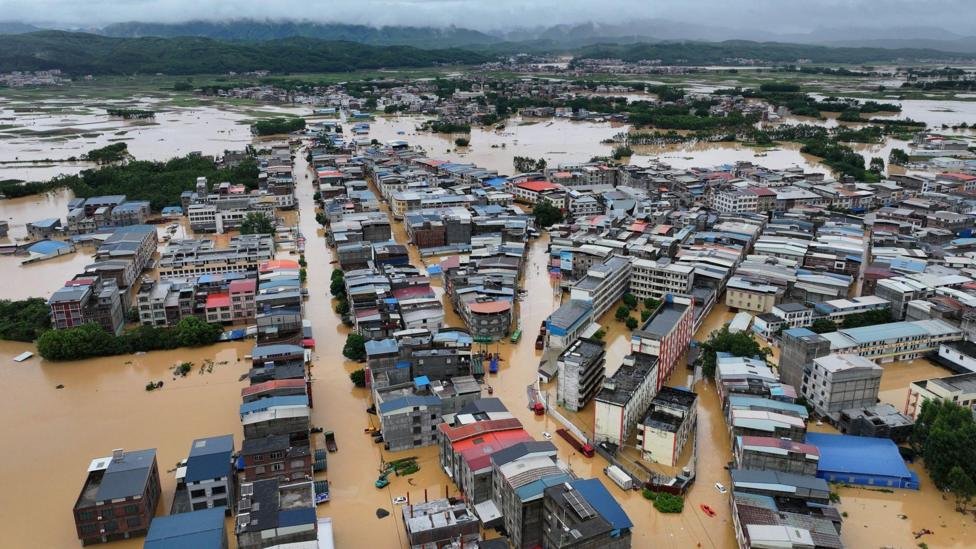
Typhoon Maysak marked the first major landfall of the 2026 season when it struck southern China, bringing immediate and severe consequences to Guangxi and Hubei provinces. Official reports confirm seventeen deaths and more than three hundred injuries, with approximately ninety thousand people directly affected. In Nanning, the regional capital of Guangxi, sixty thousand residents were evacuated as floodwaters rapidly inundated urban and rural districts alike. These figures underscore the concentrated human cost in areas where population density meets limited drainage capacity.
Personal accounts from Renhe village illustrate the sudden escalation of danger. Residents described water levels rising from knee-deep within minutes to full submersion of ground floors, trapping families without adequate warning. One household with a four-month-old infant faced acute shortages of formula as supply routes were severed. Such micro-level crises reveal how even modest storms can overwhelm local coping mechanisms when infrastructure lags behind meteorological intensity.
Hubei experienced additional hazards in the form of rare tornadoes, the first such event since 2021. In Huanggang city a man was reportedly pulled from his twelfth-floor apartment by high winds, highlighting vertical exposure in high-rise developments. Floodwaters also liberated snakes from commercial farms, introducing secondary public-health risks. These combined impacts demonstrate the compound nature of typhoon damage, where wind, water, and biological hazards intersect. The regional toll therefore extends beyond immediate mortality to longer-term displacement and livelihood disruption, setting the stage for broader questions about national preparedness.
Infrastructure Resilience Tested by Reservoir and River Failures
The Yongjiang riverbank burst and the breach of a nearby reservoir wall exposed critical weaknesses in China’s hydraulic infrastructure. Although the 14th Five-Year Plan has directed substantial investment toward flood control, the events around Nanning revealed uneven implementation between coastal megacities and inland provinces. Coastal defenses in Shanghai or Shenzhen incorporate advanced pumping systems and elevated barriers, yet comparable standards have not reached secondary river systems in Guangxi.
Communication and electrical failures compounded the physical damage. Entire villages lost power and mobile coverage for extended periods, delaying rescue coordination and leaving residents without real-time evacuation guidance. These outages occurred despite ongoing national programs to expand smart-grid coverage and early-warning networks. The gap between planning targets and operational performance suggests that technological upgrades remain concentrated in economically strategic zones rather than distributed evenly across hazard-prone regions.
Reservoir management protocols also came under scrutiny. Rapid water release decisions, while necessary to prevent catastrophic dam failure, contributed to downstream flooding. This trade-off illustrates the tension between structural resilience and operational flexibility. Without integrated basin-wide modeling that accounts for sequential storm arrivals, individual infrastructure assets remain vulnerable to cascading failures. The Maysak experience therefore highlights the necessity of aligning Five-Year Plan infrastructure goals with granular, province-level risk assessments.
Xi Jinping's Centralized Crisis Response: Capabilities and Constraints
President Xi Jinping issued an “all-out” directive shortly after Maysak’s landfall, triggering coordinated action through the Ministry of Emergency Management. Military and civilian resources were mobilized within hours, enabling the evacuation of sixty thousand people in Nanning alone. This rapid scaling demonstrates the regime’s capacity to concentrate logistical assets when central leadership prioritizes a crisis. The Ministry’s unified command structure facilitated inter-provincial deployment of rescue teams and medical supplies, reducing potential secondary casualties.
Yet the same centralized model carries inherent constraints. Visible high-level attention can bolster regime legitimacy when response metrics appear favorable, yet any perceived delay risks amplifying local grievances through social-media channels. Historical patterns show that successful crisis handling reinforces political stability, while shortcomings generate online criticism that authorities must then manage. In Guangxi, the speed of evacuation mitigated some discontent, but reports of trapped families in Renhe village circulated widely before official narratives could fully frame the event.
The dual role of crisis response—both operational necessity and political signaling—places additional pressure on local officials to align with central timelines. This dynamic can accelerate resource flows but may also discourage candid reporting of emerging shortfalls. Consequently, the effectiveness of centralized coordination depends on accurate upward information flows, an area that remains structurally sensitive within China’s governance architecture.
Climate Pressures on Agriculture and Food Security
Guangxi contributes significantly to national rice, sugarcane, and aquaculture output, making the province a linchpin in China’s food-supply chain. Typhoon Maysak inundated paddies and fish ponds at a critical growth stage, threatening both immediate harvests and seed stocks for subsequent seasons. The agriculture sector, valued at approximately 2.2 trillion yuan, faces cumulative seasonal risk should Super Typhoon Bavi follow a similar trajectory. Such sequential impacts could erode the self-reliance objectives embedded in the Dual Circulation strategy.
Adaptation measures currently under discussion include flood-resistant crop varieties, modernization of irrigation networks, and expanded farmer insurance schemes. These interventions require sustained fiscal commitment and effective local implementation, both of which have historically varied across provinces. Insurance penetration remains low among smallholders, leaving many producers exposed to income shocks that can translate into broader rural instability.
Food stability functions as a foundational element of social stability in official policy discourse. Disruptions that raise consumer prices or reduce availability risk undermining public confidence in governance. Therefore, the agricultural damage inflicted by Maysak is not merely an economic accounting exercise but a test of whether climate-adaptation investments can keep pace with intensifying weather extremes. Without accelerated integration of resilience planning into agricultural policy, the Dual Circulation framework’s domestic-production targets may prove increasingly difficult to meet.
Geopolitical Ripple Effects Across ASEAN and Climate Diplomacy
China’s disaster-management performance is closely observed by ASEAN neighbors that share similar typhoon exposure. Successful operations can enhance Belt and Road soft-power narratives by demonstrating technical competence and rapid mobilization capacity. Conversely, visible shortcomings may prompt regional partners to diversify cooperation toward alternative donors or multilateral mechanisms less tied to Chinese infrastructure models.
At international climate forums, Maysak’s impacts feed into ongoing loss-and-damage financing discussions. China occupies a dual position as both a major emitter and a provider of development assistance. This duality complicates its negotiating stance: calls for greater adaptation support from developed nations sit alongside expectations that Beijing itself contribute meaningfully to regional resilience funds. ASEAN countries affected by parallel weather systems watch these dynamics for signals of future cooperation frameworks.
The episode also underscores the diplomatic utility of disaster response as a form of public diplomacy. When evacuation and relief operations proceed efficiently, they generate positive imagery that can offset criticism on other fronts. Yet any perception that domestic priorities override regional solidarity risks eroding the goodwill accumulated through infrastructure initiatives. Climate diplomacy therefore intersects directly with operational outcomes on the ground.
Anticipating Super Typhoon Bavi and Long-Term Adaptation Pathways
With Super Typhoon Bavi now approaching China’s eastern seaboard, the Maysak experience provides an immediate stress test for surge capacity. Sequential storm seasons challenge the assumption that recovery intervals will remain sufficient for infrastructure repair and institutional learning. Lessons from Yongjiang riverbank failures and communication blackouts must be incorporated before Bavi makes landfall if authorities wish to avoid repeated exposure of the same vulnerabilities.
Integration of climate resilience into national security planning has accelerated under the 14th Five-Year Plan’s green-development pillar. Proposed measures include coastal ecosystem restoration, elevated infrastructure design standards, and expanded use of nature-based flood defenses. These steps align with broader decarbonization targets yet require coordinated implementation across multiple ministries and provincial governments.
China’s positioning on climate adaptation finance and technology transfer will also shape its international profile. Demonstrating credible domestic adaptation can strengthen arguments for differentiated responsibilities in global negotiations. At the same time, the imperative to protect strategic infrastructure corridors and agricultural heartlands remains a core national-security concern. The coming weeks will reveal whether Maysak serves as a catalyst for accelerated, system-wide resilience upgrades or merely another episodic reminder of persistent gaps.
By Prof. Marcus Chen, Staff WriterThis article was produced with AI-assisted research and editorial support. Reporting is based on sources cited in the article.
What's Your Reaction?
 Like
0
Like
0
 Dislike
0
Dislike
0
 Love
0
Love
0
 Funny
0
Funny
0
 Wow
0
Wow
0
 Sad
0
Sad
0
 Angry
0
Angry
0

World Politics Analyst at Global1.News. Based in Beijing, covering US-China relations, global trade, and geopolitical strategy. Brings deep analytical perspective to the power dynamics shaping international affairs.












Comments (0)