
Tension in Abia community over proposed cassava processing plant on disputed land
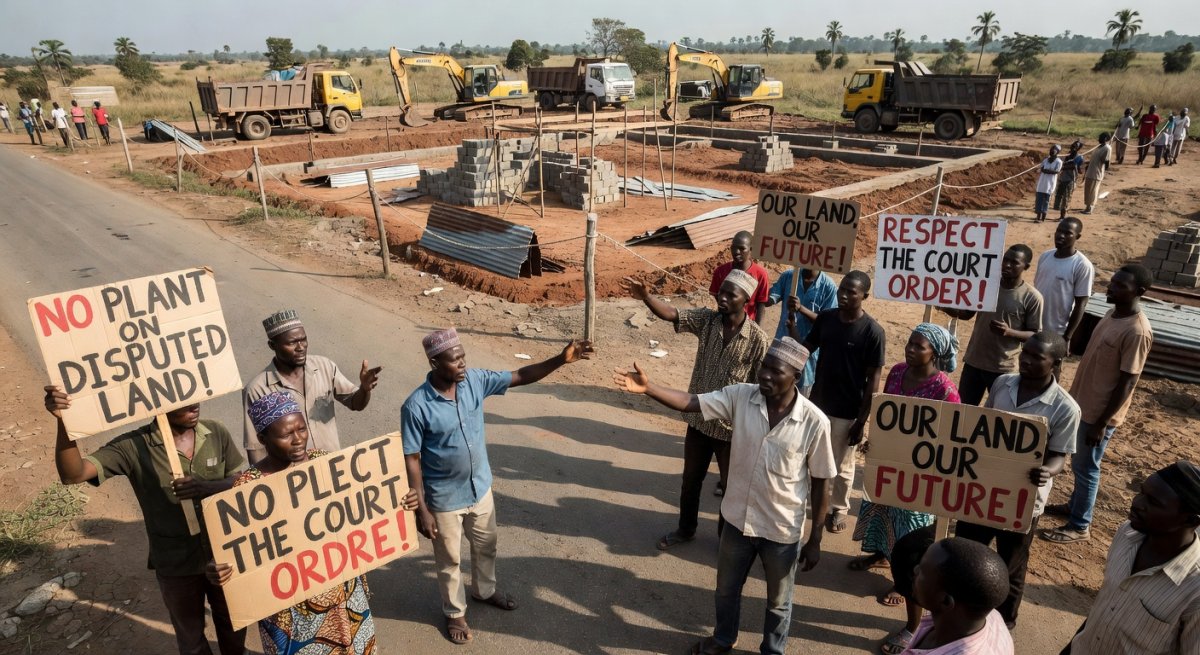
Tension grips the Obinolu Chukwu community in Umunnechi Local Government Area of Abia State as plans advance for a cassava processing plant on land currently subject to a valid court order. The proposed facility, intended to tap into Nigeria’s expanding agricultural value chain, has instead exposed deep divisions over land ownership and the rule of law. Residents who oppose the project argue that construction would violate an existing judicial directive, raising the prospect of renewed conflict in a region already familiar with protracted communal disputes.
The situation illustrates a recurring pattern across southeastern Nigeria, where economic development initiatives collide with unresolved land claims. With cassava production central to federal agricultural strategies, the stakes extend beyond one community to questions of how state-backed projects can proceed without undermining judicial authority or local consent.
The Land Dispute and Court Order
Court records confirm that portions of the land earmarked for the cassava facility remain under active litigation. A subsisting order restrains any form of development until ownership questions are conclusively settled. Community members who first raised concerns about the project maintain that state and local officials have been notified of this restriction yet have allowed preparatory steps to continue. This defiance of judicial process echoes similar cases in Abia and neighbouring states, where land matters often drag through multiple appeal levels. The specific parcel in Obinolu Chukwu carries overlapping claims involving family lineages and community trusteeships. Until these claims receive final adjudication, any physical development risks contempt proceedings and potential demolition orders.Community Divisions and Rising Tensions
Not every resident opposes the plant. Some view the facility as a rare opportunity for employment and improved infrastructure in an area with limited industrial presence. Others, however, insist that bypassing the court order sets a dangerous precedent that could erode future protections for communal land holdings. The resulting split has produced public statements, petitions to traditional rulers, and appeals to the state government. Youth groups and women’s associations have separately voiced fears that construction could trigger physical clashes between rival claimants. Security agencies have been urged to maintain a visible presence to prevent escalation while legal avenues remain open.Economic Context: Cassava Processing in Abia State
Abia State possesses suitable agro-ecological conditions for cassava, a crop that supports millions of smallholder farmers nationwide. Federal and state policies have promoted processing facilities to reduce post-harvest losses and generate export-quality products such as high-quality cassava flour and starch. A plant in Umunnechi could, in principle, create direct jobs in processing, packaging, and logistics while stimulating out-grower schemes for surrounding villages. Yet the economic case weakens when legal uncertainty clouds land access. Investors typically require clear title before committing capital to machinery and buildings. Persistent disputes raise the risk of project abandonment or costly relocation, outcomes that have already affected several agro-industrial initiatives in the Southeast. The Obinolu Chukwu episode therefore serves as a test of whether development partners can navigate Nigeria’s complex land tenure system without repeating past failures.Implications for Governance and the Rule of Law
The tension highlights gaps between policy pronouncements on agricultural modernisation and the practical enforcement of court decisions. When government-backed projects appear to sidestep subsisting orders, public confidence in both the judiciary and land administration agencies declines. Traditional institutions, often the first line of conflict mediation, find themselves caught between statutory law and customary expectations. Analysts note that sustainable agricultural investment depends on predictable dispute-resolution mechanisms. Without them, communities may resort to self-help measures, further fragmenting social cohesion and deterring external capital. Abia State authorities have previously pledged to fast-track land adjudication; the current standoff offers an opportunity to demonstrate whether those commitments will translate into concrete action.What Happens Next
Legal proceedings are expected to determine whether the proposed site can be used or whether alternative locations must be identified. Community leaders have called for mediated dialogue involving the state Ministry of Agriculture, the judiciary, and all claimant groups. Should the court uphold the existing order, project sponsors may need to identify uncontested land or negotiate fresh consent agreements. In the meantime, residents continue to monitor site activity closely. The outcome will influence not only cassava value-chain ambitions in Abia but also broader efforts to reconcile economic development with judicial integrity across Nigeria’s agrarian communities.By Sarah Okafor, Staff Writer
This article was produced with AI-assisted research and editorial support. Reporting is based on sources cited in the article.
What's Your Reaction?
 Like
0
Like
0
 Dislike
0
Dislike
0
 Love
0
Love
0
 Funny
0
Funny
0
 Wow
0
Wow
0
 Sad
0
Sad
0
 Angry
0
Angry
0

Sarah Okafor
Africa Correspondent at Global1.News. Based in Lagos, covering politics, business, technology, and culture across the continent. Focused on telling African stories beyond the headlines — the innovation, entrepreneurs, and communities shaping the region's future.















Comments (0)