
Gawuna agreed, no rift over Kano NDC 2027 tickets – Kwankwasiyya spokesman, Habeeb
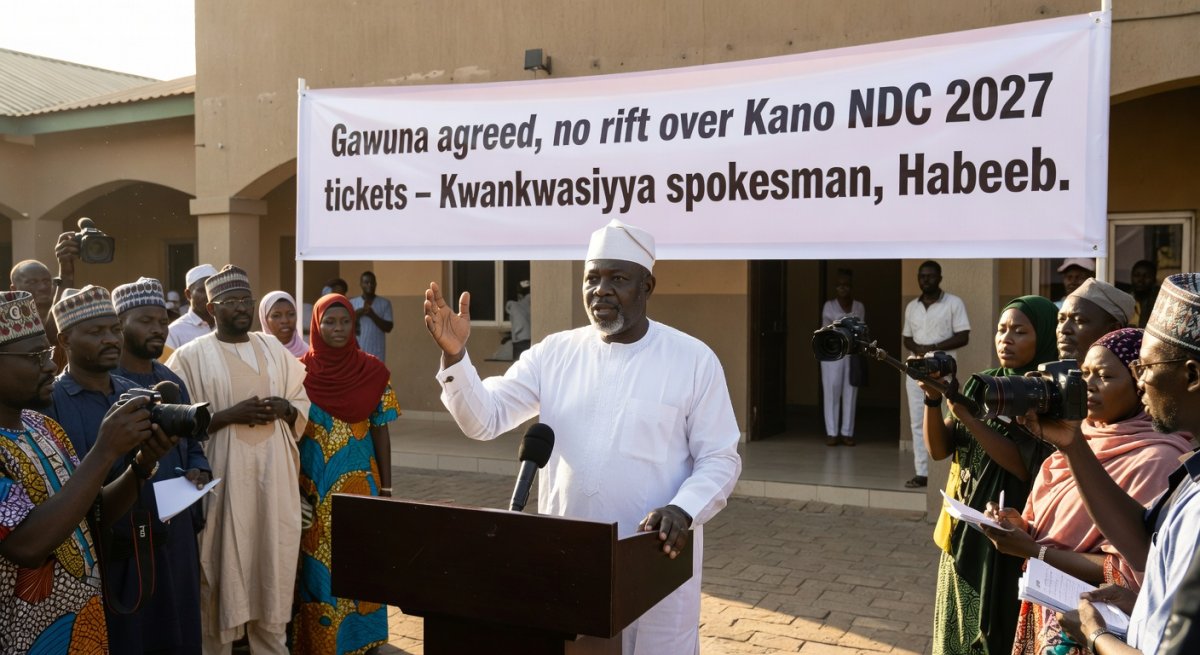
In the buildup to Nigeria’s 2027 general elections, the Kwankwasiyya Movement has moved quickly to quash speculation of internal fractures over the distribution of political tickets under the Nigeria Democratic Congress platform in Kano State. The group’s leadership asserts that all decisions were reached through broad consensus and explicitly endorsed by senior figures, including former gubernatorial candidate Nasiru Gawuna. This clarification arrives at a moment when Kano’s political alignments carry significant weight for national stability and economic continuity in Nigeria’s most populous northern state.
The statement from Kwankwasiyya spokesman Habeeb underscores that no rift exists and that reports suggesting otherwise misrepresent the movement’s internal processes. By framing the ticket allocations as the product of inclusive dialogue rather than top-down imposition, the movement seeks to present a united front ahead of what promises to be a competitive electoral cycle.
Consensus as Political Strategy
Kwankwasiyya leaders have described the recent ticket-sharing arrangement as the outcome of extended consultations involving multiple stakeholders. Habeeb stated that Gawuna himself accepted the outcome without reservation, thereby removing any basis for claims of disagreement. This emphasis on consensus reflects a deliberate effort to insulate the movement from narratives that could weaken its negotiating position with potential allies or within the broader opposition landscape.
Such public affirmations of unity serve a practical purpose in Nigerian politics, where perceptions of cohesion often determine the willingness of financiers, community leaders, and grassroots structures to commit resources early. By addressing the issue directly, the movement reduces the space for opponents to exploit alleged divisions.
Kano’s Political and Economic Stakes
Kano State remains central to northern Nigeria’s commercial networks, hosting major markets, manufacturing clusters, and agricultural value chains that link the region to national and international supply routes. Any prolonged internal discord within a dominant political movement risks distracting state actors from policy continuity on infrastructure, security, and trade facilitation. The Kwankwasiyya clarification therefore carries implications beyond party circles: it signals an intention to maintain focus on governance deliverables that affect daily commerce and investment decisions.
The movement’s history of disciplined mobilisation has previously translated into strong electoral performance. Sustaining that organisational strength through transparent internal agreements is viewed by analysts as essential if the group intends to retain influence over policy priorities that shape Kano’s contribution to national GDP.
Broader Context of Pre-Election Positioning
Across Nigeria, political movements routinely face media speculation about ticket negotiations in the months preceding primaries. The Kwankwasiyya response fits a familiar pattern in which spokespersons issue prompt rebuttals to maintain momentum and reassure supporters. What distinguishes the current episode is the explicit reference to Gawuna’s acceptance, which removes ambiguity about the stance of a high-profile stakeholder.
This approach also aligns with the movement’s established communication style under Rabiu Kwankwaso’s leadership, which prioritises direct messaging to counter misinformation. By confirming that decisions were collective, the group reinforces its claim to internal democracy while discouraging premature defections or realignments.
Forward Outlook for 2027
With the denial of any rift now on record, attention is likely to shift toward the practical implementation of the agreed ticket allocations and the movement’s outreach to other political platforms. Observers will monitor whether the same consensus model extends to alliance negotiations at the national level. Should the Kwankwasiyya structure hold, the movement is positioned to enter the campaign season with its organisational machinery intact, focusing resources on voter mobilisation rather than internal reconciliation.
The coming months will reveal whether this public affirmation translates into sustained coordination among stakeholders or whether fresh pressures emerge as nomination deadlines approach. For now, the movement’s message is unambiguous: decisions on 2027 tickets in Kano were made collectively and remain binding.
By Sarah Okafor, Staff Writer
This article was produced with AI-assisted research and editorial support. Reporting is based on sources cited in the article.
What's Your Reaction?
 Like
0
Like
0
 Dislike
0
Dislike
0
 Love
0
Love
0
 Funny
0
Funny
0
 Wow
0
Wow
0
 Sad
0
Sad
0
 Angry
0
Angry
0

Sarah Okafor
Africa Correspondent at Global1.News. Based in Lagos, covering politics, business, technology, and culture across the continent. Focused on telling African stories beyond the headlines — the innovation, entrepreneurs, and communities shaping the region's future.













Comments (0)